Spring outfits in 2026 span from a three-layer wool system for 40-degree mornings to a white tee and jeans that only feel seasonal once you add the right bag. The difference between looking considered and looking like you gave up halfway through usually comes down to a single adjustment: where the belt sits on a sweater, whether you commit to a full tuck, or if the sleeve roll hits exactly at the wrist bone. A 12–14 ounce coat weight, for instance, lets you keep it through a 9 a.m. commute without sweating by lunch.
1. Bold Jacket, Jeans, and Ballet Flats
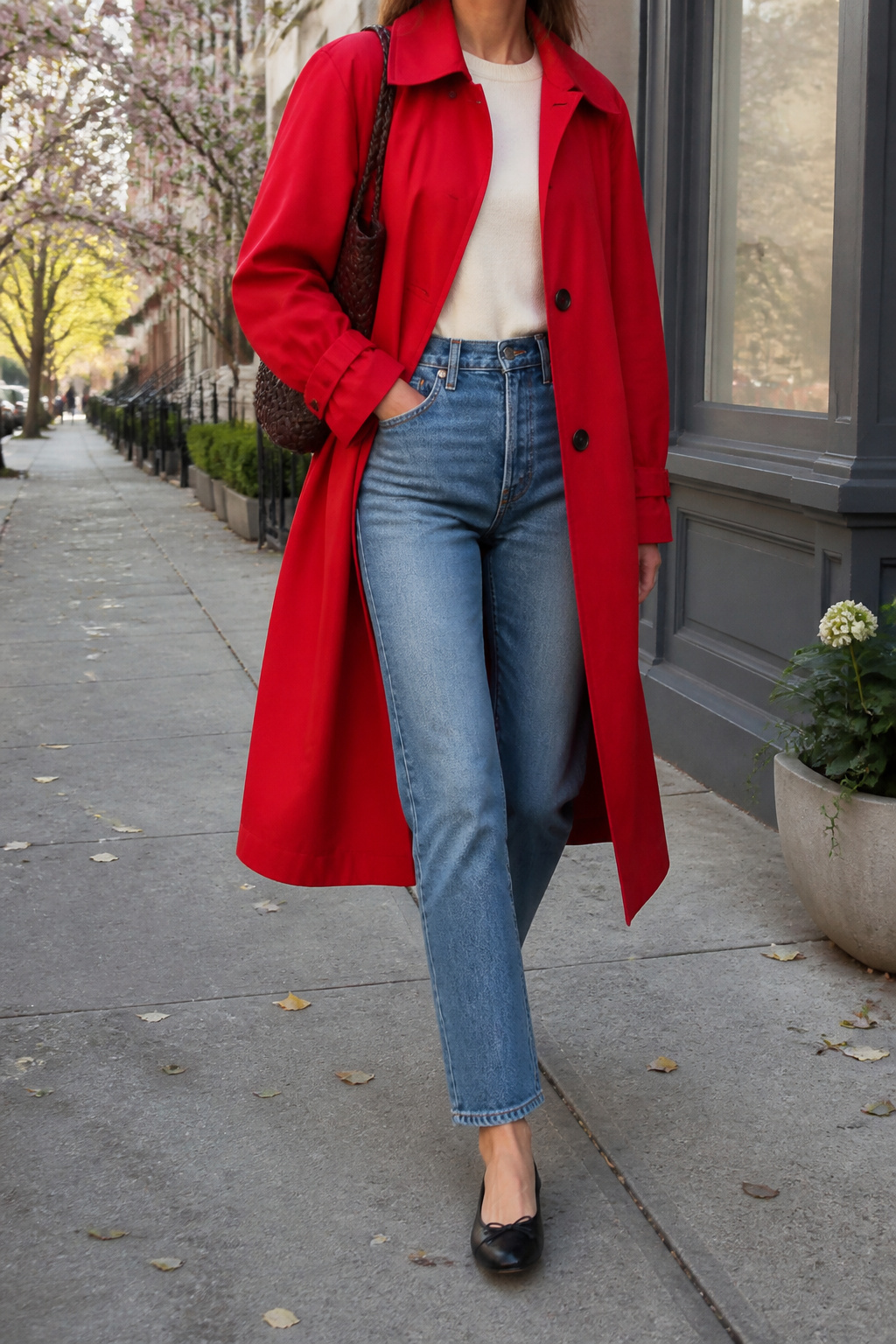
A bold jacket lets one piece carry the whole outfit while your jeans and ballet flats stay simple. In practice, bold means one of three things: a saturated color like Prada’s tomato-red trench, a strong pattern, or an oversized shape that dominates the frame. Pick one, not all three.
For proportions, keep the denim slim or straight-legged. Levi’s 501 ’90s Straight Leg Jeans give the clean line you want here. The ballet flat, like Margaux’s Demi, sits low and narrow, which balances volume on top. If the jacket is cropped, let the jeans sit at the natural waist. If the jacket is long, the hem should hit mid-hip or lower to avoid cutting you in half.
This is the outfit you reach for when you want to look considered without layering in extra effort. The jacket talks; everything else listens.
2. Hourglass Blazer, Skirt, and T-Strap Pumps
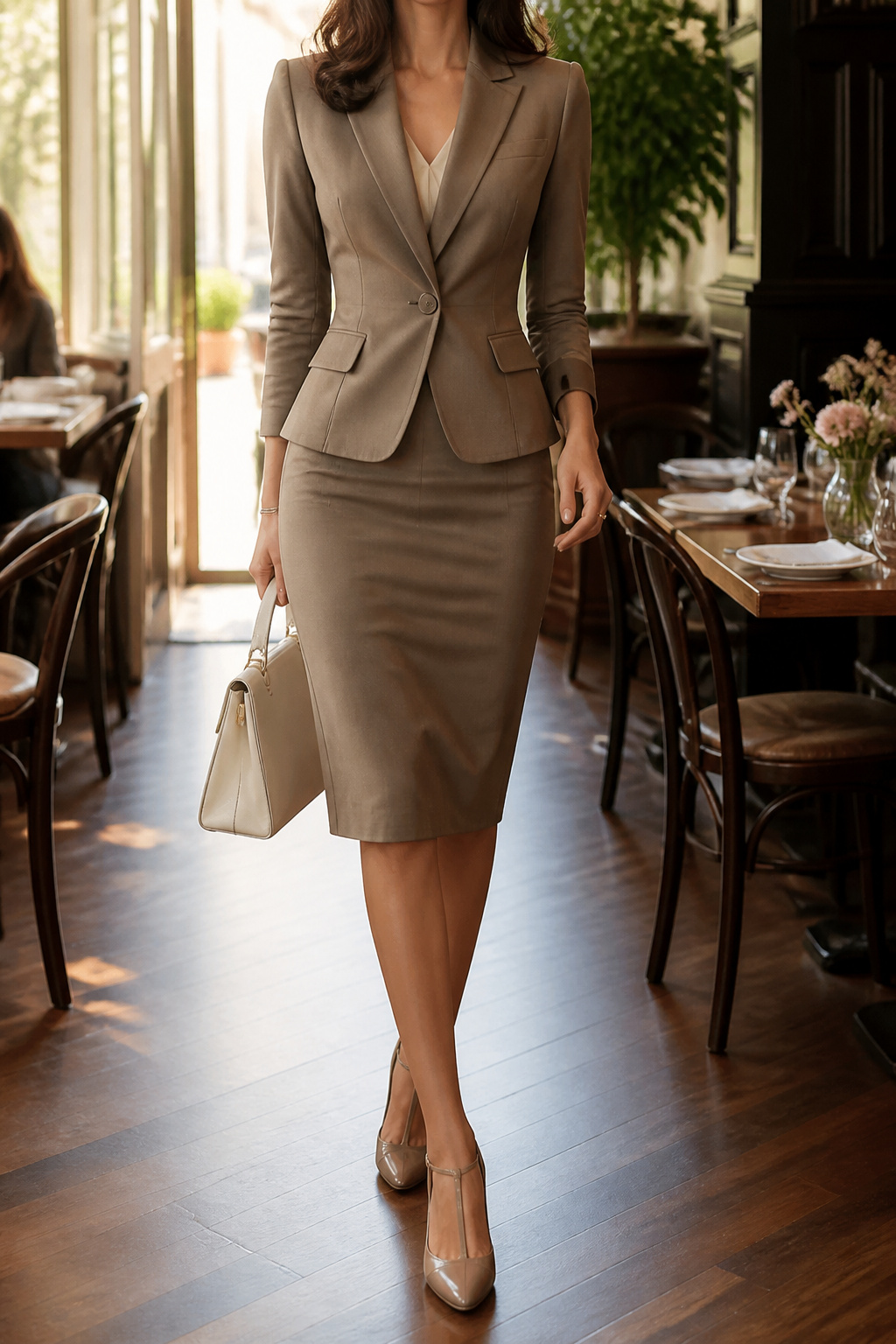
An hourglass blazer earns its name from the silhouette it builds: the waist nips in while the shoulders stay structured and slightly extended, creating that curved shape without padding that looks like costume. The effect depends on the internal canvas and a single button placed high enough to pull the waistline in, not just to close the front.
The skirt that pairs cleanest here is straight and knee-length or a narrow A-line that drops from the same high waist point the blazer emphasizes. Anything too full fights the jacket’s line; anything too tight turns the outfit into evening wear.
T-strap pumps read current rather than vintage when the strap sits low across the instep and the toe is almond, not too pointed or too round. The open sides let air move, which matters on the first warm days when you still need polish for the office or a dinner reservation.
This formula works where you need authority without heaviness. The tailoring carries meetings, the skirt keeps it from looking like borrowed menswear, and the T-strap nods to spring without dropping into sandal territory too early. Keep the colors quiet, navy or bone with cognac leather, and the look holds across offices, client dinners, and spring events where a full suit would feel like overreach.
3. Blazer, Button-Down, and Baggy Jeans
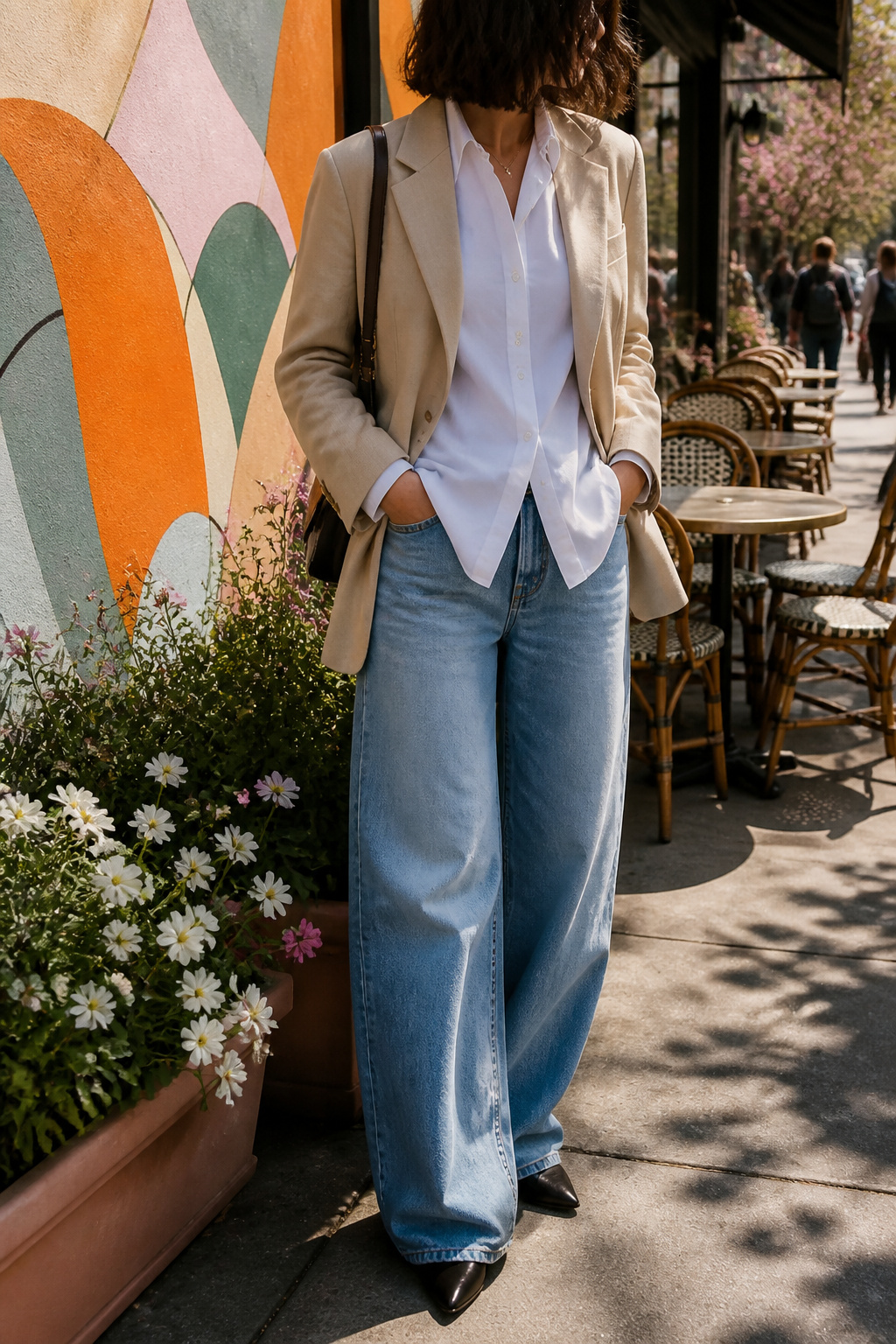
A blazer over a button-down with baggy jeans lives or dies on intentionality. The structure up top and the volume below need to read as a deliberate pairing, not a morning accident. Tuck the shirt fully or commit to leaving it completely out; the half-tuck lands in no-man’s-land here and makes the whole outfit look like you gave up halfway through.
The shoe weight matters more than you’d think. A leather thong sandal or a slim loafer disappears under all that denim and throws the balance off. You need something with actual presence, a sole that can hold its own against the jean volume without fighting the blazer’s tailoring. Think of it as anchoring the look from below.
Color is where you keep it from feeling corporate. A zebra-pattern loafer or an unexpected sandal finish keeps the neutral palette from going flat. The high-low mix works because the blazer and button-down earn their formality, not despite the bagginess but paired with it.
4. Wool Coat, Cashmere Sweater, and Tee
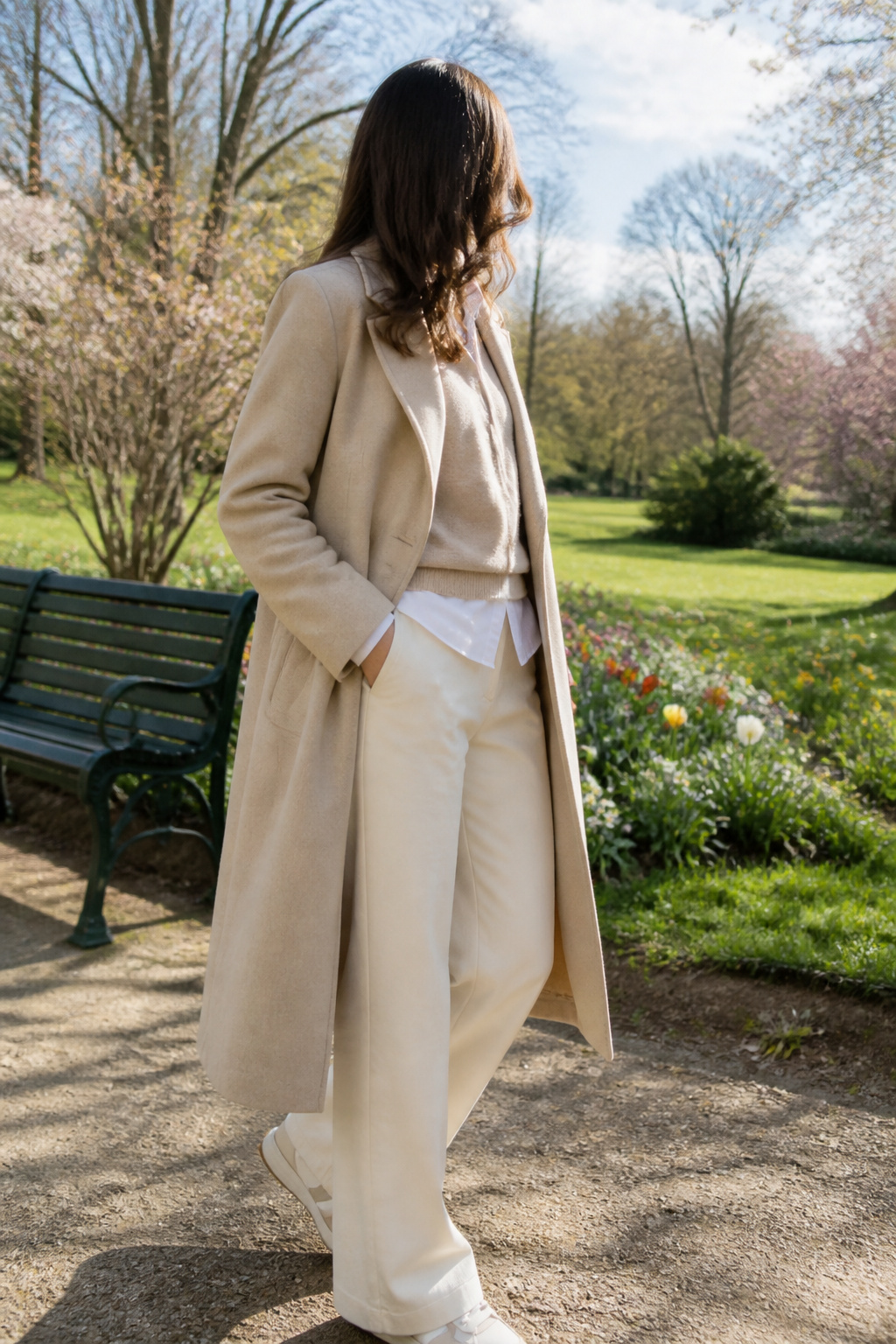
Cold spring mornings start below 40 and end near 65, which is exactly where a three-layer wool system earns its keep. The coat should be lightweight, not the heavy melton you wore in January. Something in the 12–14 ounce range lets you keep it on through a 9 a.m. commute without sweating through your shirt by lunch.
The cashmere layer does the actual temperature work. A mid-gauge V-neck, not a chunky turtleneck, traps heat close to your body and still fits under the coat without squeezing the sleeves. Naadam’s cashmere V-neck is the right weight for this, thin enough to layer but dense enough to wear alone.
The tee underneath is not an afterthought. When the sweater comes off at noon, you want a clean finish, not a rumpled base layer. A crisp white crew neck keeps the outfit intentional. The color stack runs dark to light or light to dark, never mixed neutrals that fight each other: navy coat, heather gray sweater, white tee reads deliberate. Camel coat, cream sweater, white tee works too. Avoid putting two similar mid-tones together, like taupe on oatmeal, which flattens the whole thing into one muddy plane.
The coat comes off last, the tee stays on all day, and the sweater lives in your bag until evening.
5. Cardigan, White Tank, and Straight-Leg Jeans
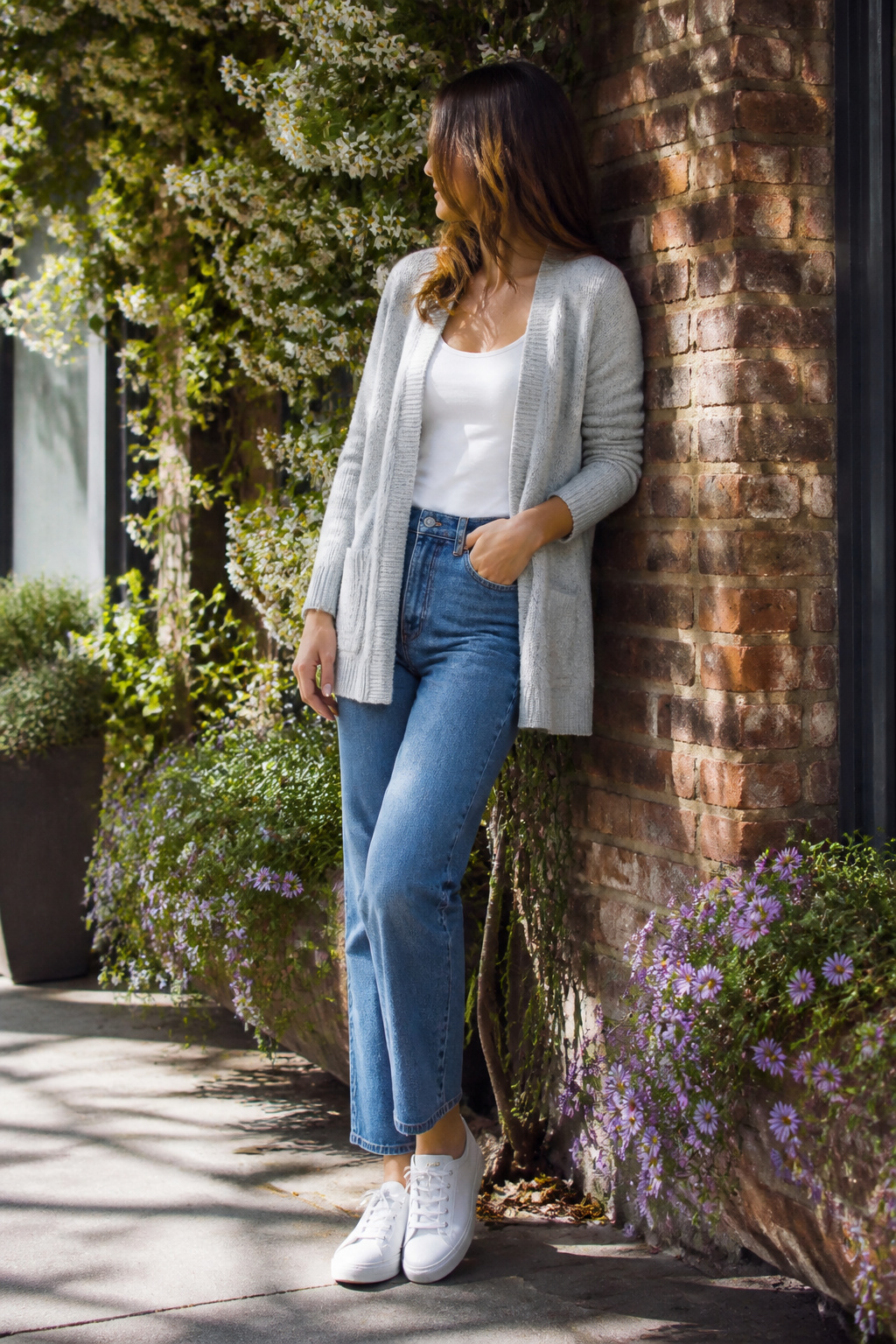
A cardigan over a white tank with straight-leg jeans is the combination you reach for when you do not want to think about what to wear. It reads as put-together without trying, which is why it has become the casual default for so many women once the weather turns.
The tank underneath matters more than most people assume. A fully opaque white layer keeps the outfit from looking accidental; anything too thin or too cropped shifts the whole register toward loungewear. Look for a tank with enough body to sit smoothly under the knit without bunching at the waist.
Cardigan length changes how the proportions land. A hip-length cut tends to flatten the straight line of the jeans, while something that hits mid-thigh or just below creates a longer vertical that balances the leg. The exception is a cropped cardigan worn with a high-waisted jean, which can work but requires the waistband to sit exactly right.
Shoes are where this outfit loosens up. White sneakers keep it casual, loafers push it toward errands-with-intent, and a low-heeled sandal takes it to dinner without changing anything else. The cardigan does the structuring; the shoe decides the destination.
6. Sweater, Belt, and Skirt
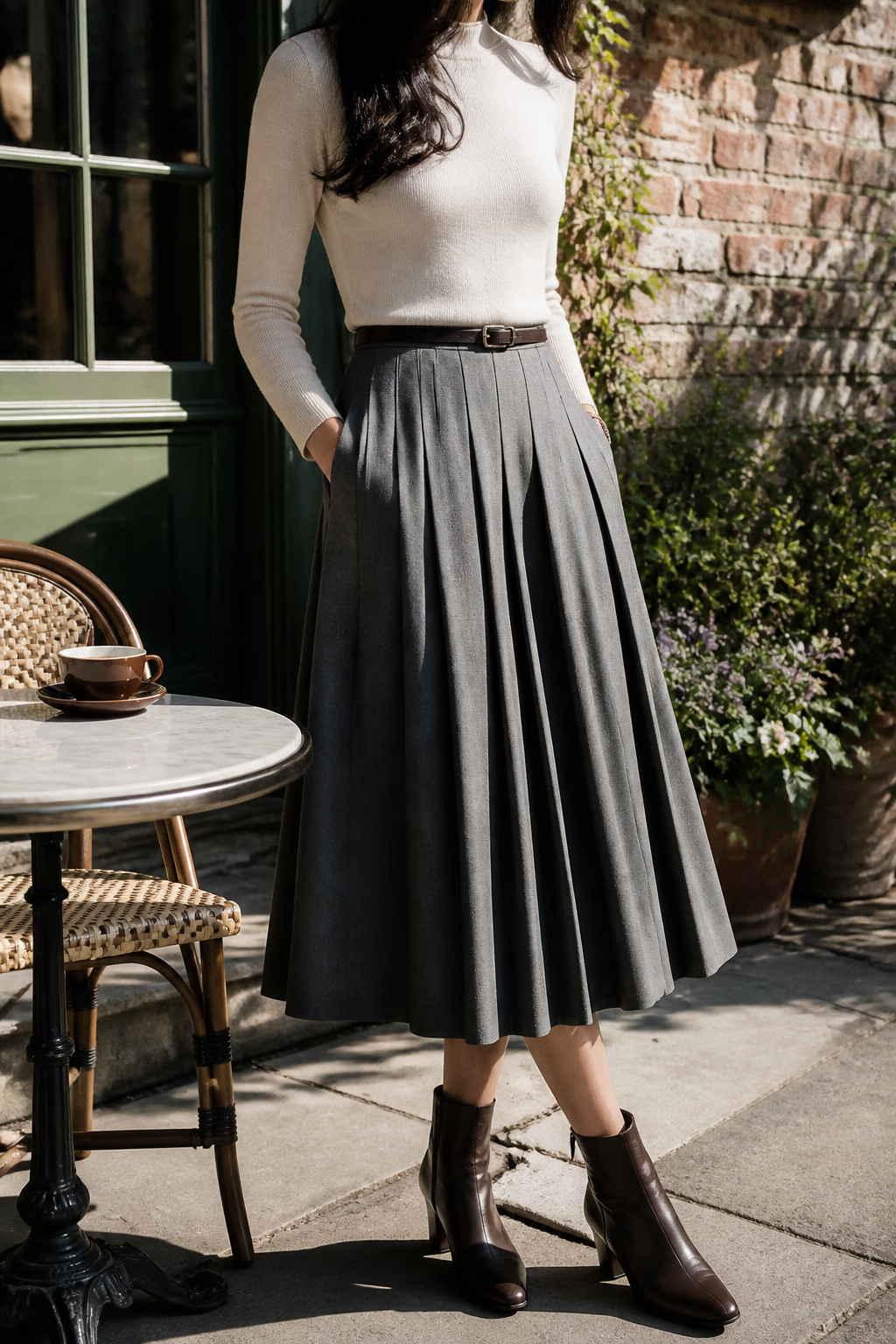
A belt over a sweater only works if you place it at the natural waist, the narrowest point of your torso, not down at the hip where it slides and looks accidental. The sweater itself matters: fine-gauge knits and lightweight cashmere like the Reformation Jadey take a belt cleanly, while thick cable knits or bouclé bunch underneath and refuse to lie flat. You are building a column of fabric that needs to hold a line.
For the skirt, a pleated wool midi from & Other Stories gives the outfit its structure. The volume balances the cinched waist and keeps the silhouette from reading top-heavy. A slim belt in solid brass leather, again from Aritzia, is the right scale here. The common mistake is reaching for a wide or thick belt, thinking it adds more shape, when it actually creates a bulky horizontal band that breaks the line entirely. The belt should disappear into the outfit, not announce itself.
7. Trench, Tee, and Pants
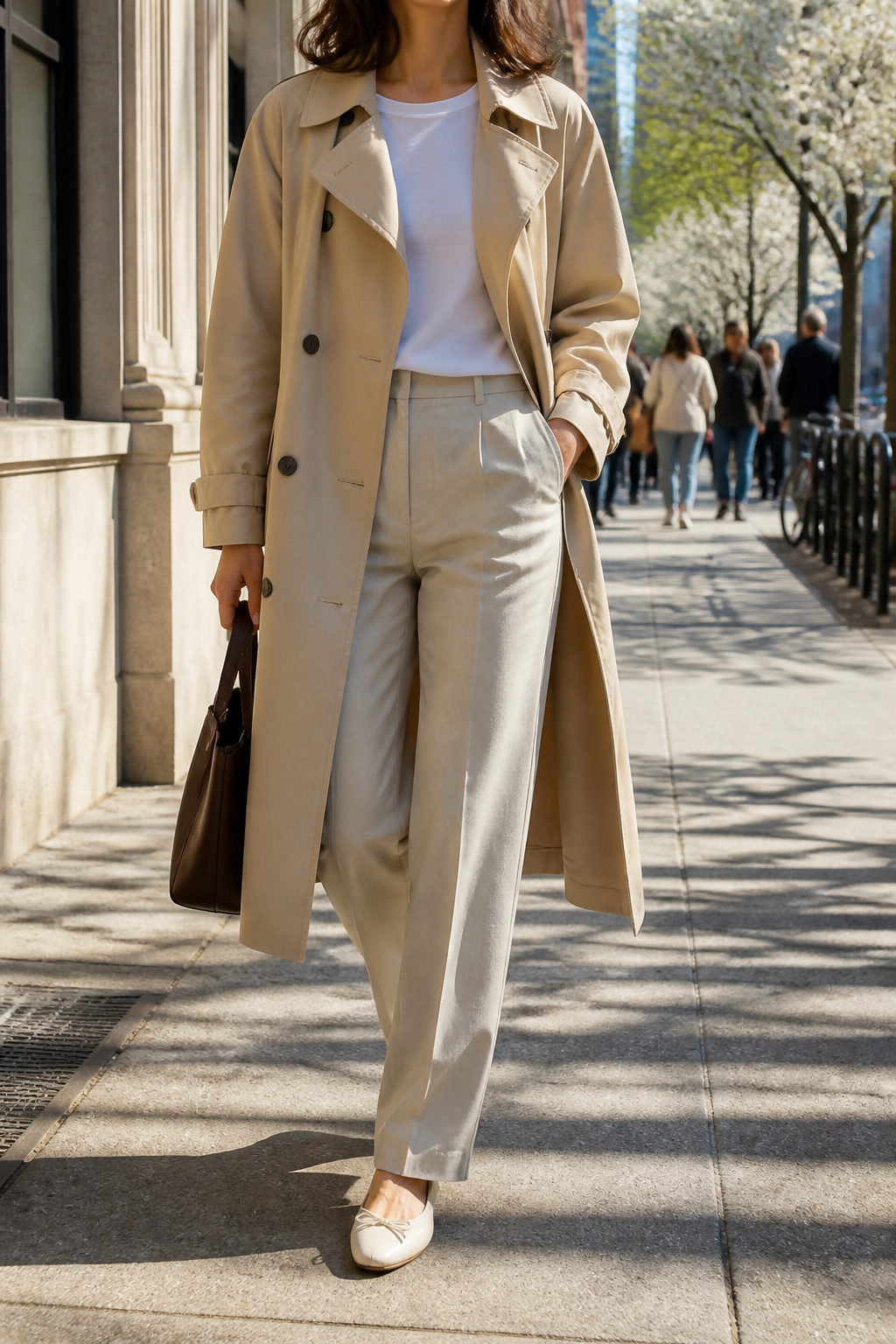
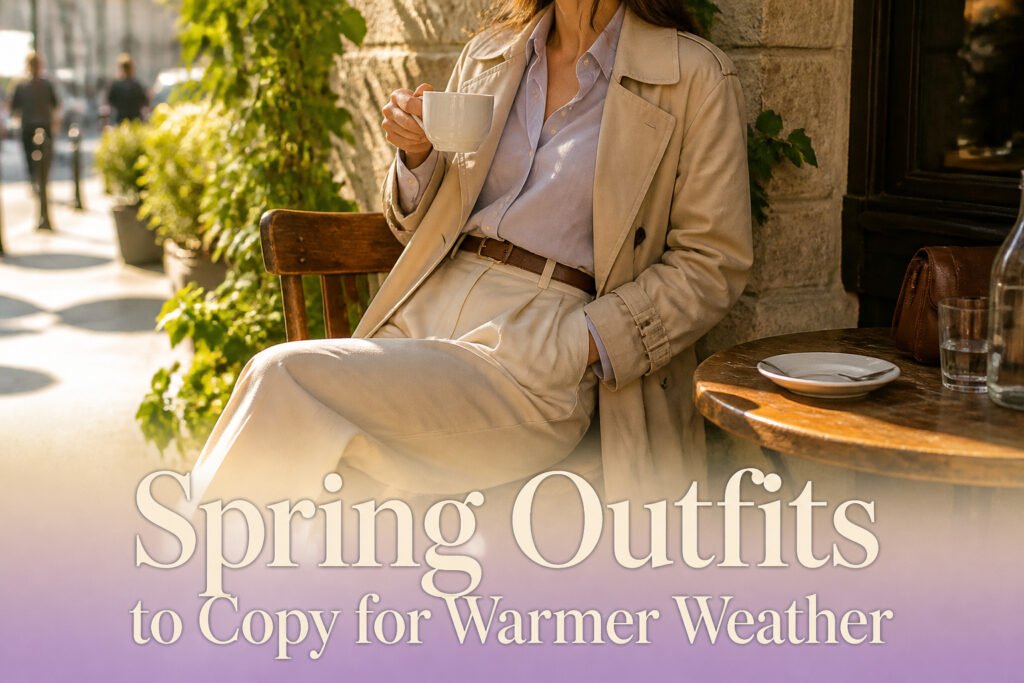
The trench coat is spring’s outerwear default because it solves the problem every morning presents: something between you and the wind that does not look like you are still dressed for winter. Throw it over a tee and tailored pants, and you read as polished without having planned anything. The Frankie Shop’s Lottie Wing Collar Trench Coat does this job cleanly.
The pant shape matters more than most people notice until they belt the coat. Straight-leg or slim tailored cuts keep the line clean under the trench’s wrap; anything fuller stacks at the midsection and turns the silhouette bulky. The DISSH Eden Bitter Choc Tailored Pant is cut for this exact pairing.
A plain tee underneath is not a placeholder. It is the deliberate choice that lets the coat carry the outfit, since the trench’s collar, belt, and length already give the eye enough to work with. A printed or fussy top fights the coat for attention and loses.
Sleeve length on the tee should hit at or just past the wrist bone. That gives you the couple of inches you need to roll once above the trench cuff, so the layering reads intentional rather than like you grabbed the wrong shirt. The Toteme torso-length trench in the cobalt story works the same way; even with Lisa Yang’s butter-yellow long-sleeve tee, the sleeve roll is what keeps the look controlled rather than crowded.
8. Button-Down Shirt, Skirt, and Bag
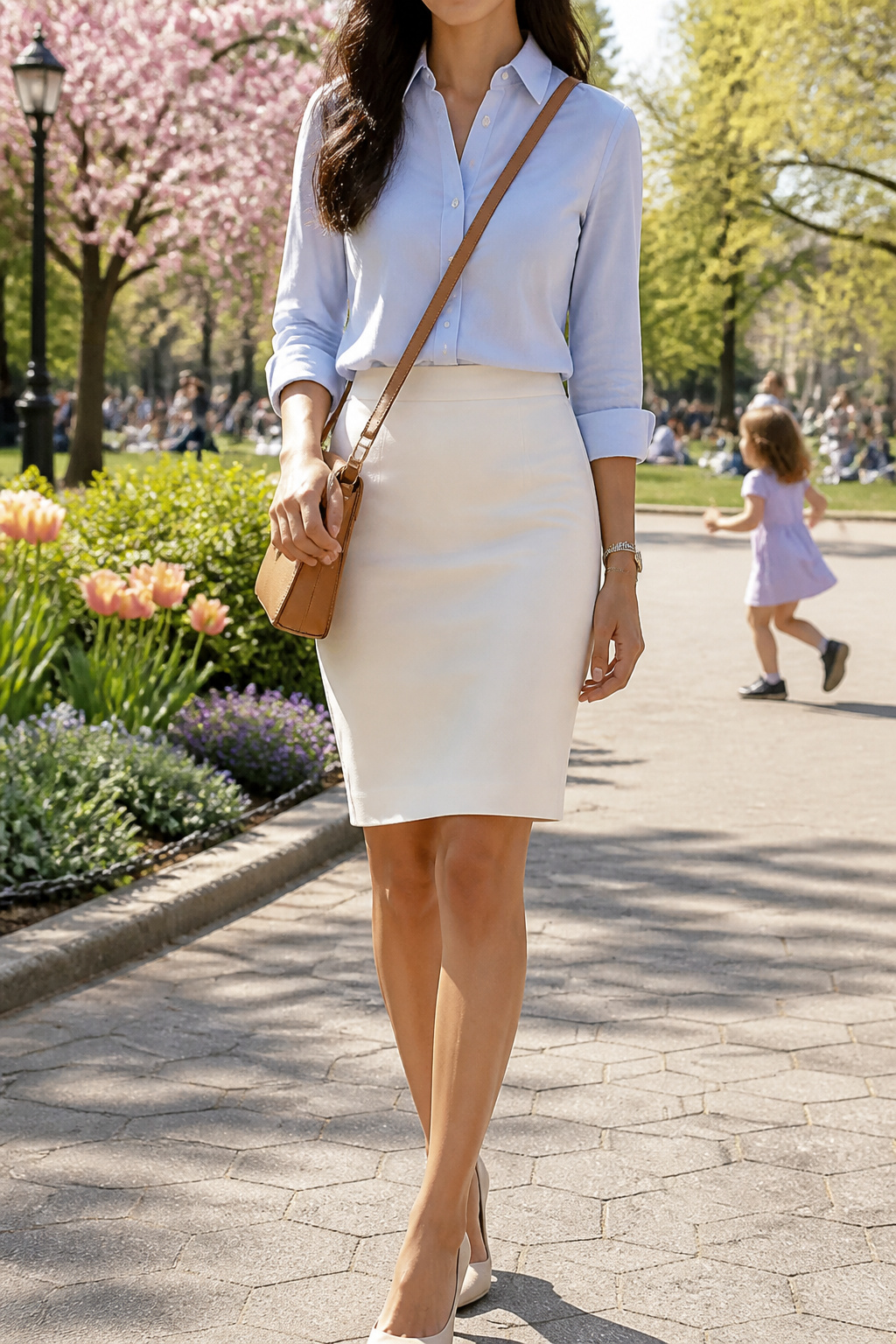
A button-down shirt with a skirt walks a fine line between neat and rumpled depending on how you handle the waistline. Tuck the shirt all the way in and use a half-tuck only when the skirt sits at or above your natural waist; lower rises let the blouse billow out at the sides, which reads as sloppy rather than relaxed. High-waisted pencil skirts and A-line cuts hold the fabric flat against your body, so the shirt stays where you put it.
The bag does the heavy lifting for color or texture. A croc-embossed leather crossbody or a saturated suede clutch gives the outfit its point of view while the shirt and skirt stay neutral. In cotton or chambray with a denim skirt, this reads casual. Switch to silk or poplin with a structured midi, and the same silhouette works for a dinner where you need to look pulled together without wearing a dress. The bag is where you show you made a choice.
9. White Button-Down, Black Pants, and Black Flats
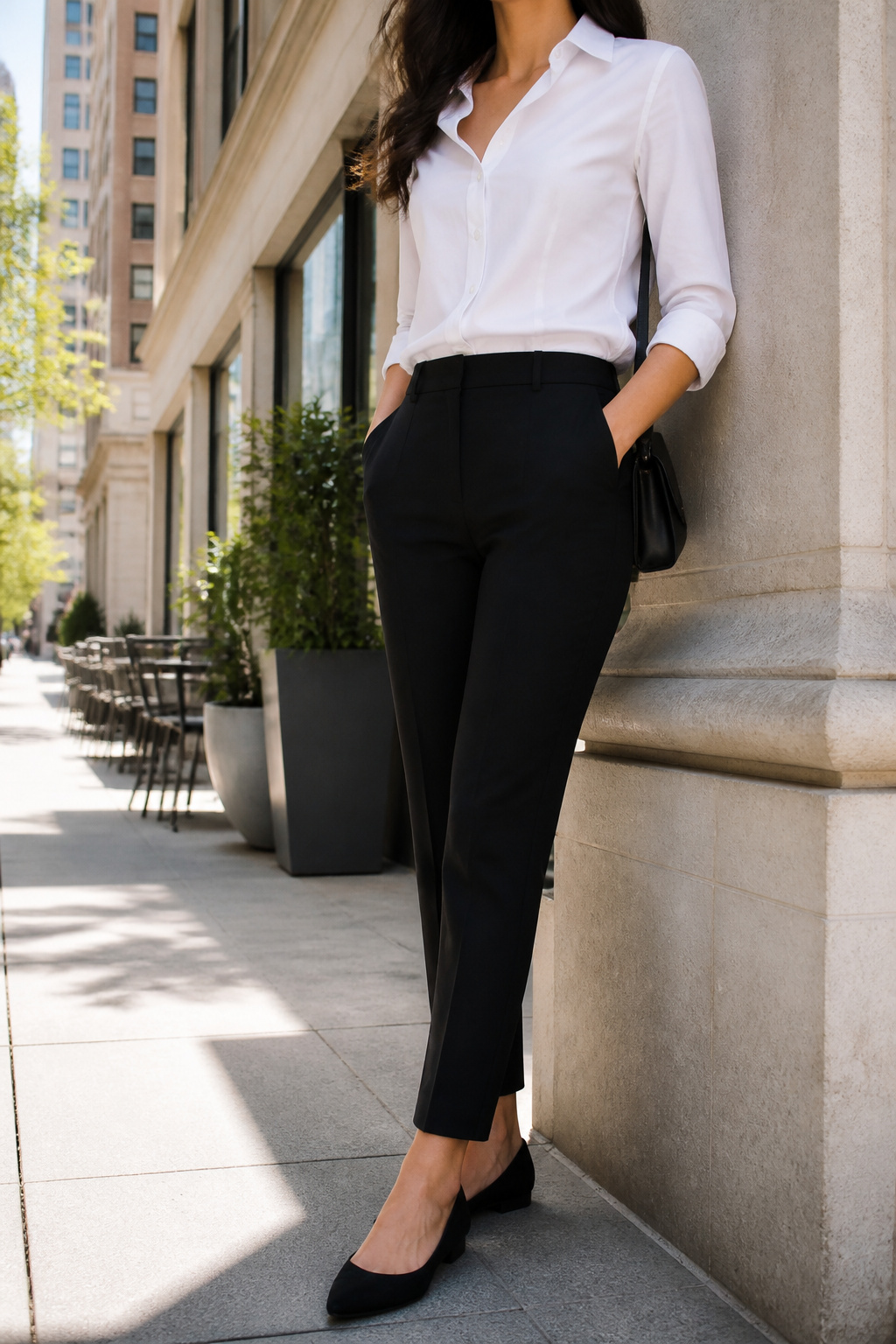
A white button-down and black pants reads as a uniform the moment the fit goes slack. You see it in offices everywhere: excess fabric pooling at the ankle, a collar that gapes two fingers wide, sleeves that swallow the hand. The color story is not the problem. The proportions are.
The pant cut makes or breaks this. A straight leg with a slight taper keeps the silhouette current; anything flared or aggressively cropped swings costume. A flat-front waist sits cleaner than pleats here, and the break at the shoe should skim the top of the foot, not accordion over it. You want the eye to travel vertically, not to stall at a puddle of cloth.
The shirt details steer the tone. A standard point collar leans corporate; a slightly spread or camp collar relaxes the whole thing without trying hard. On the flats, a pointed toe reads sharper and more intentional than a round one, which can tip into commuter territory. Leather that has some structure, not soft and collapsed, signals you chose this rather than defaulting to it.
Keep the shirt untucked only if the hem hits mid-hip and the side slits do not climb past the waistband of the pants. Otherwise tuck it, and let the waistband sit at the natural waist, not drooping toward the hips. Small shifts, but they are what separate a formula from a look.
10. Barn Jacket, Gray Sweater, and Jeans
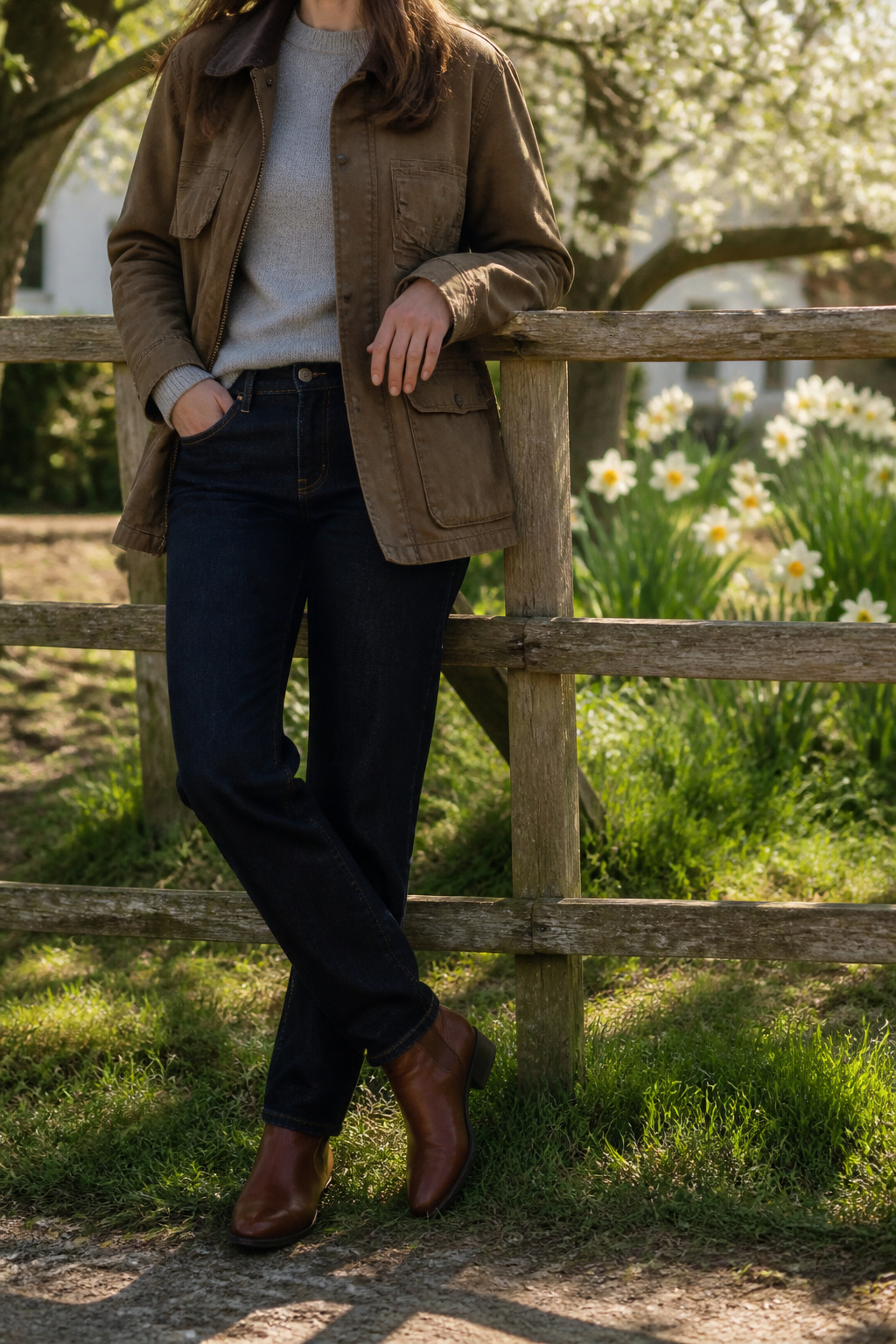
The barn jacket came back hard in 2024 and stayed through 2025, and for spring weekends it has settled into one reliable formula. You throw it over a gray sweater, which does the quiet work of letting the jacket’s brass snaps or plaid lining read as the point of interest rather than competing with it. That neutral ground is why gray wins here where cream or olive would fight the hardware.
The jean wash is where you can slip into costume if you are not careful. A clean dark indigo or a faded but not destroyed light wash keeps the look off the ranch; anything with heavy whiskering or a raw selvedge cuff starts to stack workwear on workwear until you look like you are about to mend a fence. A simple straight leg, neither wide nor skinny, finishes the outfit without adding another statement.
You will reach for this on Saturday mornings without thinking about it. It is presentable enough for the hardware store and the coffee shop in the same morning, and that is exactly what a weekend default should do.
11. Blue Button-Up, Jeans, and Black Loafers
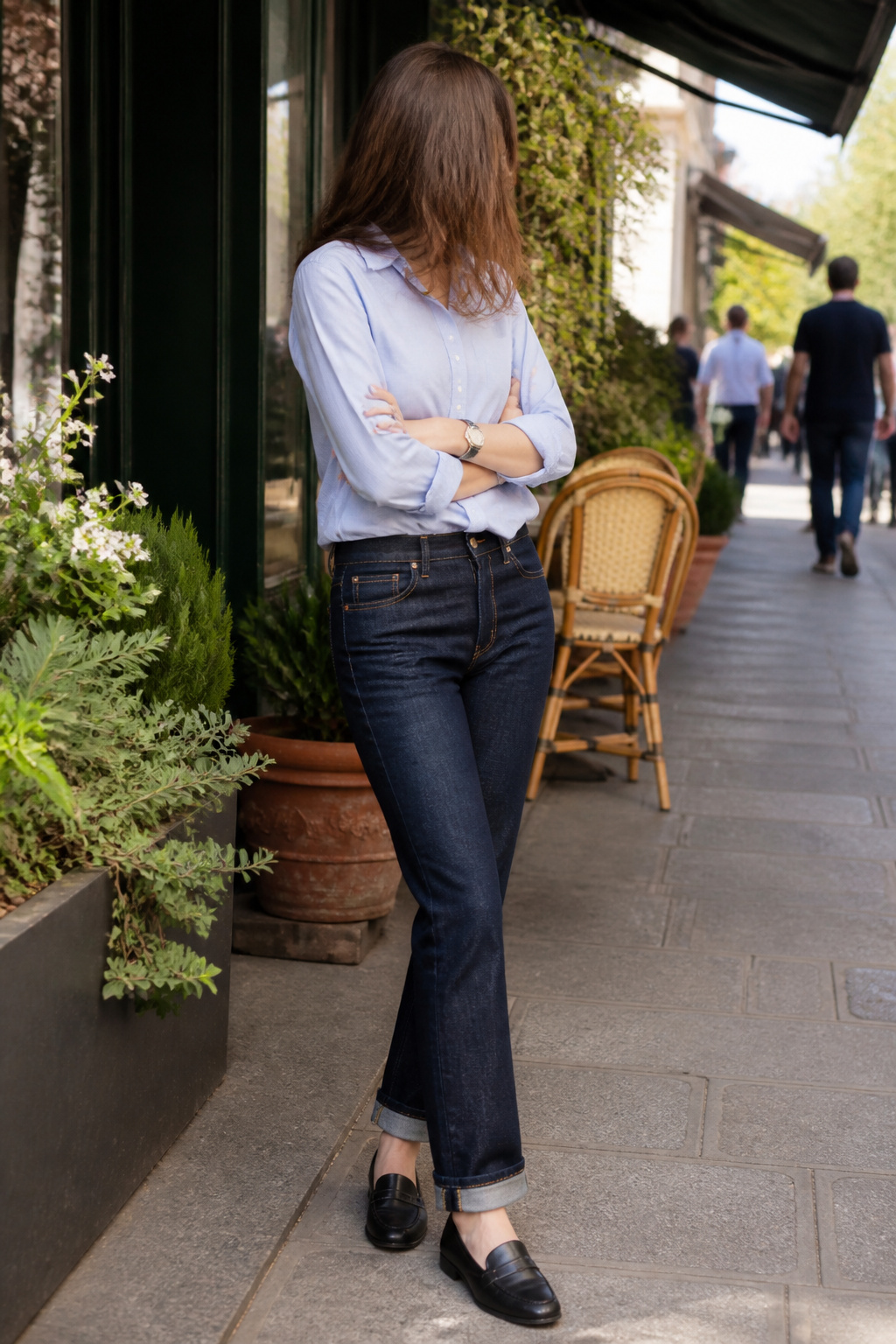
A blue button-up with jeans only works if the two blues actually talk to each other instead of matching. You want enough tonal distance that the eye reads them as separate pieces: a pale chambray against raw indigo, or a deep navy oxford against a lighter wash. Too close and you look like you tried to coordinate and missed.
The black loafer matters here because it grounds the outfit without the seasonal heaviness of boots. It carries the same polish but reads lighter on the foot, which keeps the whole thing from tipping into fall territory.
For the shirt itself, oxford, chambray, and lightweight poplin are the fabrics that signal spring. Oxford has that slight texture that catches light differently than a broadcloth, chambray reads as denim’s softer cousin, and poplin stays crisp in heat without going full summer sheen. Anything heavier or with flannel brushing belongs back in the closet.
On socks: the loafer exposes enough ankle that a bare foot looks like a mistake, but a full crew sock breaks the line. A no-show liner, or nothing at all if the shoe fits snugly, keeps the loafer’s intent intact. A dark sock peeking above the vamp is the detail that throws the whole proportion off.
12. Denim Button-Up, White Jeans, and Tan Loafers
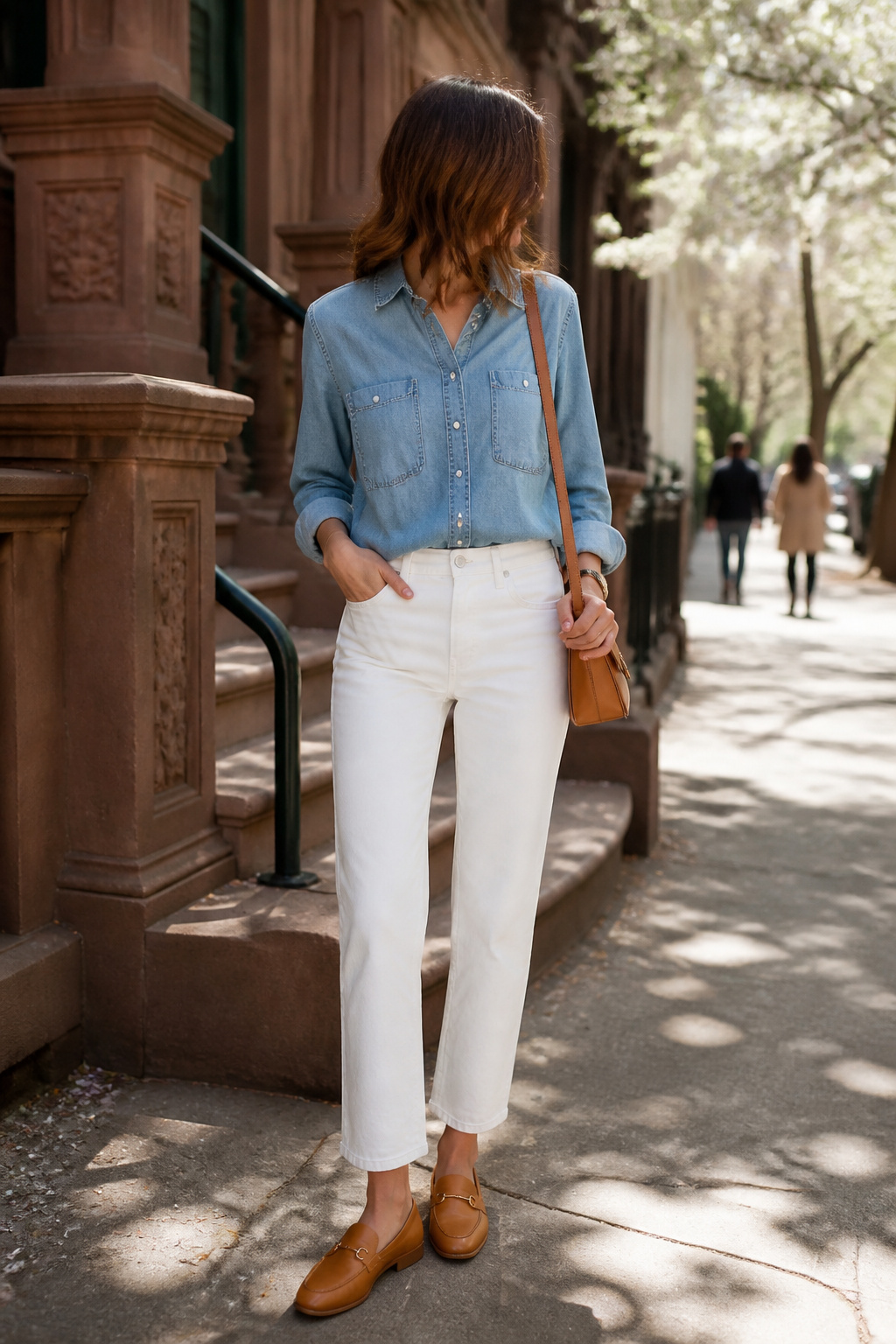
A denim button-up with white jeans and tan loafers is one of those pairings that looks intentional the moment you put it on, but it asks for some care in the execution. The top and bottom need different weights of denim, or you end up in a monochrome void that flattens the whole look. A lighter chambray or a rinsed indigo shirt against sturdier white jeans gives the contrast some air; matching weights make you look like you grabbed uniform pieces without thinking.
White jeans in spring are a gamble on opacity. Thin denim turns transparent in daylight, and a low rise shifts the whole outfit toward casual in a way that undercuts the loafers. A mid-rise or high-rise cut in denim with enough heft to block skin tone keeps the look crisp rather than beach-bound.
The tan loafers do the real work here. They warm up the blue-white palette and sit right in the middle of casual and polished, which is exactly where this outfit lives. Without them, you are in weekend territory; with them, you can walk into a meeting that ends at a patio table. Just know that the contrast is loud. This is a high-contrast look, and you have to wear it like you chose it on purpose.
13. Black Blazer, Jeans, and Loafers
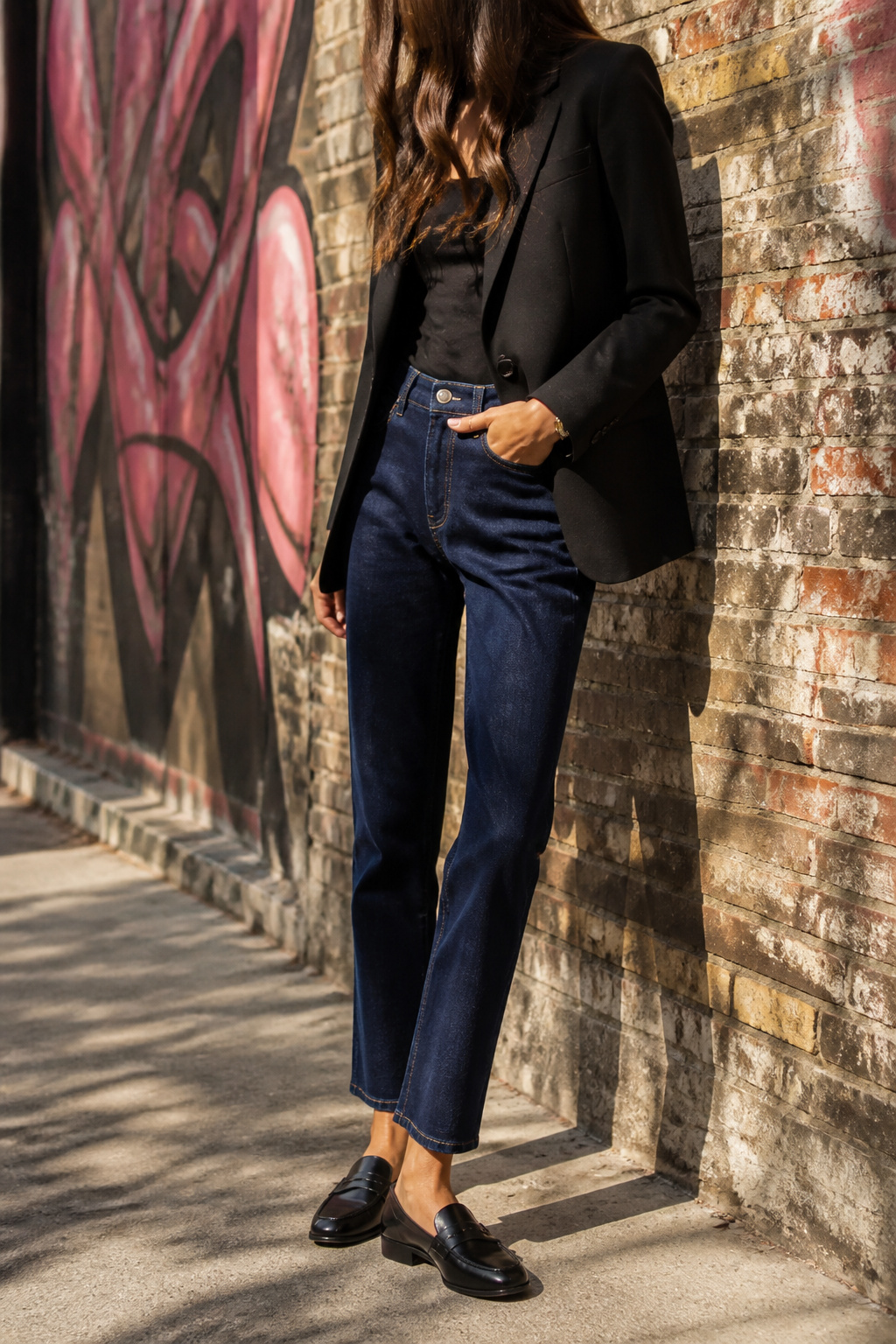
A black blazer with jeans is not the same formula as navy or gray. Black reads sharper, more evening, more city, and without care it can look like you grabbed your work jacket on a Saturday. Keep the denim dark, a clean indigo or deep wash, so the two pieces share a single tone rather than fighting each other. Mid-blue or faded denim against black creates a visual break that feels accidental, not intentional.
The loafer is where this outfit lives or dies. A thin-soled, overly formal pair looks like you forgot your oxfords; a too-casual driving shoe looks like you gave up. Choose a loafer with enough structure to meet the blazer halfway, a substantial sole and clean vamp. Zebra print adds just enough personality to keep the look from turning predictable while staying inside a neutral palette, though a well-made black or dark brown pair holds the line more quietly. The point is intention: the shoe should look chosen, not inherited.
14. White Tee, Jeans, and Colorful Bag
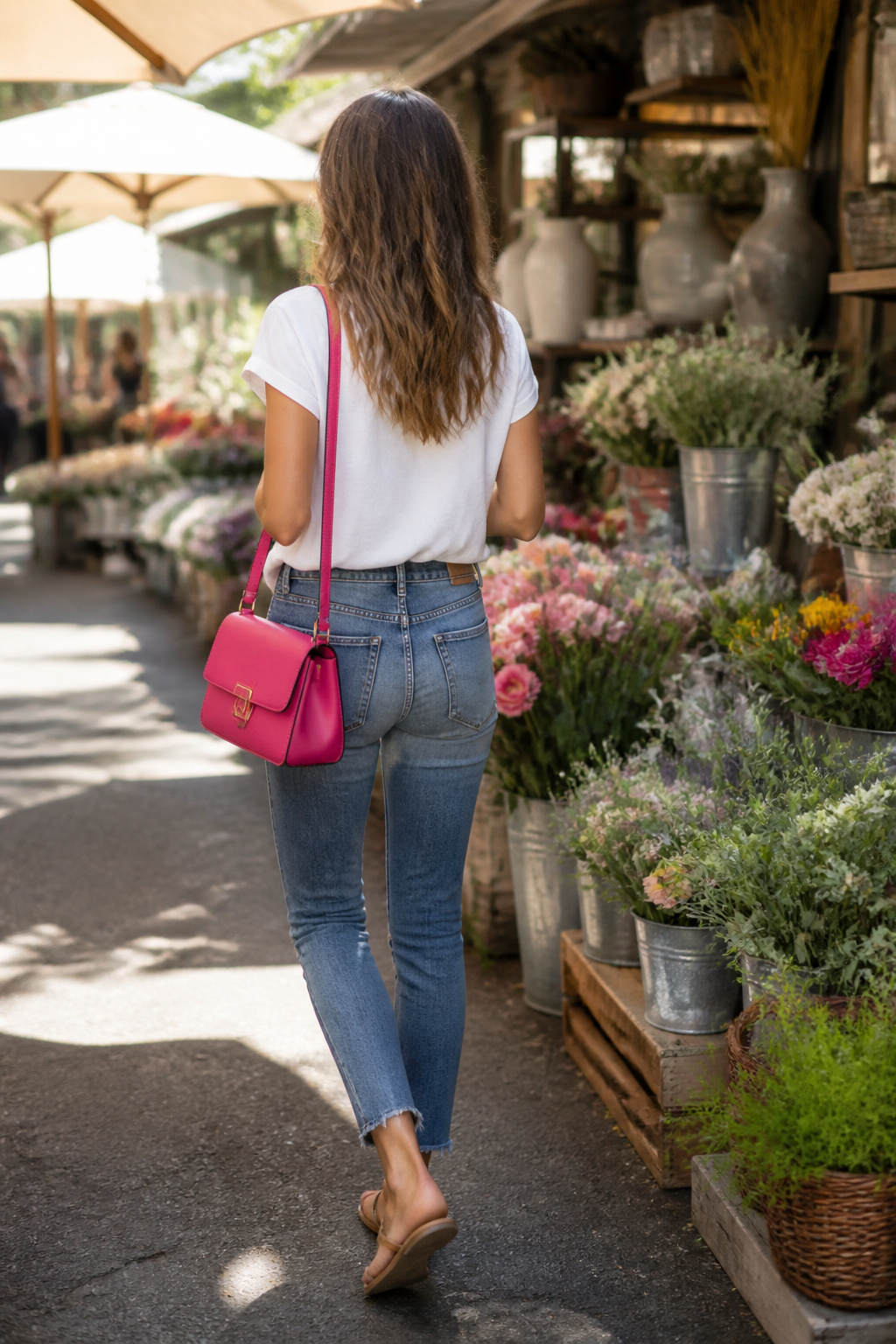
A white tee and jeans is the most classic pairing there is, but it only starts to feel like spring outfits when you hang something bright off your shoulder. The bag does every bit of the work here; the clothes are just the wall you paint on.
Size matters more than people expect. A mini bag gets lost against the volume of denim, while an oversized tote swallows the clean lines that make this combination sharp. A medium structured bag, roughly the span of your hand to your elbow, sits right. It holds its own without competing.
The mistake is treating the color as a one-off accent. You will look like you grabbed whatever was by the door. Pick one other place to repeat that exact shade. A shoe in the same tone ties the look together from the ground up. A scarf or a lip color works too, though the lip demands more precision than most mornings allow. Two echoes of the color reads as intention. Three starts to feel like a costume. Stop at two, or let the bag stand alone and keep everything else neutral. Both work; the error is landing somewhere uncommitted in between.
15. Gray Sweater, White Jeans, and Black Loafers
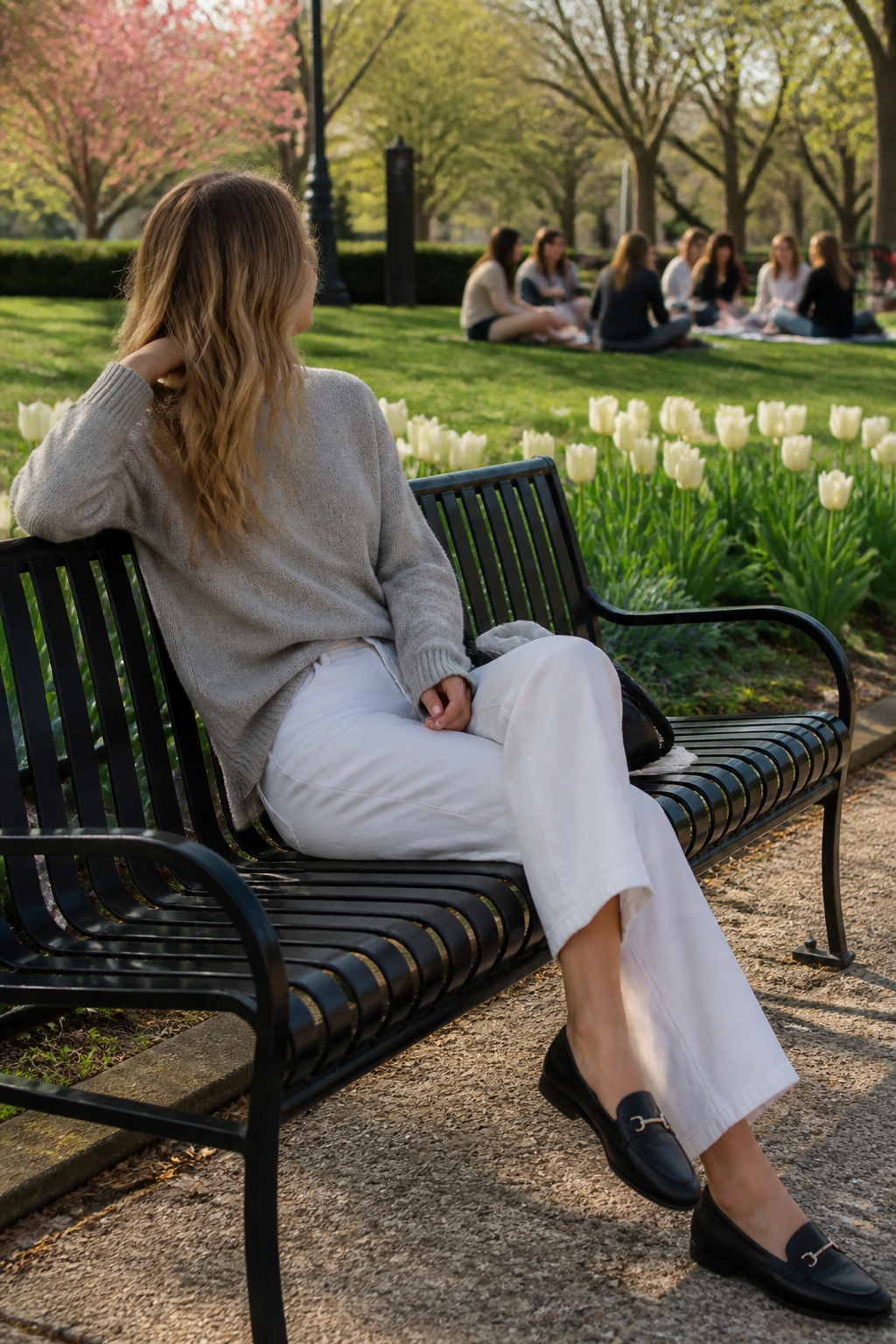
A gray sweater with white jeans trades the sharpness of black and white for something softer against spring light. The pairing still reads as clean, but the gray lets the white denim do the bright work without the contrast feeling theatrical.
Not every gray works the same way. A mid-tone heather flatters cooler skin, while charcoal or mushroom depths lean warmer and suit olive or deeper complexions. If you are unsure where you land, hold the sweater up in daylight: the shade that makes your hand look healthier is the one.
Texture matters here. A fine-gauge merino keeps the outfit polished enough for dinner; a slubby linen blend or brushed cotton gives it Saturday morning energy. Ribbed knits add vertical line that helps if the white jeans feel too expansive on your frame.
The black loafers are what keep this from floating away. White jeans and pale gray can read as too airy, almost insubstantial, without that dark anchor at the foot. A sleek penny loafer keeps the silhouette long; something bulkier, like a lug-sole version, drags the eye down and fights the lightness you built. Keep the loafer narrow, keep it black, and let it ground the whole thing without announcing itself.
16. Casual Spring Dresses
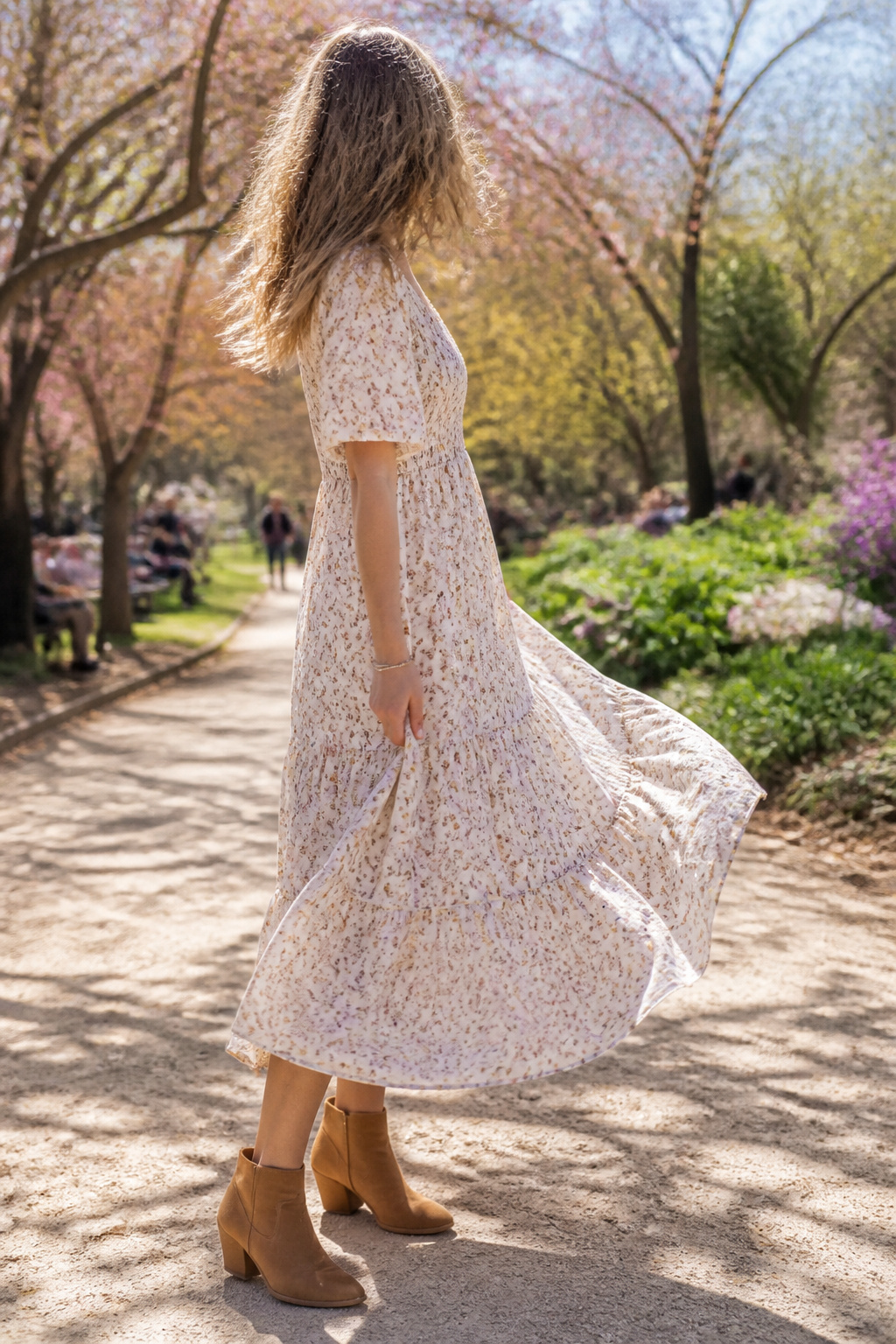
A casual spring dress sits in a narrow window between seasons, and getting the fabric weight wrong is the mistake you will feel all day. You want cotton or rayon blends that breathe but still hold some structure, not the featherweight gauze that belongs to July or the lined crepe that carries winter’s heaviness. Sleeve length does the same work: a three-quarter sleeve or a loose long sleeve reads March through May, where a strapless cut jumps straight to summer and a turtleneck never left December.
Print scale matters more than people expect. Small florals or tight stripes signal spring; oversized tropical motifs read vacation, and dense dark patterns read cold weather. Lengths tend to cluster at midi or maxi, with necklines staying open enough for a light cardigan but closed enough to stand alone in a breeze.
The shoe changes everything. Sneakers ground a wrap dress into errands and coffee runs; swap them for strappy sandals and the same dress handles a dinner out. Flats split the difference, though they lean dressier than most people think. A woven tote completes the look without trying, which is the whole point of this category.
17. High-Waisted Jeans and Tucked-In Blouse
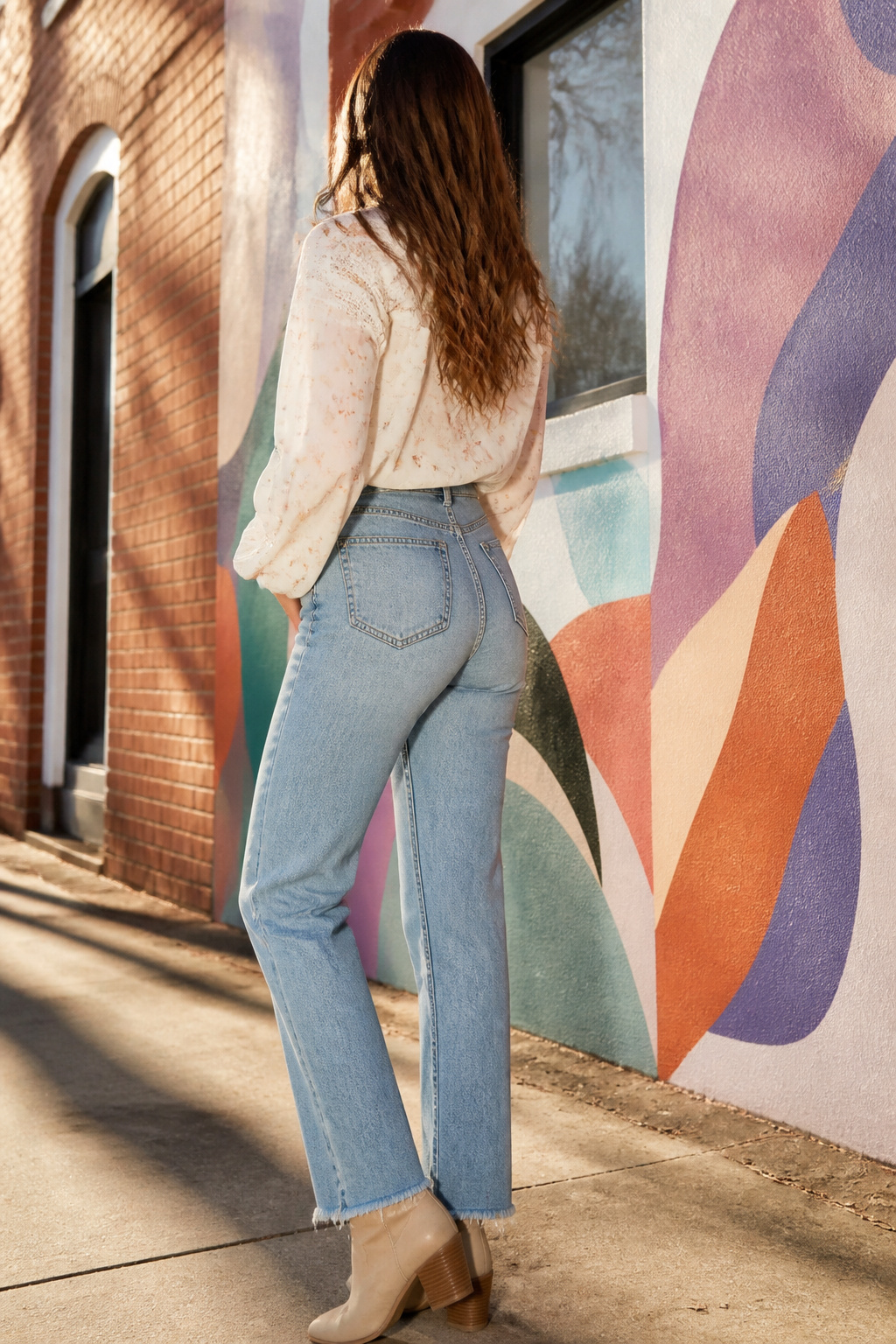
High-waisted jeans with a tucked-in blouse took hold because the waistband sits at the natural waist, the narrowest point on most bodies, and tucking the blouse defines that line rather than hiding it under a drape of fabric. The silhouette reads as intentional, not sloppy.
Silk, thin cotton voile, and lightweight rayon tuck smoothly without the ridge of bulk that heavier fabrics leave under the denim. A blouse with a curved hem helps; the extra length at center front and back stays put when you move, where a straight hem untucks at the sides.
The real test is sitting. The gap opens between the waistband and the shirt because your torso compresses and the fabric has nowhere to go. Tuck into underwear, the old trick, or accept that a half-tuck at the front only solves half the problem. A bodysuit underneath the blouse eliminates the gap entirely, though you trade the ease of a quick bathroom break. For most spring days, the small readjustment after you stand is worth the clean line while you are upright.
18. Flowy Midi Skirt and Fitted Blouse
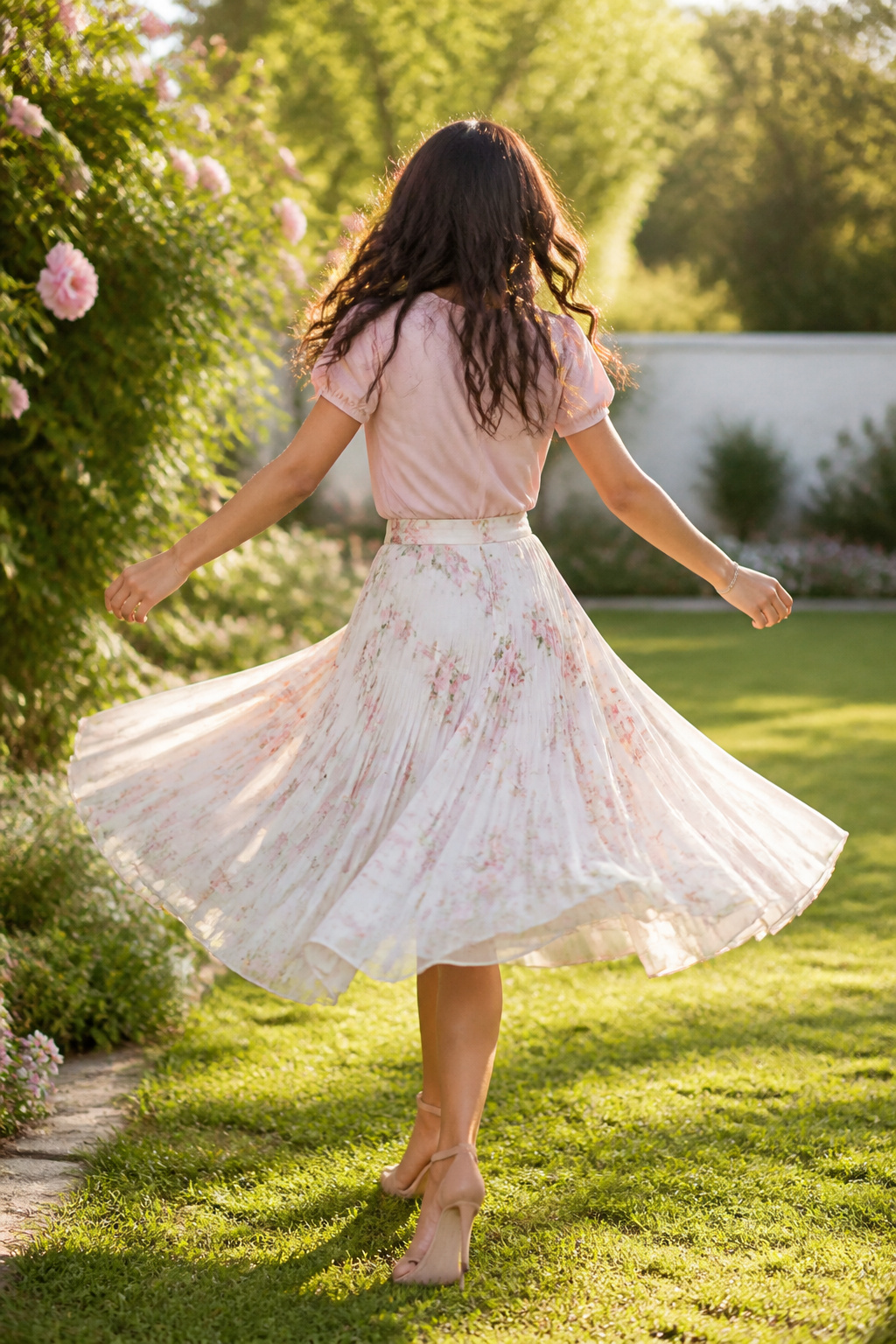
The volume-below, structure-above rule is what makes this pairing work. A flowy midi skirt needs air to move, so you want fabrics light enough to catch a spring breeze: cotton voile, silk crepe, or a soft rayon blend. Anything heavier and the skirt hangs like a curtain; anything stiffer and it tents out from your hips.
The blouse should be fitted, not tight. Fitted means it follows your shape without pulling at the buttons or clinging at the underarm. Tight means you are aware of the fabric while you wear it. You want to forget it is there.
Where the blouse ends matters more than most people notice. Tuck it fully into the waistband of a high-waisted midi skirt. A half-tuck at the hip breaks the vertical line and adds bulk right where the skirt already has volume. A full tuck at the natural waist keeps the silhouette clean and lets the skirt do the moving. Leave the blouse untucked only if the skirt sits at your true waist and the hem hits at mid-hip, which is a harder proportion to land.
19. Lightweight Jackets
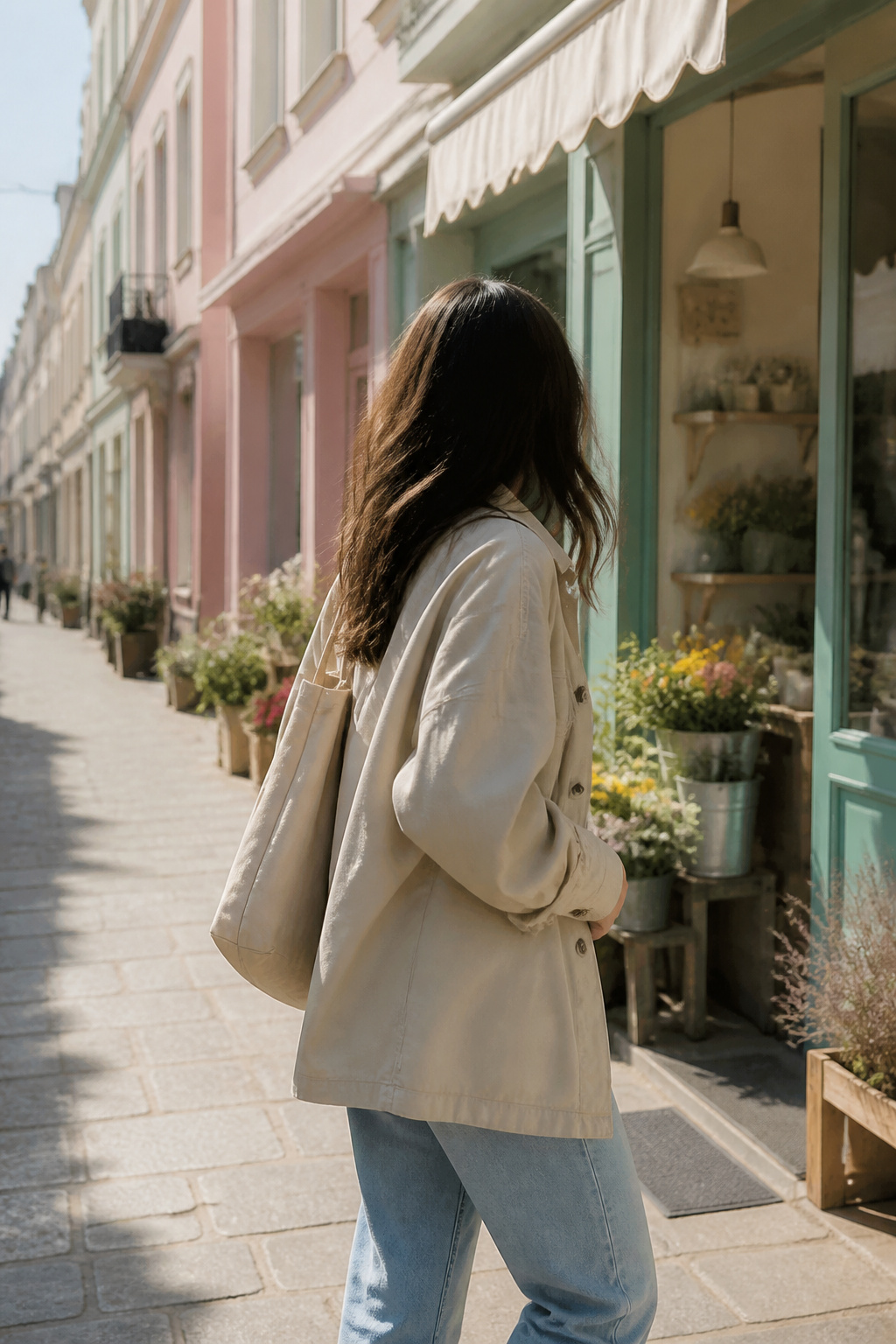
A lightweight jacket is the piece that makes spring dressing possible. When the thermometer sits between 50 and 65°F, you need something you can throw on in the morning and peel off by afternoon without carrying a bulk of wool.
The useful ones fall into four types. A denim jacket works over anything white or cream and reads as finished even with a plain tee underneath. Utility jackets, including the barn jackets that came back last season, give you pockets and a shape that looks intentional with gray knitwear and classic denim. An unstructured blazer bridges the gap when you need to look put-together without the weight of lined tailoring. Bombers add structure to simple bottoms without the formality.
The trick is letting the jacket do the work. Keep what is underneath quiet: a soft blouse, a lightweight shirt, a cropped sweater. The outer layer supplies the interest, the pockets, the color. You are not building an outfit around a statement piece; you are using the jacket to make a basic combination feel complete.
The right weight is cotton or unlined twill, nothing quilted or insulated. You want to be able to push the sleeves up and forget you are wearing it. That is the test: if you notice it after ten minutes indoors, it is too heavy for the season.
20. Spring Dresses for Brunch
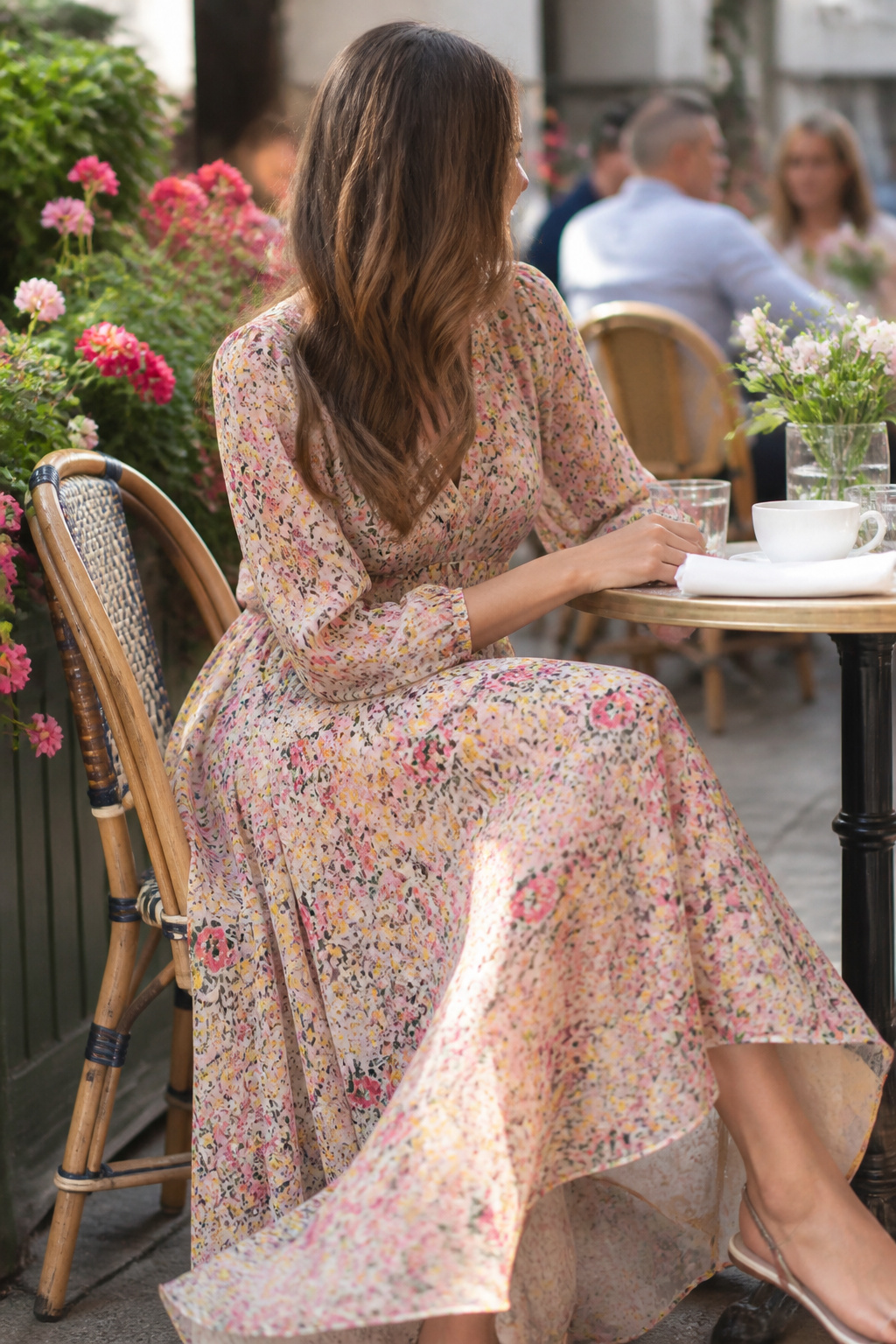
Brunch sits in that awkward middle ground where you need more polish than a coffee run but less structure than dinner out. You will likely be seated for an hour or more, so the dress needs to give at the waist and the fabric needs to breathe. Flowy cuts in pastel or floral prints handle this well, and a belted shirt dress gives you shape without rigidity. For footwear, ankle boots or espadrilles cover most spring mornings; the espadrille wins if the patio is gravel or grass. A light trench or denim jacket handles the temperature drop that hits outdoor tables around hour two. Skip anything that wrinkles from sitting or shows sweat under a phone flash.
21. Spring Formal Dresses
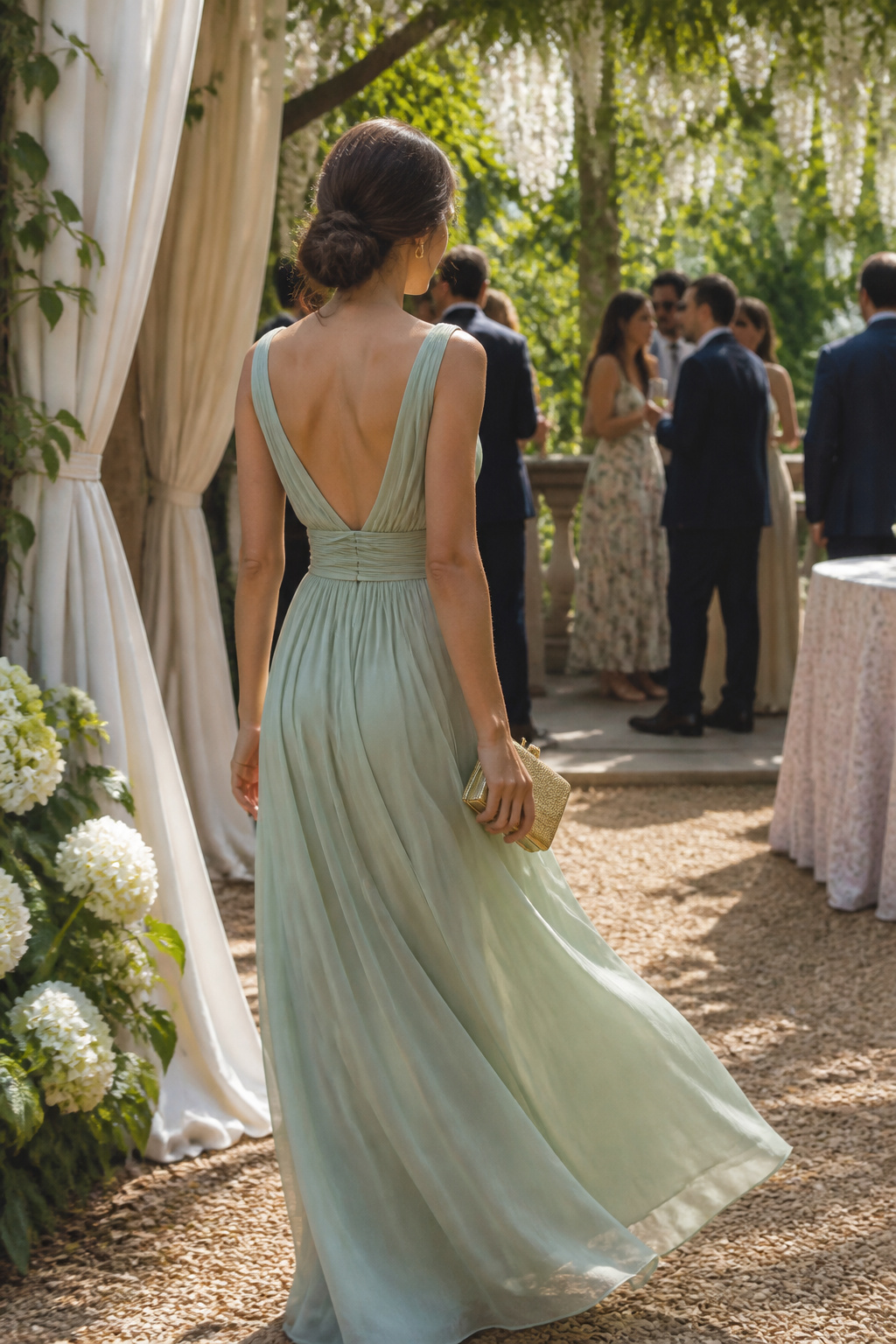
Spring formal sits in a narrow window between the weight of winter and the bareness of summer. You want lighter fabrics than wool crepe or heavy satin, but not so light that a gust of wind turns the dress transparent. Chiffon with a lining, silk faille, or a substantial cotton-silk blend hits the mark. Color works the same way: brighter than the burgundies and emeralds of December, softer than the stark whites and neons of July. Think dusty rose, sage, butter yellow, a muted periwinkle.
Coverage matters more in spring than you might expect. A garden party at four o’clock can drop fifteen degrees by seven. Sleeves, even sheer ones, or a higher neckline give you the texture and richness that summer dresses abandon. Hem length loosens up too; a midi or knee-length reads as formal in April where it might look office-bound in August.
The events you will actually wear these to cluster in May and early June. Outdoor weddings with uneven ground, graduations in drafty arenas, garden parties that start in sun and end in shade. For all three, you want a dress that moves without clinging and holds its shape without armor-plating you. Skip anything that demands constant adjustment; you will be holding a glass, a program, or someone else’s elbow the whole time.
22. Tailored Wide Leg Pants
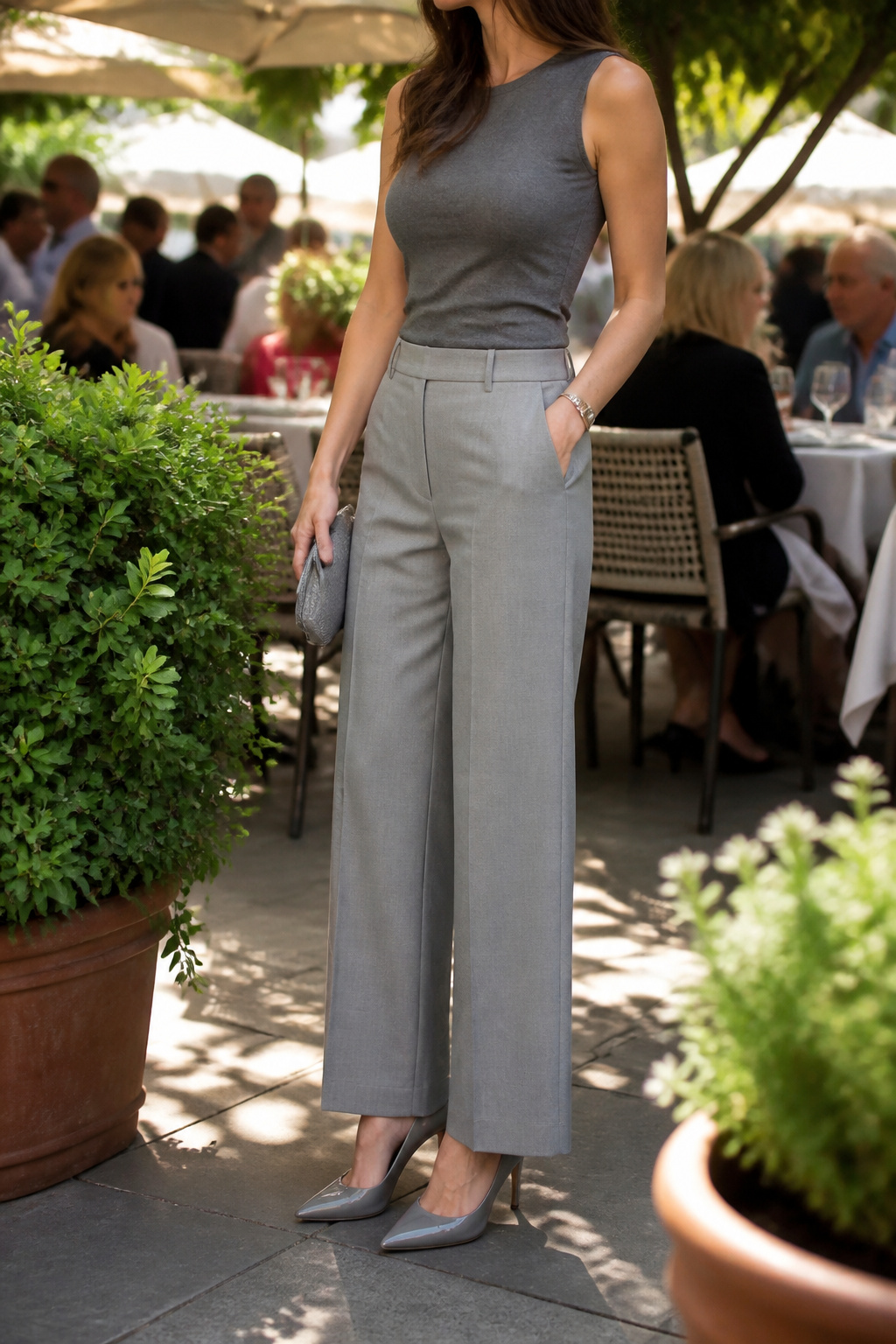
Wide leg pants only work if the waistband sits exactly at your natural waist and the hem breaks cleanly over the shoe. Anything higher and the crotch droops; anything lower and the leg swallows your frame whole. A tailor should take in the waist and shorten the inseam before you wear them out, because off-the-rack wide leg almost always pools at the ankle or gaps at the back.
For spring, balance the volume with a fitted knit top or a tucked-in shell that ends at the hipbone. A cropped jacket works; anything boxy or long-line fights the silhouette and wins. You are building a column, not a triangle.
The shoe has to meet the pant, not hide under it. A low stacked heel or a substantial loafer with a real sole gives the hem something to land on. Skinny flats or minimal sneakers disappear and leave the fabric looking unfinished. This is the piece you reach for when you need to look pulled together in ten minutes, which is why it is worth getting the cut right once.
23. Slip Dress with Light Shawl
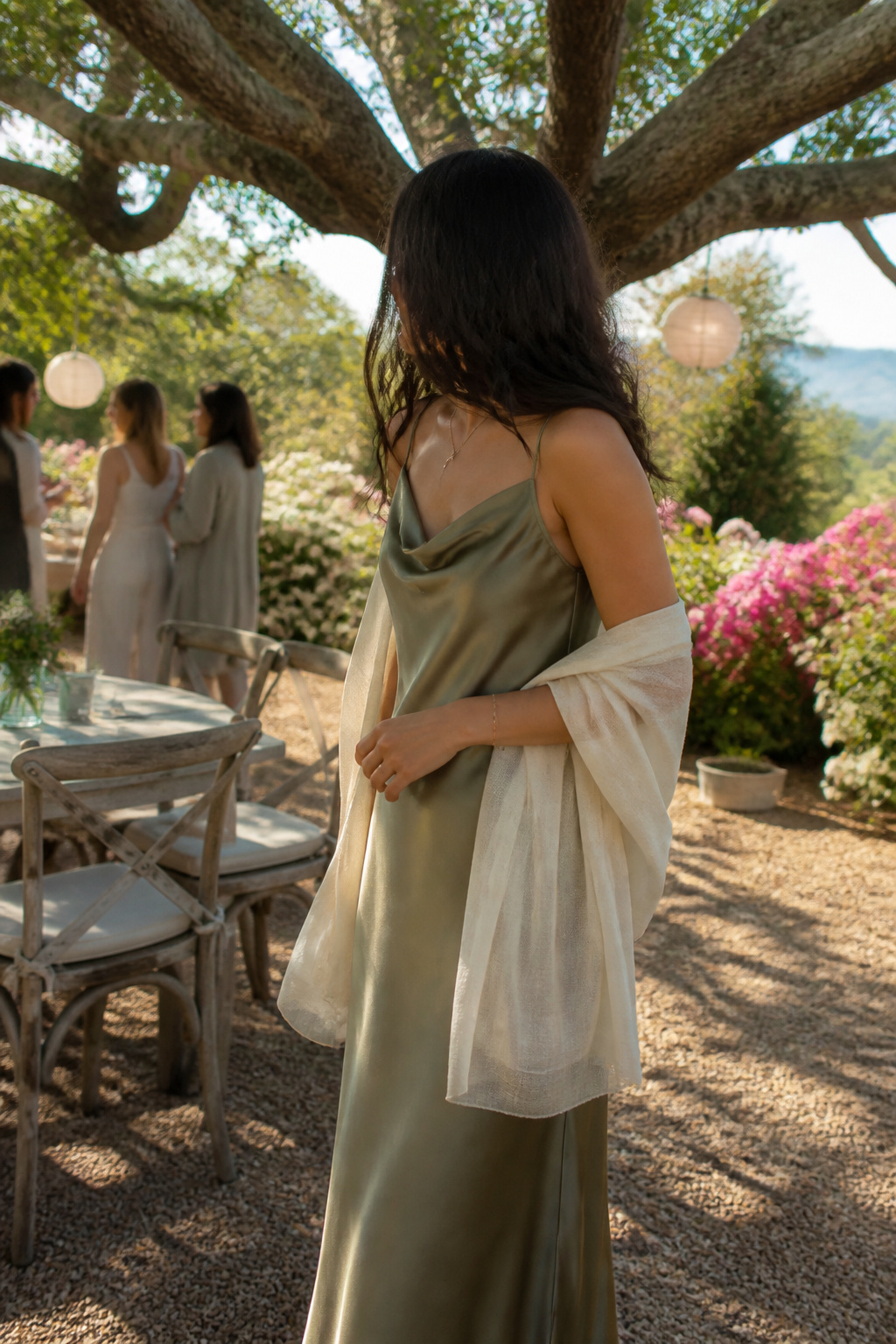
A slip dress that spent winter under a wool turtleneck and thick tights earns its keep in spring once you let it stand alone. The same bias cut that skimmed over layers now falls clean against bare shoulders, and the fabric lightens from matte crepe to something with a faint sheen that catches April sun. The trick is covering up without undoing that openness.
A shawl beats a cardigan here because it gives you the option of nothing on your arms at all. Drape it, knot it, or let it slide off one shoulder as the afternoon warms. A cardigan, even a fine one, adds bulk at the underarm and breaks the line that makes a slip dress flattering. A shawl in silk or lightweight wool is coverage you can fold into a bag once you no longer need it.
For daytime, keep the length at midi or just above the knee; a floor-length slip reads evening no matter what you layer over it. A V-neck or soft cowl photographs better than a high halter for lunch or errands, since it frames the collarbone without looking like you stepped out of a cocktail party.
The bra question matters more here than with most dresses. A standard strapless will show at the neckline unless the dress sits very high. Your better move is a plunge-front, low-back style or, for smaller frames, built-in cups sewn into the dress itself. Test this in daylight before you commit to an outing; what looks fine in your bedroom mirror fails at noon on a sidewalk.
24. Belted Shirt Dress
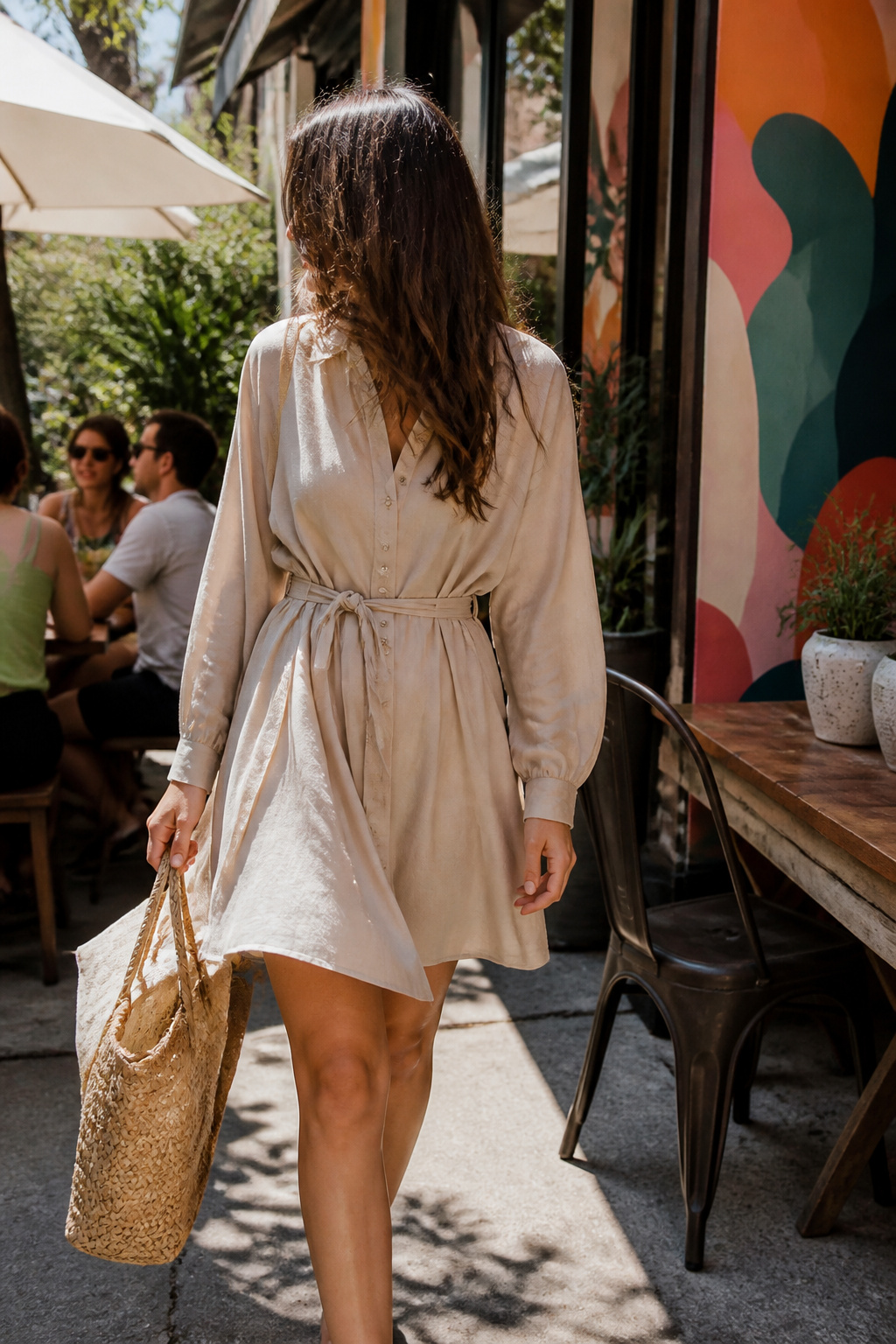
A shirt dress without a belt is just a long blouse. The straight cut hangs from the shoulders, which means the belt is doing almost all the shaping work and you will notice the difference the moment you try it with and without. Cotton poplin and light denim hold a leather or fabric belt better than silk or rayon, which tend to let the band ride up or twist by noon. You want a fabric with enough body to keep that waist definition in place through a full day of sitting and standing.
The same piece works as an actual dress, cinched and worn with sandals or loafers, or left open over slim pants as a long layer that reads more like a duster. If you are wearing it open, roll the sleeves to the forearm first. A long sleeve hanging loose at the wrist looks like you forgot to finish getting dressed, but a neat roll gives the whole thing intention. Two or three turns, enough to show some skin or a thin watch.
25. Breezy Maxi Dress
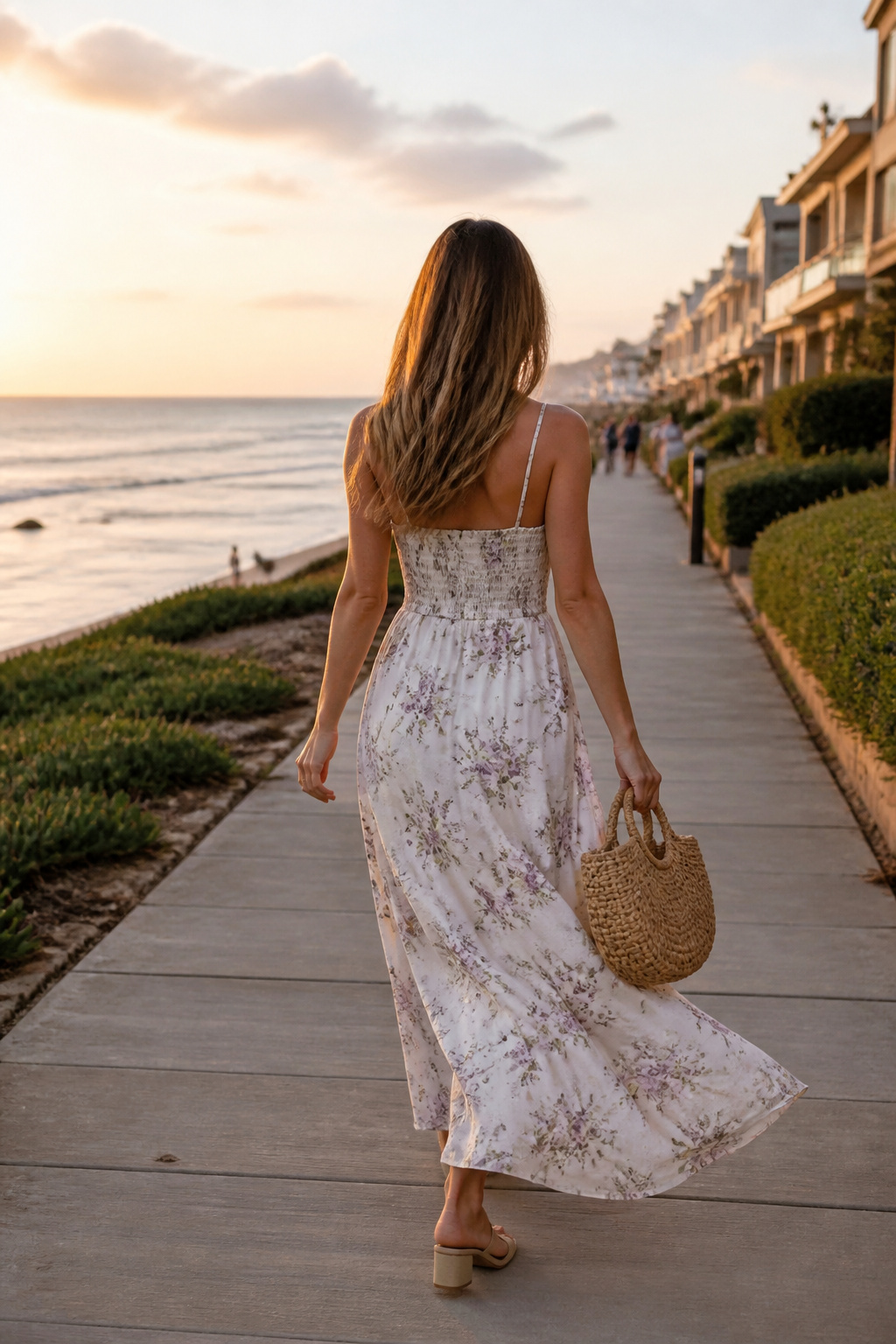
A maxi dress works in spring because it catches air without exposing skin, giving you coverage on days that start cool and end at seventy. The mistake is fabric weight; anything too stiff turns you into a tent the moment the wind picks up. Reach for rayon, lightweight cotton, or a soft jersey that drapes close to the body and moves with you. Linen blends work if they are not the heavy, structured kind meant for trousers.
Hem length is the other place this goes wrong. A skirt that skims the ground looks romantic for one block, then filthy. Pair the dress with sandals that have a slight lift, a low block heel, or even a clean espadrille. You gain an inch or two of clearance without trying to look dressed up.
For travel, this is one piece that does the work of an outfit. No matching required, no separate top and bottom to coordinate after a red-eye. Roll it, pack it, shake it out. Add the lightweight scarf or sun hat you already have in your bag, and you are dressed for exploring.
26. High-Waisted Shorts and Linen Shirt
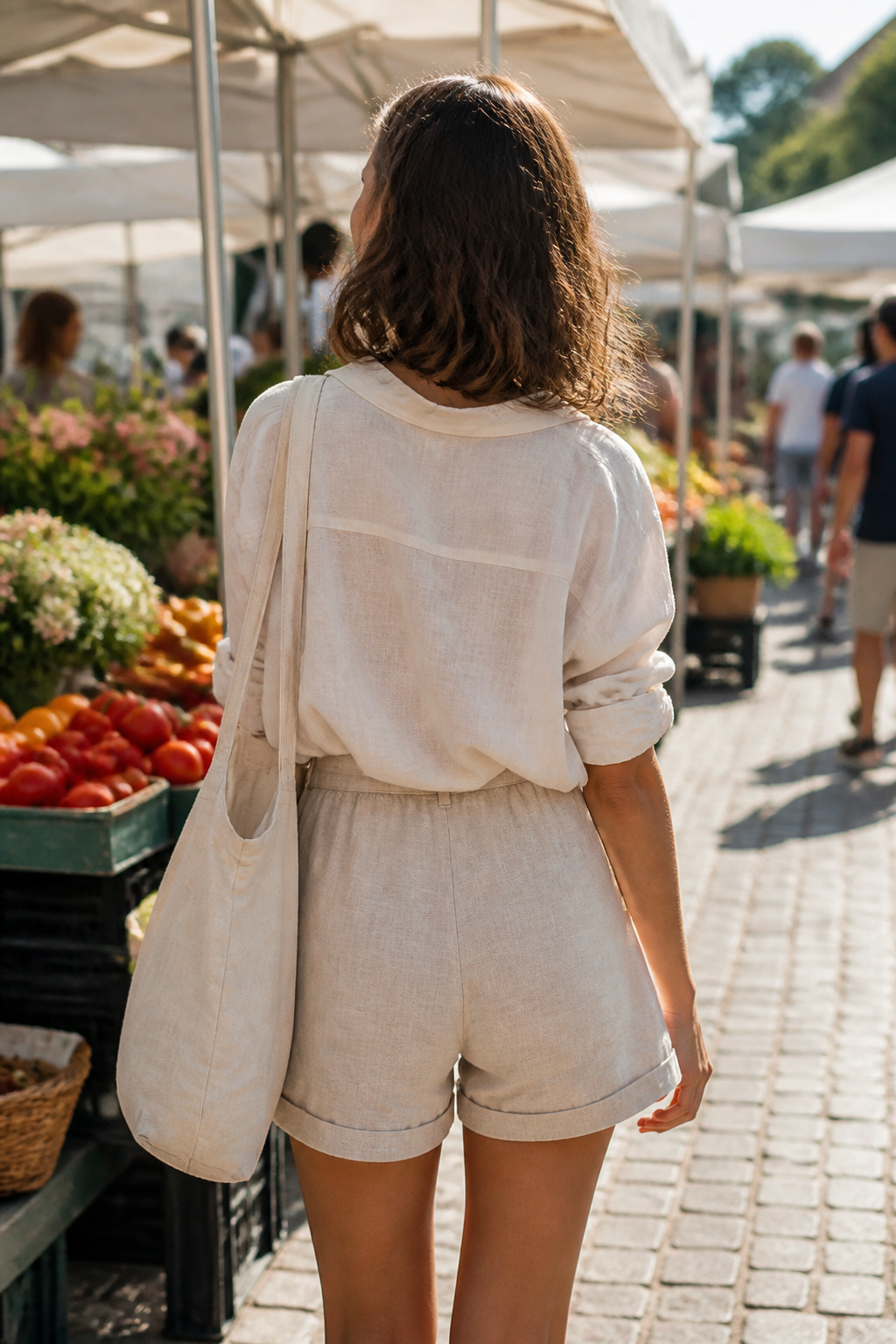
You wait for the thermometer to settle above 70°F for a few days running before you pull this combination out. Anything lower and you end up carrying a sweater all afternoon or shivering through brunch on a shaded patio.
The linen shirt matters more than you might expect. Cotton lies flat and reads as a uniform surface; linen breaks up the light with its slubs and soft wrinkles, so you get texture without trying to layer. A pale oatmeal or faded blue works best here, something that looks already lived-in.
High-waisted shorts earn their place by where the waistband sits. At or just above the navel, they read as intentional rather than as though you cut off a pair of jeans and called it a day. The leg opening should be generous enough that you can sit without the fabric binding, but not so wide that the silhouette loses its shape.
On thigh exposure, the inseam is your control. A 4- to 5-inch inseam hits about mid-thigh, which most people find manageable without tugging. Shorter than that and you are in costume territory; longer and you lose the airiness that makes this outfit feel like spring.
27. Lightweight Scarves
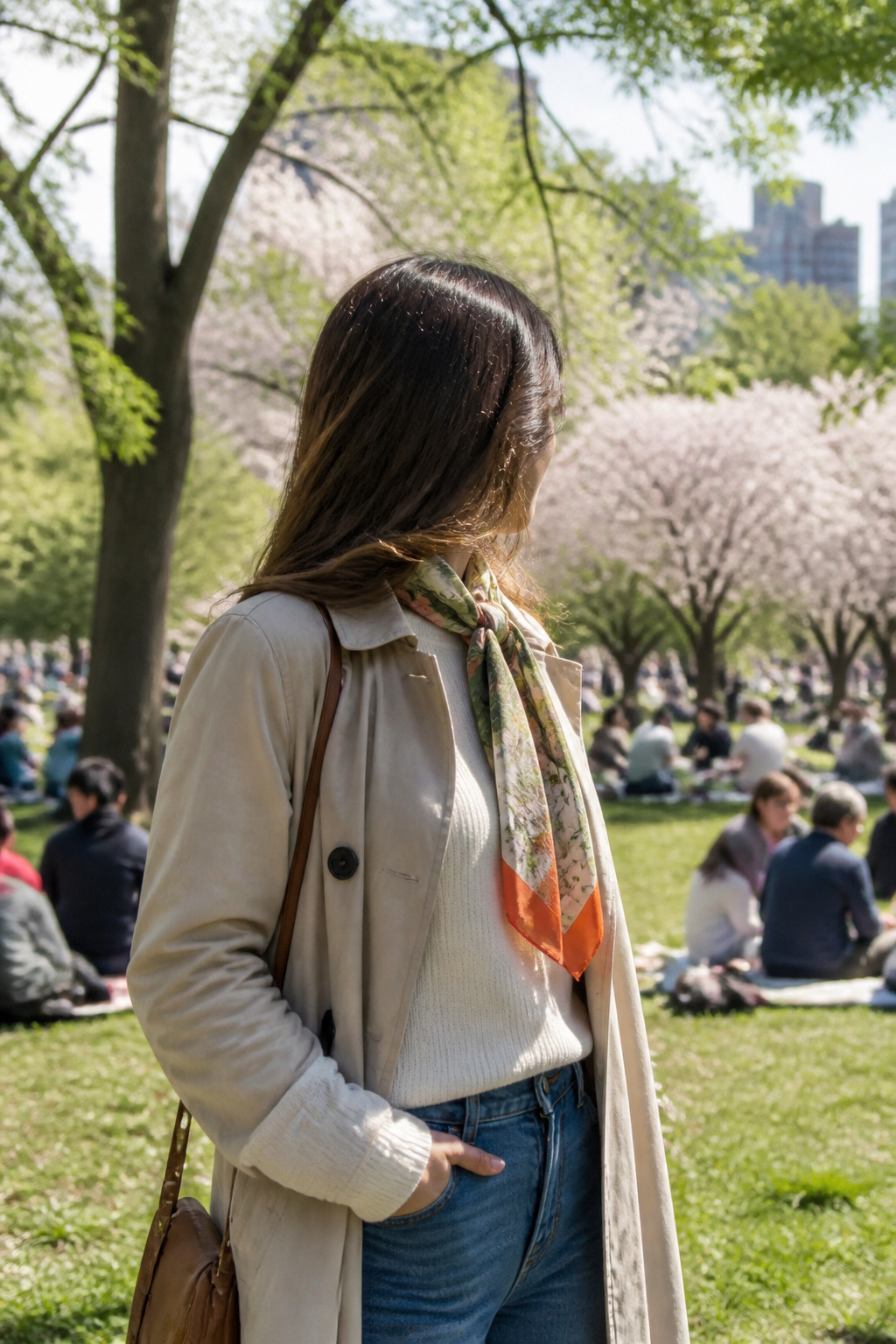
A 35-inch square scarf hits the sweet spot for spring. Anything larger and you fight bulk around the neck; anything smaller and you lose the drape that makes a scarf functional rather than decorative. Silk and cotton are the fabrics that earn their keep here, with lightweight wool as backup for mornings when the thermometer still dips.
The trick is tying without volume. Fold the square in half to make a triangle, then loop the long edge once and let the point sit flat against your chest. No knots piled at the throat, no ends flapping. Sources mention fringed silk specifically for days when winter’s chill lingers, and that fringe adds movement without weight.
You need this most when you’ve already shed the coat but the wind hasn’t finished with you. A bare neck in a tee or thin blouse leaves you exposed; the scarf bridges that gap. It also handles sun protection in a way heavier layers cannot, which matters when you’re outside longer than planned.
Skip the winter-weight wool and the oversized pashmina. This is a layering tool, not a blanket. Get the fabric right and you will wear it more than you expect.
28. Suede Sneakers
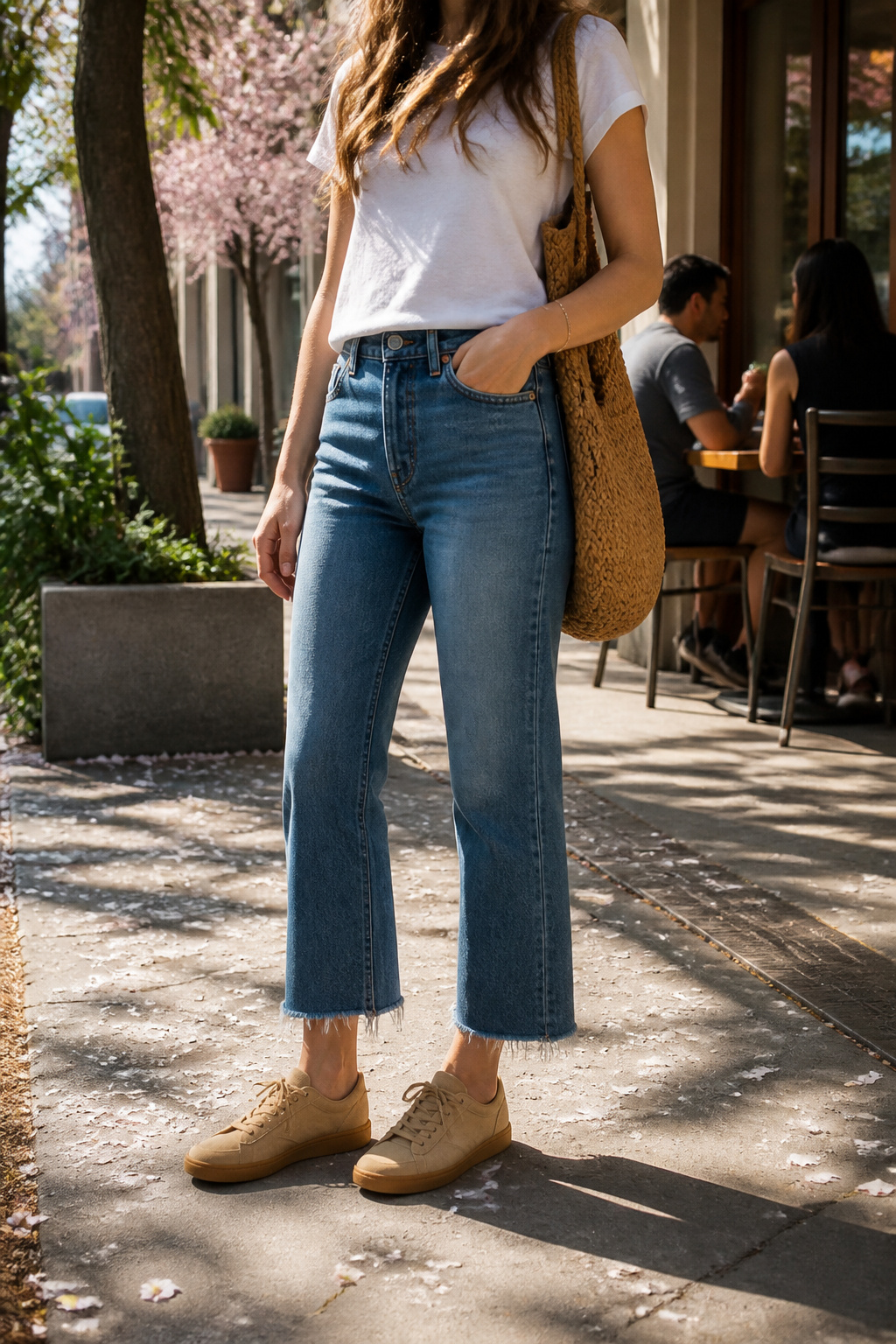
Suede reads lighter than leather, and that shift in texture is what moves a shoe from autumn back toward March. Where smooth leather feels like boots and brisk air, suede carries the soft, dusty look of dry ground and longer evenings. Tan is the starting point, the color that warms up blue denim without announcing itself. Gray keeps things quieter, soft green nods to the season without going botanical, and blush works if the rest of the outfit stays restrained.
The advantage is in how little they ask of you. Jeans and a tee stay jeans and a tee, but the suede underneath makes the whole thing look considered, not calculated. No extra layers, no jewelry required.
The catch is water. Suede darkens when wet and rarely recovers evenly. A light spray protector helps, though it is not a seal. Mud is worse than rain, salt worse than mud. Clean them dry, with a soft brush, and accept that scuffing is part of the material’s life. If you need shoes for puddles, wear something else that day.
29. Cobalt Blue Outfits
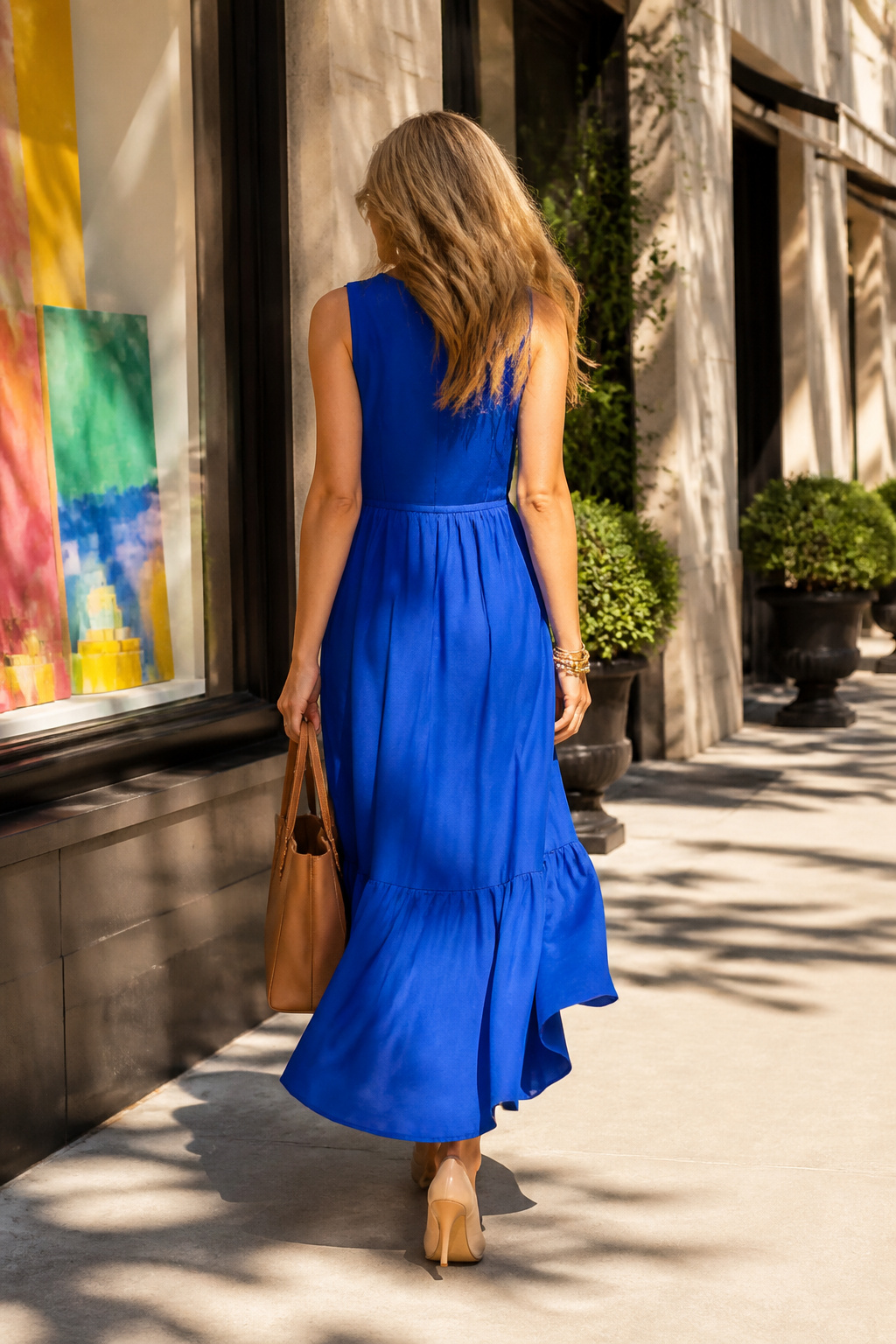
Cobalt blue lands differently than navy or sky because it carries enough saturation to read as deliberate, not accidental. You wear it when you want to be seen.
As one piece, a cobalt dress or trousers do the heavy lifting while everything else steps back. The neutrals that work are the ones that know their place: warm white, camel, or a mid-gray let the color dominate without turning the outfit into a competition. Black fights it. You will notice the tension in a mirror and so will everyone else.
As an accent, a cobalt shoe or bag gives you an exit if the full piece feels like too much. That is the practical side. The truth is cobalt asks something of you. It does not hide behind trend or irony. You have to own the choice or it owns you, and that is why it works for spring when the light is brighter and the wardrobe shifts from hiding to showing.
30. Textured Tops
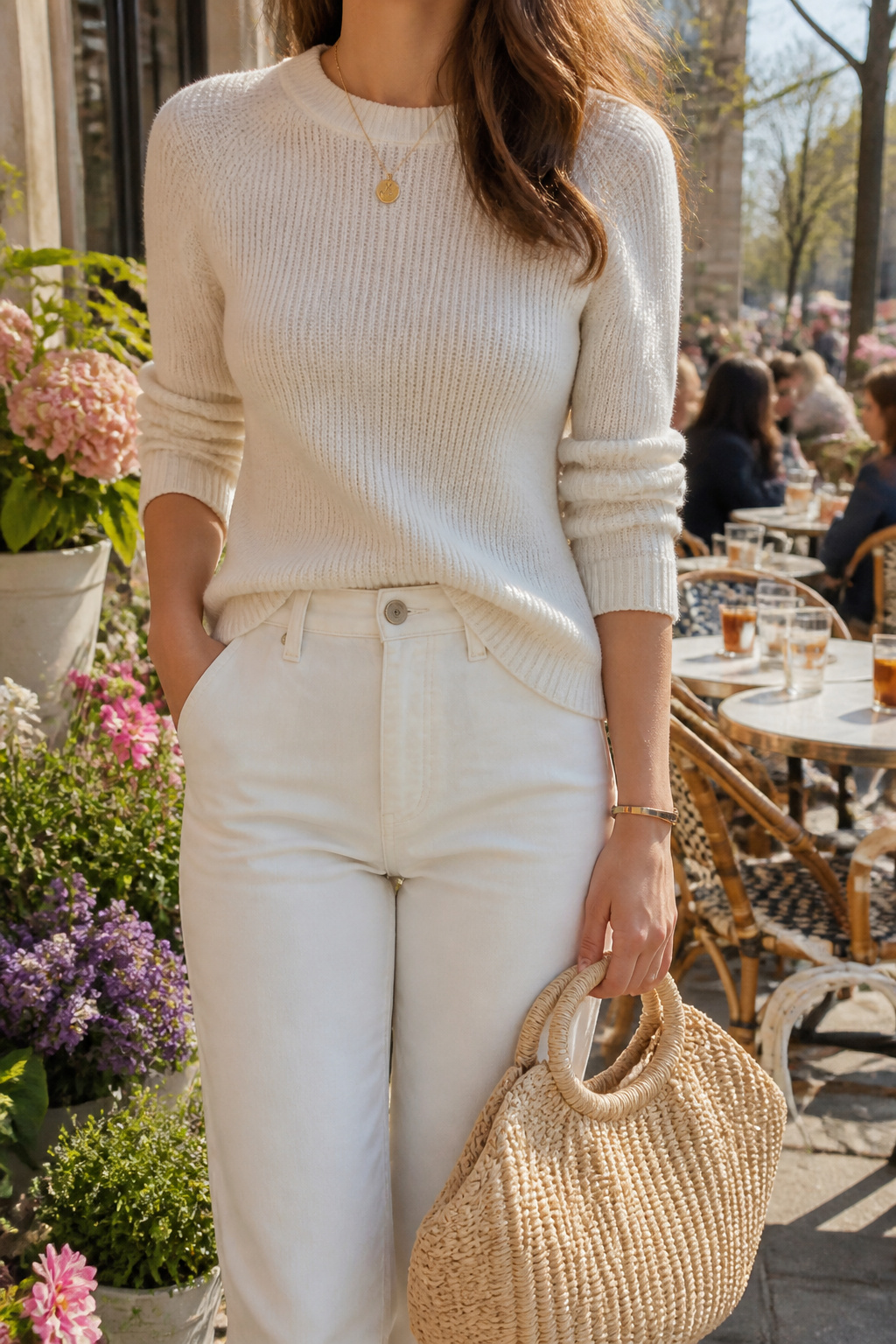
Spring is where texture does the work that prints did in other seasons. Ribbed cotton, pointelle, seersucker, and bouclé all read as warm weather because they catch light differently than flat weaves, and they do it without shouting. The trick is letting one texture lead and keeping everything else quiet. A pointelle knit under a cotton blazer reads intentional; the same knit against a tweed jacket fights for attention. Seersucker works best when you do not also reach for linen trousers, since both textures compete for the same visual space. Bouclé in a soft spring weight pairs cleanly with smooth denim or a plain gabardine skirt. This is a quiet-trend category, meaning it will not date quickly but also will not carry an outfit on its own. Treat texture as the interest and let cut and color do the rest.
31. Casual Friday Outfits

Casual Friday in spring means trading the weight of winter without drifting into weekend territory. You still need structure, just less of it. The suede jacket that worked under a wool coat in February now stands alone, and the shift is where most people misread the room. A pair of wide-leg Levi’s with a bright cardigan and glove flats hits the mark because the jacket gives polish while the color underneath signals the season. Leave the boots in the closet. Loafers or espadrilles keep the line lighter without surrendering to sneakers, which read as chores-not-collarbone.
The guardrail is simple: if you would wear it to garden or to a picnic, it is too far. A blue button-up with jeans and black loafers still belongs here, because the shirt has a collar and the denim is clean and fitted. What changes from January to April is the fabric weight and the color story. A tucked-in blouse or cropped cardigan over high-waisted jeans does the same job in cotton rather than cashmere, and a woven bag or small shoulder bag finishes the look without the bulk of winter leather.
Dress codes that say "smart casual" on Fridays want exactly this midpoint: relaxed enough that you are not in a suit, shaped enough that you still look like someone who could chair the 3 o’clock.
32. Sporty Jackets
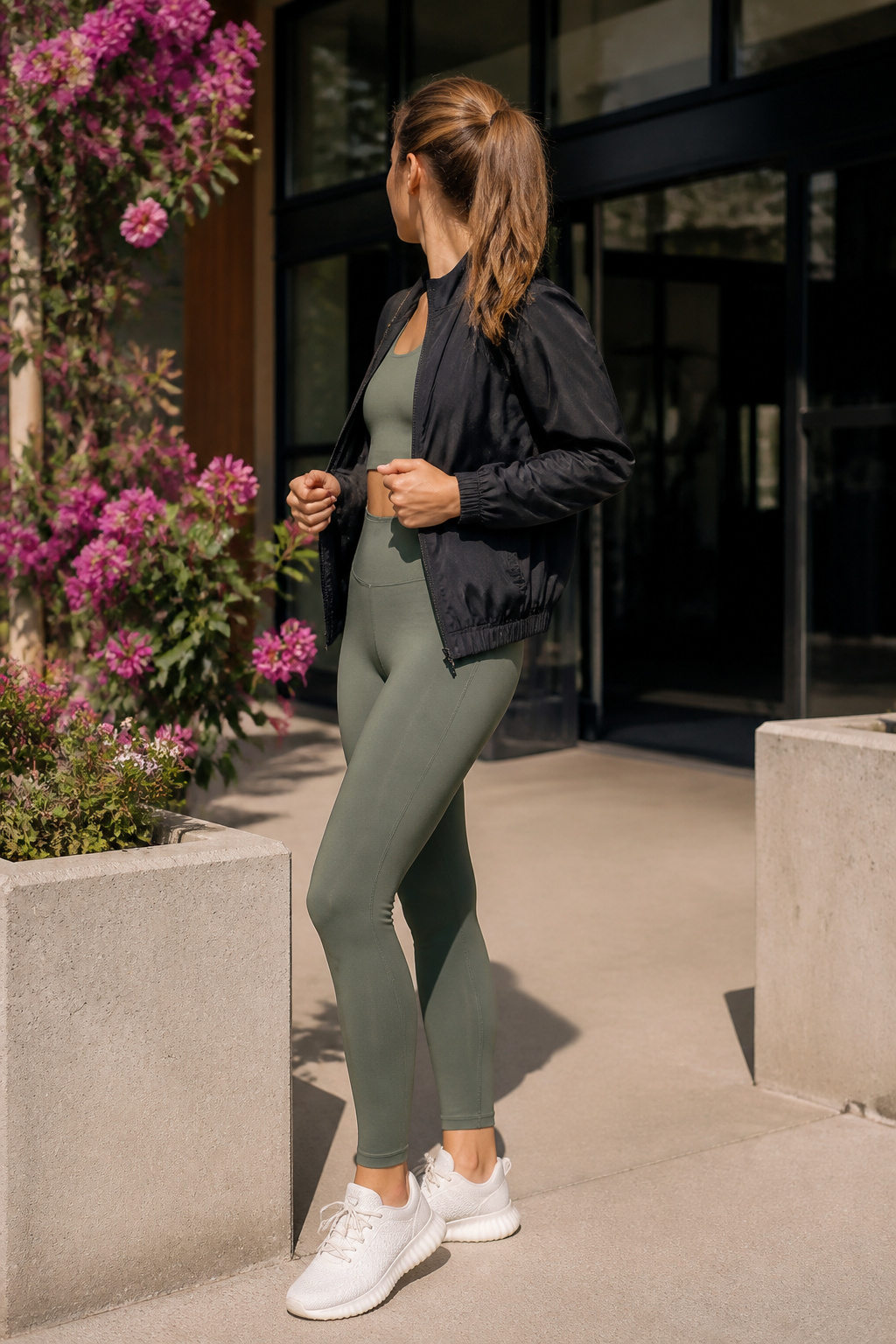
Track-inspired shells, windbreakers, and bombers all read as sporty jackets, but the zip front is what separates them from their snap-button cousins. A full zip lets you break the line cleanly at the neck; snaps tend to hold the shape open and can look like you forgot to change after a run. The same jacket that works with a lace-trimmed slip skirt and a striped polo sweater from Ssstein reads as intentional, not athletic, because nothing else in the outfit nods to the gym. Suede boat shoes and a slouchy shoulder bag finish that move. If you prefer denim, a gray sweater underneath keeps the countryside energy out of the city version. The rule is simple: one sporty piece per look, and it has to be the only one.
33. Floral Prints
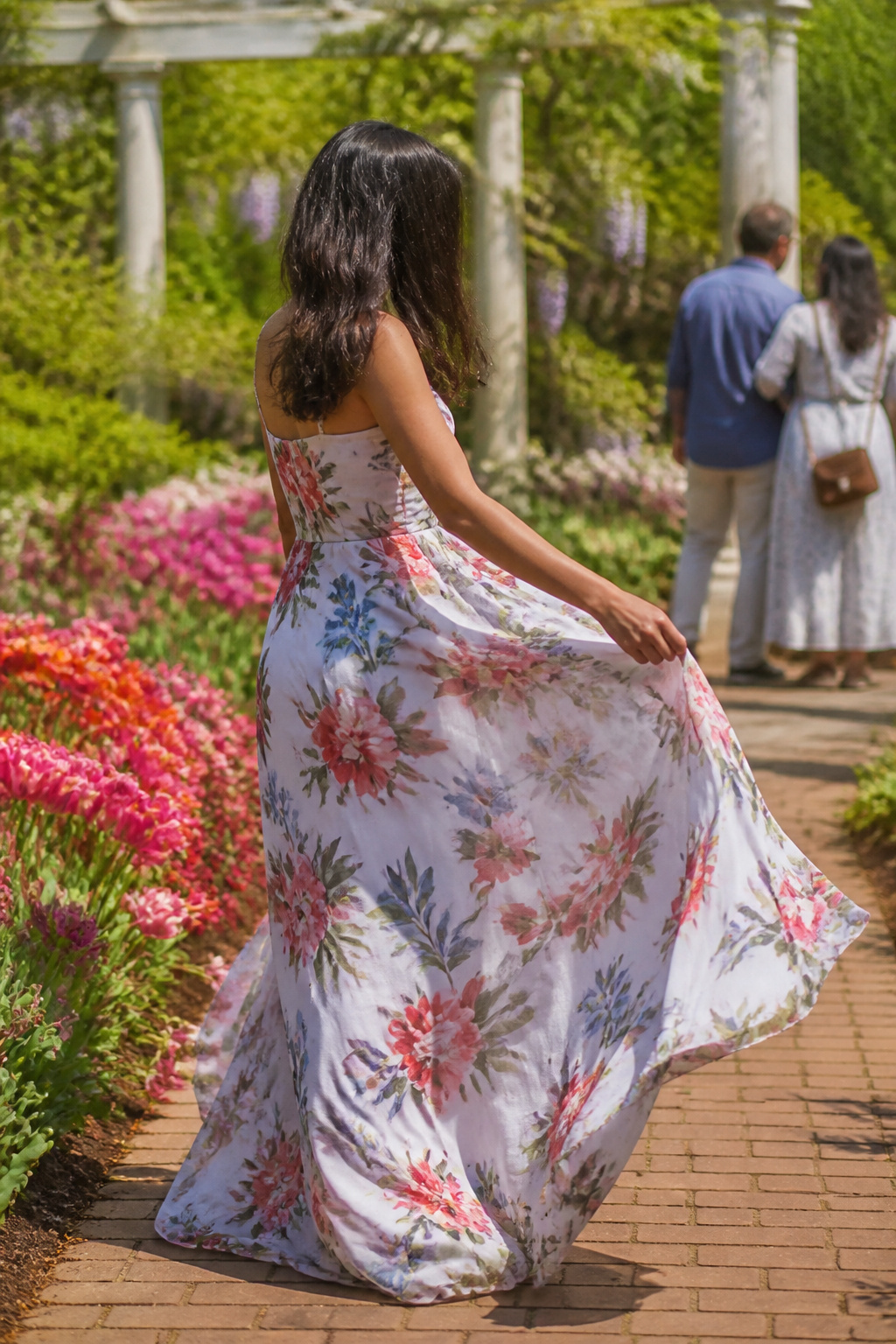
Scale is the first thing that separates a floral print you will wear from one you will not. Large blossoms need a larger frame to look intentional; on a petite build, they swallow the figure and read as costume. Small, scattered florals work the other way, getting busy and cramped on someone tall or broad.
Saturation is where spring florals go dated fast. Acid-bright blooms on a black ground look like resort-wear from a decade ago. Better to stay in the middle: dusty rose, soft sage, butter yellow, a navy that is almost ink. These read as fresh without shouting.
Dress, skirt, or top: those are your reliable shapes. A floral dress carries the print as a single statement. A skirt lets you ground it with a solid. A blouse under a jacket keeps the pattern where the eye expects interest. Pants in a floral print break the line of the leg and draw the eye to the seat and thigh in a way almost no one wants. If you spot a pair you love, buy them and see how rarely you reach for them.
The curtain fear is real and simple to avoid. A dense, all-over repeat in a slick synthetic reads upholstery. A print with hand-painted variation, irregular spacing, or a ground color that is cream rather than pure white looks like fabric meant to move, not to hang at a window.
34. Striped Tops
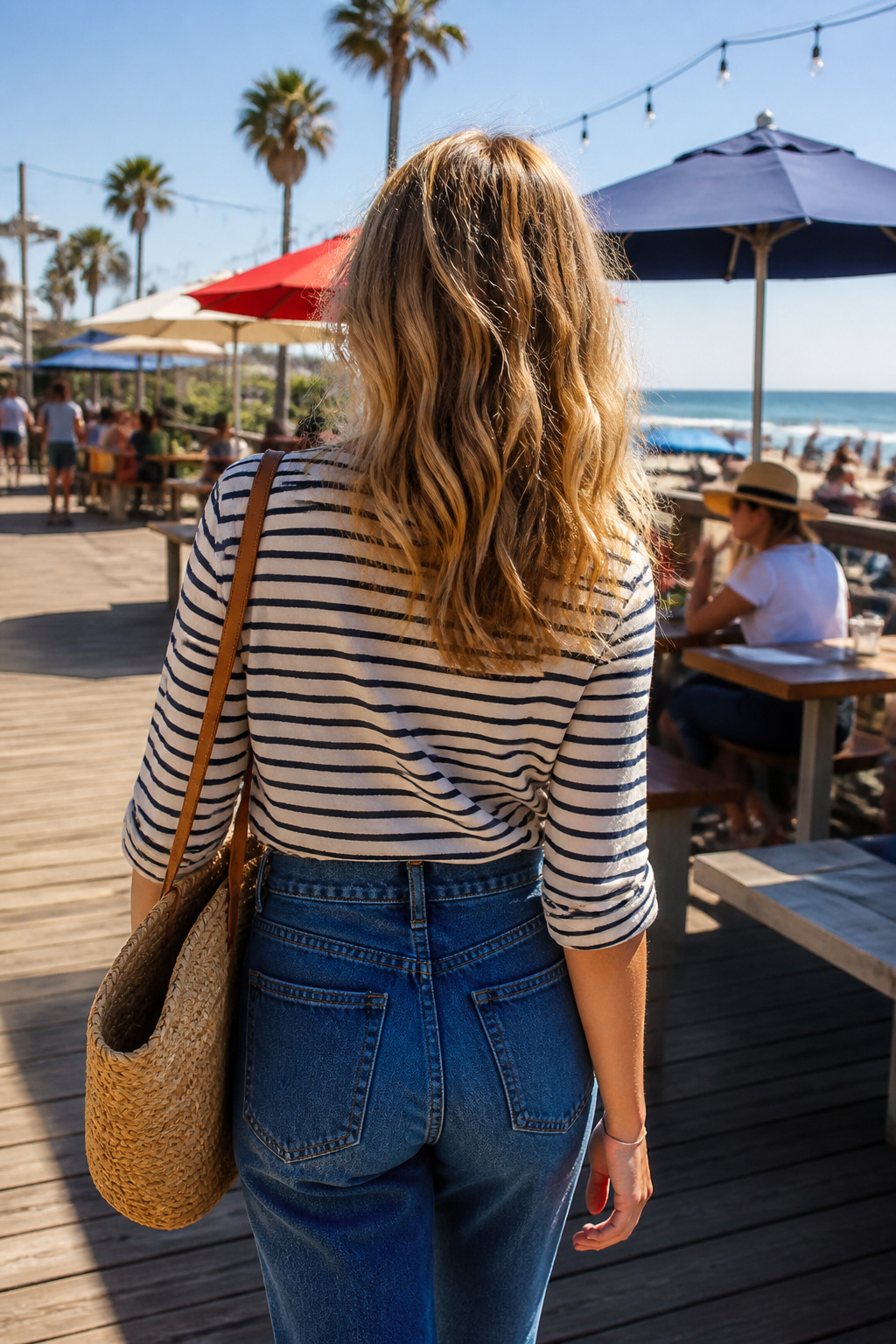
Stripes read as a neutral because the eye treats them as texture rather than pattern, which means you can layer them under a blazer or over a printed skirt without the clash you’d get from florals or checks. The classic navy-and-white pairing still works, but softer combinations, olive and cream or rust and stone, feel less expected and more current for spring.
Horizontal stripes across the chest add visual width, so if you are broader-shouldered, look for a finer gauge or a top where the stripes stop at the side seam. Vertical stripes draw the eye up and down, which lengthens the torso; a Breton-style top with a boat neck and narrow horizontal bands is flattering on narrower frames, though you risk costume if you pair it with a beret or too-precise red lip. The safer move is to treat it like any other tee: tucked into high-waisted jeans, sleeves pushed up, nothing sailor about it. A stripe width between a quarter-inch and a half-inch reads as the most versatile, neither too bold nor so fine it blurs into solid color from a few feet away.
Layering for Unpredictable Weather
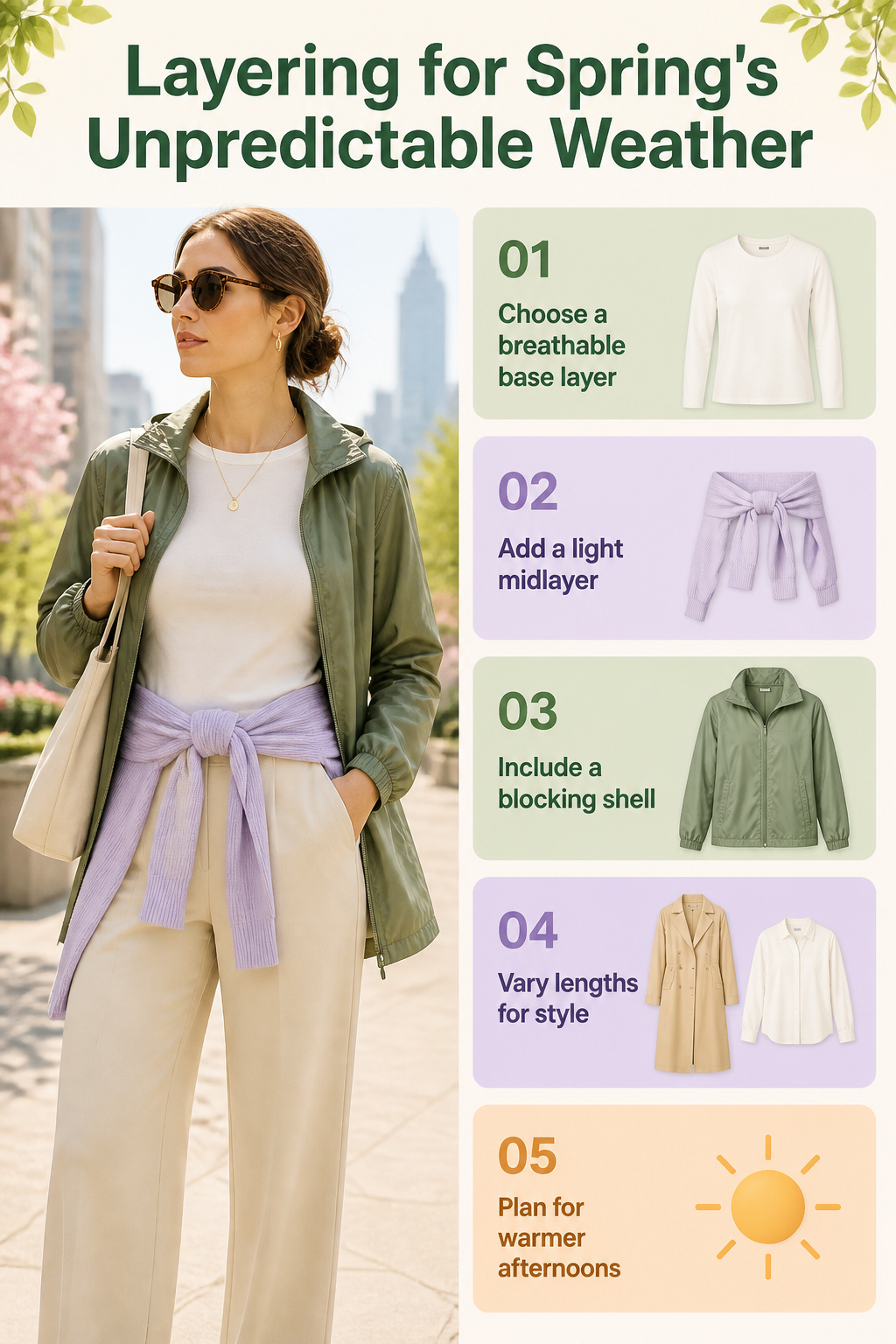
Layering for unpredictable weather starts with the three-layer system: a breathable base, a light midlayer you can knot around your waist or shoulders, and a shell that blocks wind or a light drizzle. The skill is in the fabrics, not the volume. Merino, fine-gauge cotton, and paper-thin nylon pack to the size of a sandwich and spring back without creasing; a bulky knit defeats the point because you will carry it or leave it behind.
The real move is varying lengths so shedding reads as style, not retreat. A cropped shell over a hip-length shirt lets you lose the top piece and keep a proportion that still looks deliberate. Same with a knee-length duster over trousers; drop it and the outfit underneath stands alone. The base layer has to look finished on its own; if you would not wear it into a coffee shop without the jacket, it is not a layer, it is a lining.
Temperatures in spring can swing twenty degrees by mid-afternoon. Plan for the high, not the low. Start slightly cold and trust that walking will warm you, or that you will peel down to the shirt by noon. The mistake is dressing for the morning chill and spending the afternoon sweating through a sweater you cannot remove without exposing a stained or mismatched base.
Spring Color Choices
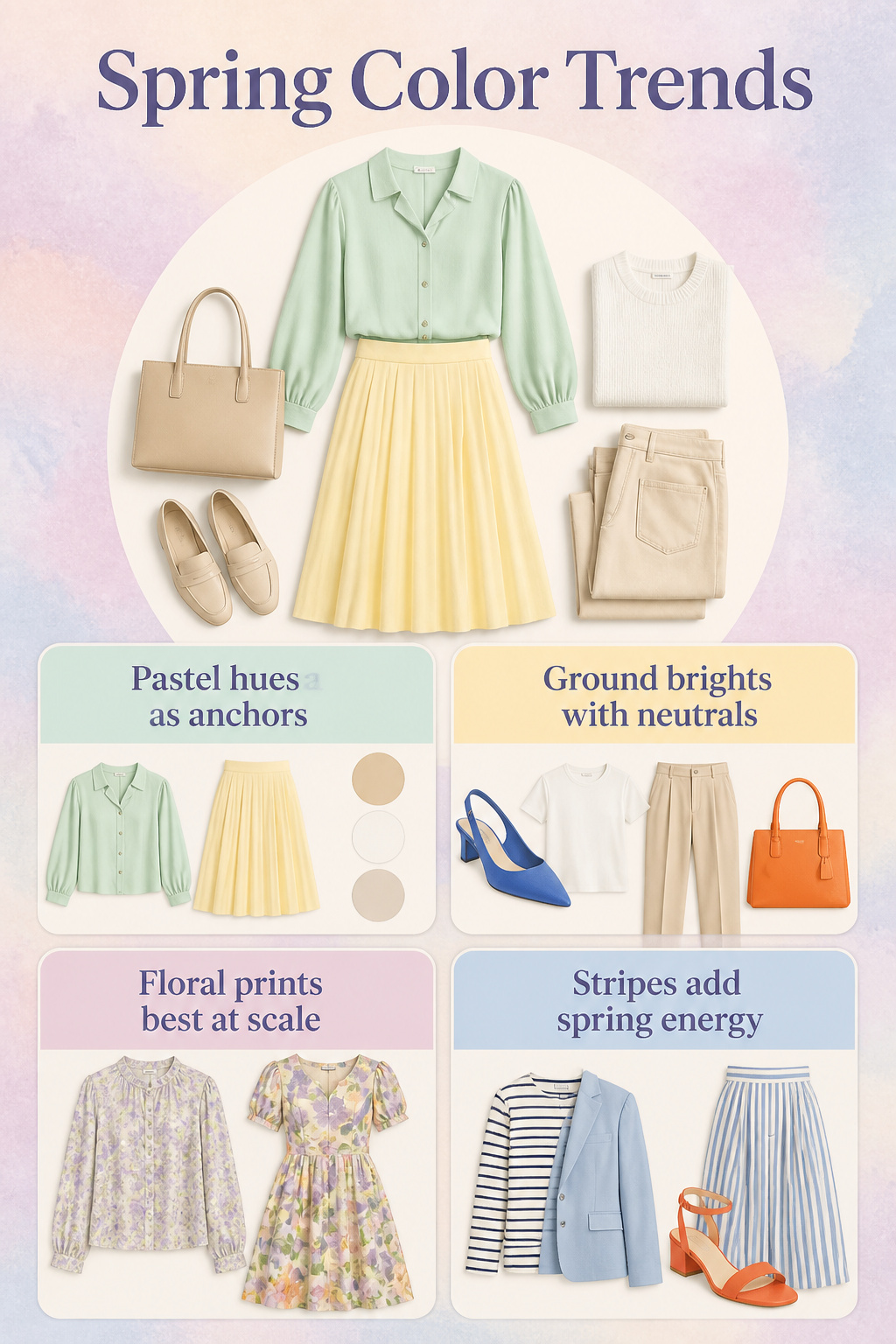
Pastel hues, fresh whites, and soft blues dominate spring outfits this season, but the real skill is wearing them without looking like an Easter egg. Start with one pastel piece as your anchor, maybe a mint blouse or a butter-yellow skirt, and keep everything else in a clean neutral like beige or white. That restraint is what separates a spring look from a costume.
If you are warm-toned, lean into peach, coral, and soft yellow; cool skin carries lavender, powder blue, and pale rose with less effort. When you want brights instead of pastels, treat them the same way: one loud piece, grounded by neutrals. A cobalt shoe or a tangerine bag against a white tee and tan trousers reads confident, not loud.
Floral prints work best at scale: a smaller repeat for a blouse you will wear to the office, a bolder bloom for a weekend dress. The print itself is doing the work, so you do not need to compete with extra color elsewhere. Stripes share that same spring energy, and they pair cleanly with either palette. A striped top under a pastel blazer, or bright sandals with a striped skirt, gives you the season without the overload.
Casual and Formal Balance
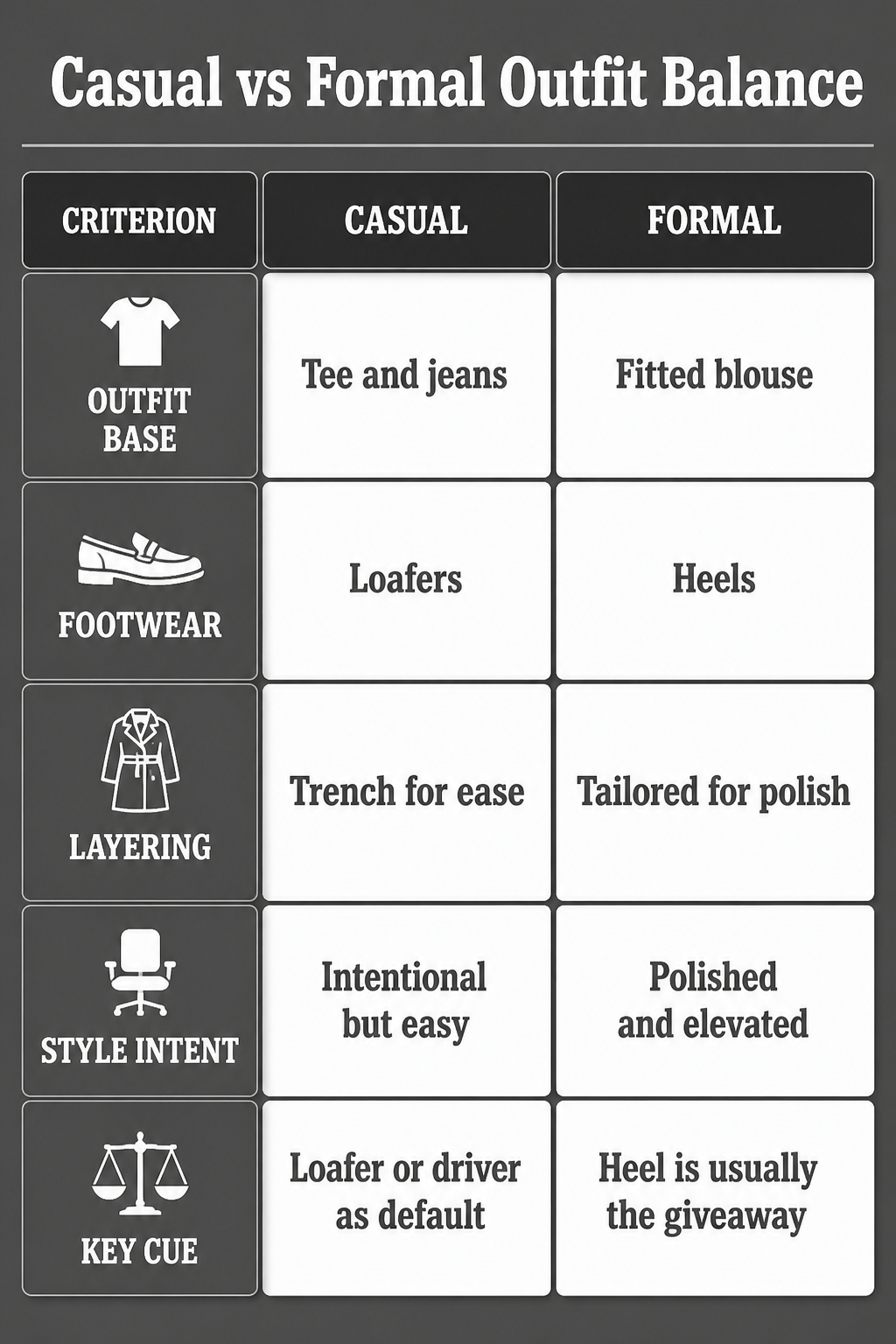
The same black blazer that carries you through a Saturday of errands will carry you into a dinner if you know what to swap. Start with it over a white tee and jeans, the pairing the Everygirl formula relies on: structured on top, relaxed below, loafers on your feet. That is your baseline casual. To push it toward polished, trade the tee for a fitted blouse and the loafers for a heel. The blazer does not change; the register does.
A trench operates the same way. Over a tee with tailored pants and leather drivers, it reads as intentional but easy. The shift is in what sits under it and what sits at your ankle. Linen or pastel blazers work the same trick for spring specifically, losing the weight of winter wool without losing the shape that signals you made an effort.
The mistake is treating the invitation as the only cue. Read the room instead. A pleated midi skirt and fitted blouse with sleek loafers lands as formal in most offices and overdressed at a backyard gathering. The heel is usually the giveaway: if you would not walk grass in it, the rest of the outfit needs grounding. Wide-leg pants in soft hues with a crisp shirt sit in the middle naturally; add the floral or the pattern and you have tipped toward seasonal without tipping into costume.
When you are unsure, default to the loafer or the driver. You can always look more relaxed than you are; looking more polished than the room is the harder correction.
Essential Spring Wardrobe Pieces
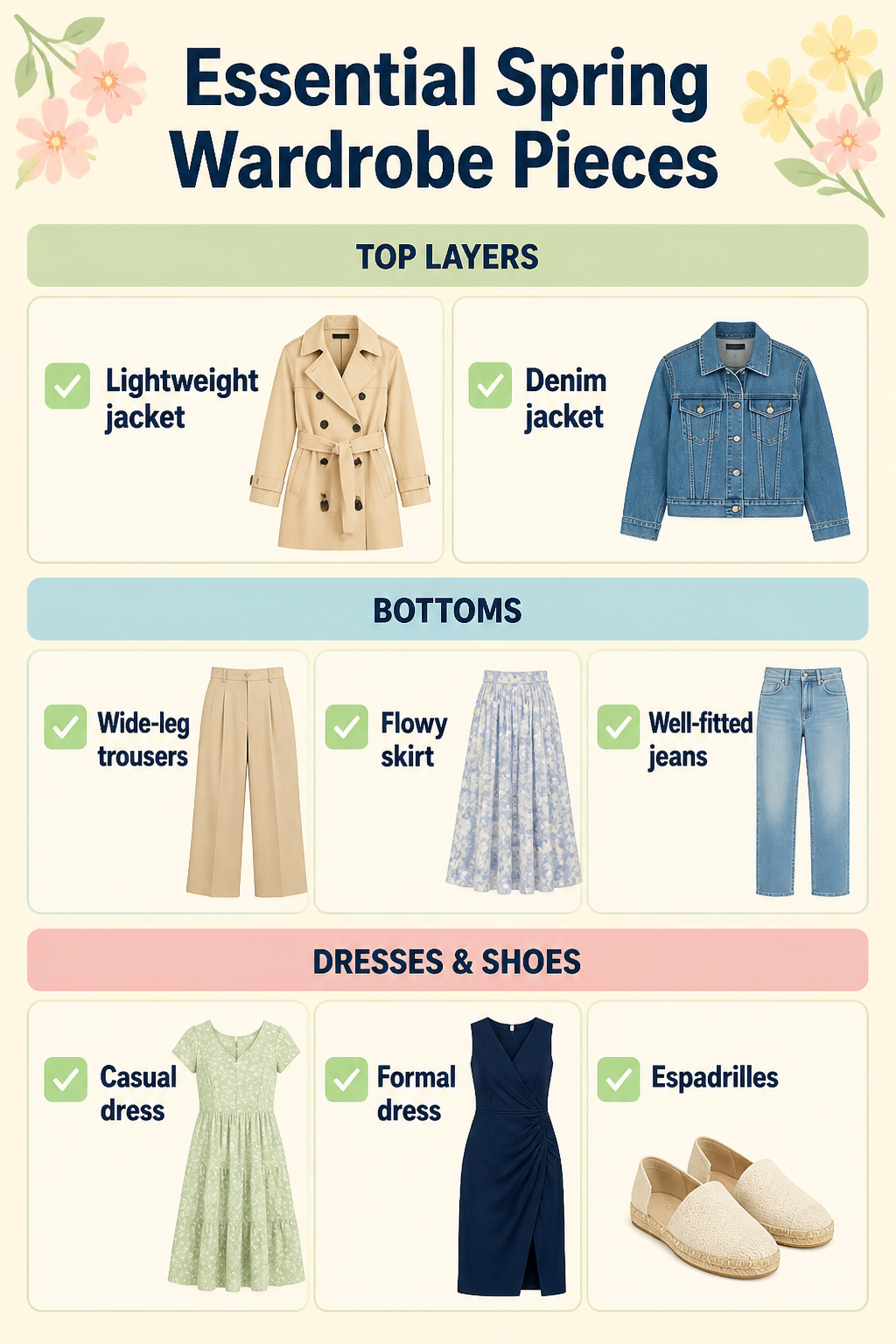
One lightweight jacket carries more spring outfits than any other layer. A trench over a tee and tailored pants reads polished for work; the same jacket thrown over a dress handles evening plans without a change. That is the standard to hold every piece against.
You need two jackets at most: the trench, plus either a denim jacket or a lightweight cardigan for days when structure feels like too much. Three bottoms earn their keep: wide-leg trousers, one flowy skirt, and well-fitted jeans. The trousers and skirt each pair with the same two or three tops you already own, so the math works in your favor.
Dresses do the heaviest lifting when they cross from day to night. Keep three: one casual, one formal, one that splits the difference. Anything that only works for a single occasion costs more hanger space than it returns. The same rule applies to shoes. Espadrilles, sneakers, and block-heel sandals cover every combination above; a fourth pair is where closets start to crowd.
The mistake is buying the exciting piece first and hoping the basics follow. Reverse it. Build from the trench, the trousers, the skirt that moves with you, and the dress you could wear to three different events in one weekend.
Frequently Asked Questions
What kind of clothes do we wear in spring?
Spring calls for lightweight fabrics, breathable layers, and pieces that handle temperature swings from cold mornings to warm afternoons. Think cotton voile, silk crepe, and soft rayon blends for bottoms; fine-gauge knits and mid-weight cashmere for tops; and lightweight outerwear like trenches or unlined wool coats rather than heavy winter gear.
What to wear when it’s spring but still cold?
Layer with a three-piece system: a lightweight wool coat in the 12–14 ounce range over a mid-gauge cashmere sweater, with a crisp tee underneath. The cashmere traps heat close to your body while fitting under the coat, and you can shed the sweater by noon and still look intentional in just the tee.
What is spring attire?
Spring attire means outfits built for transitional weather and longer days, combining structure with breathability. The article covers 34 specific formulas, from a bold jacket with jeans and ballet flats to a trench over tailored pants and a tee, all designed to move between 40-degree mornings and 65-degree afternoons without looking like you’re dressed for the wrong season.
What are the dress code colors for spring?
Soft pastels, fresh whites, floral prints, and light neutrals like beige and soft blues dominate spring fashion. The article emphasizes keeping color stacks deliberate: dark to light or light to dark, never mixed mid-tones like taupe on oatmeal that flatten into a muddy plane.
What is spring formal attire?
Spring formal attire includes elegant dresses, chic jumpsuits, and lightweight suits in soft hues or floral patterns, perfect for special occasions. For office-appropriate authority without heaviness, the article suggests an hourglass blazer with a straight or narrow A-line skirt and T-strap pumps in quiet colors like navy or bone with cognac leather.