
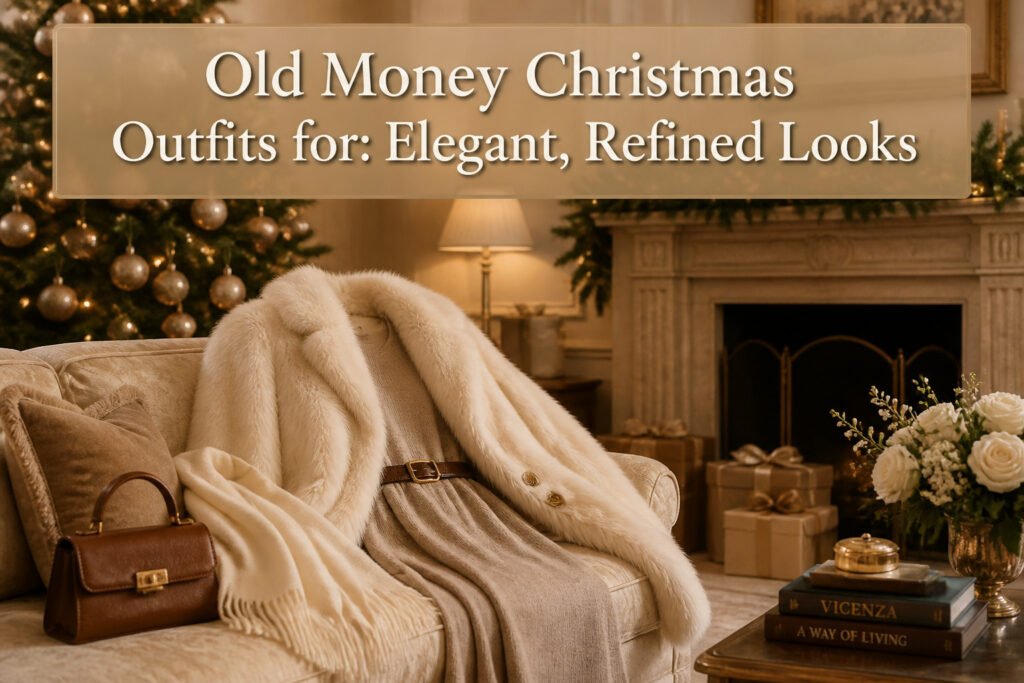
Old money Christmas outfits range from cashmere scarves you wear at home to full-length wool coats you wear to a formal dinner, and the single factor that decides which one belongs in your closet is how much structure you need for the occasion. The risk is always the same: looking costumed rather than inherited. A cream faux fur coat over red tights works because the texture does the holiday work, not a print or sparkle.
1. Luxe Cream Faux Fur Coat Over Festive Red Tights
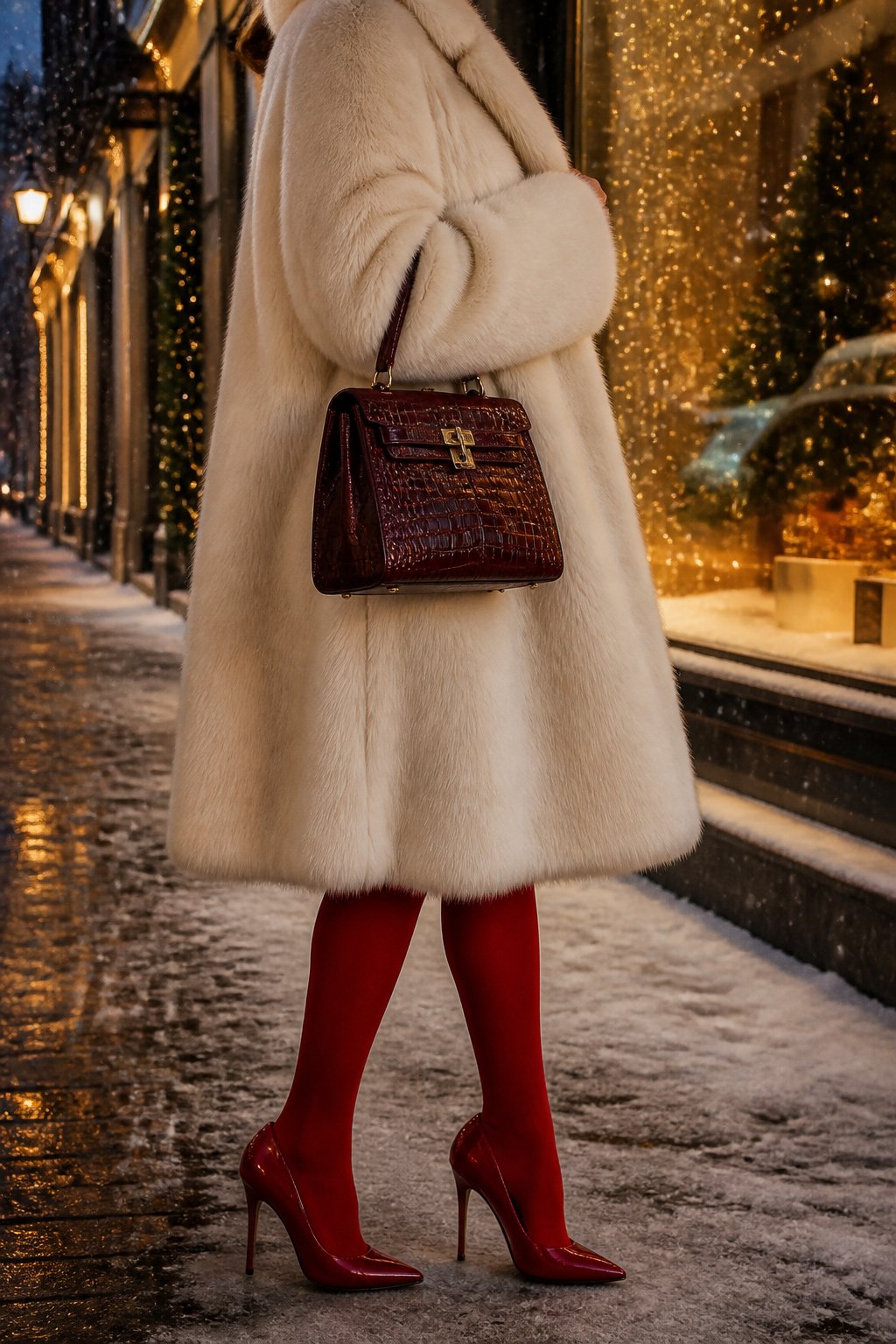
A cream faux fur coat reads as quiet luxury the moment you put it on. The texture does the holiday work, not a print or a sparkle. Pair it with red tights and the look stays refined, not costumed. The red is festive enough for a Christmas dinner or an evening at a friend’s house, but the coat keeps the overall tone elevated.
Sources show this combination with shiny red heels and a textured bag. That works if the gathering leans dressy. For something more restrained, matte leather flats and a structured leather bag in cognac or black keep the same silhouette without the shine. The coat’s plushness is the statement. Let it be.
2. Elegant Red Knit Dress with Luxe White Fur Coat
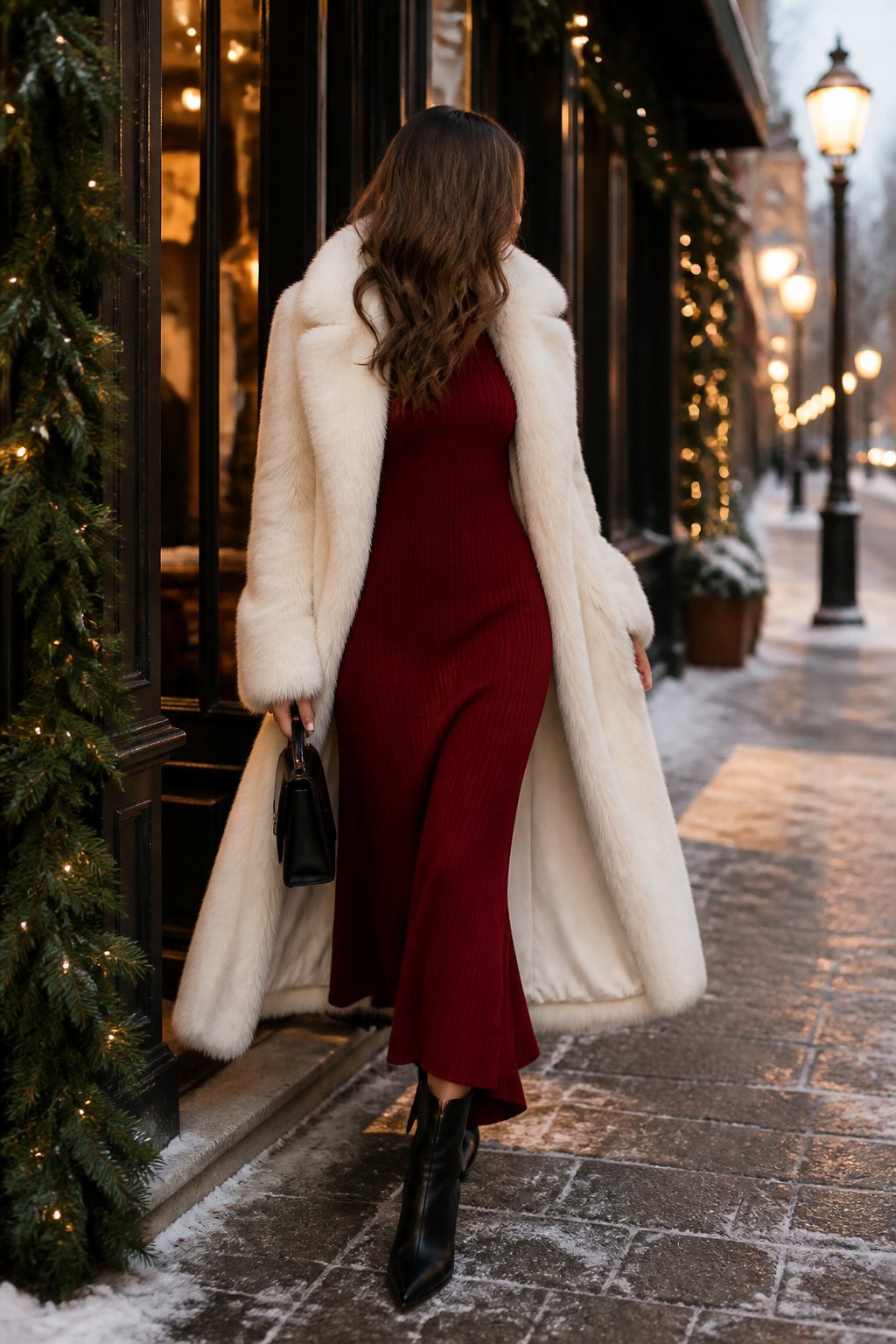
A deep red knit dress under a voluminous white fur coat is the pairing that shows up across nearly every roundup of old money Christmas outfits, and the reason is simple: the red does the festive work while the white handles the luxury. You do not need both pieces to shout. One source pairs a sweater-and-skirt set in the same red tone with a white fur jacket and keeps the accessories monochrome; another goes with a single knit dress and adds black boots and leather gloves for contrast. The fur should read as neutral, not costume, which means avoiding anything too long or too fluffy. Volume in the coat is fine, but structure underneath keeps you looking like you are heading to a dinner, not a pageant. Black boots ground the look and keep it wearable for an evening walk through the city rather than just a car-to-curb moment. If you already own a cream or ivory coat, this is the one outfit where borrowing or buying a true white piece pays off; the contrast against the red is what makes the combination register as intentional rather than assembled from what was clean.
3. Soft Cream Knit Scarf and Taupe Sweater Combo
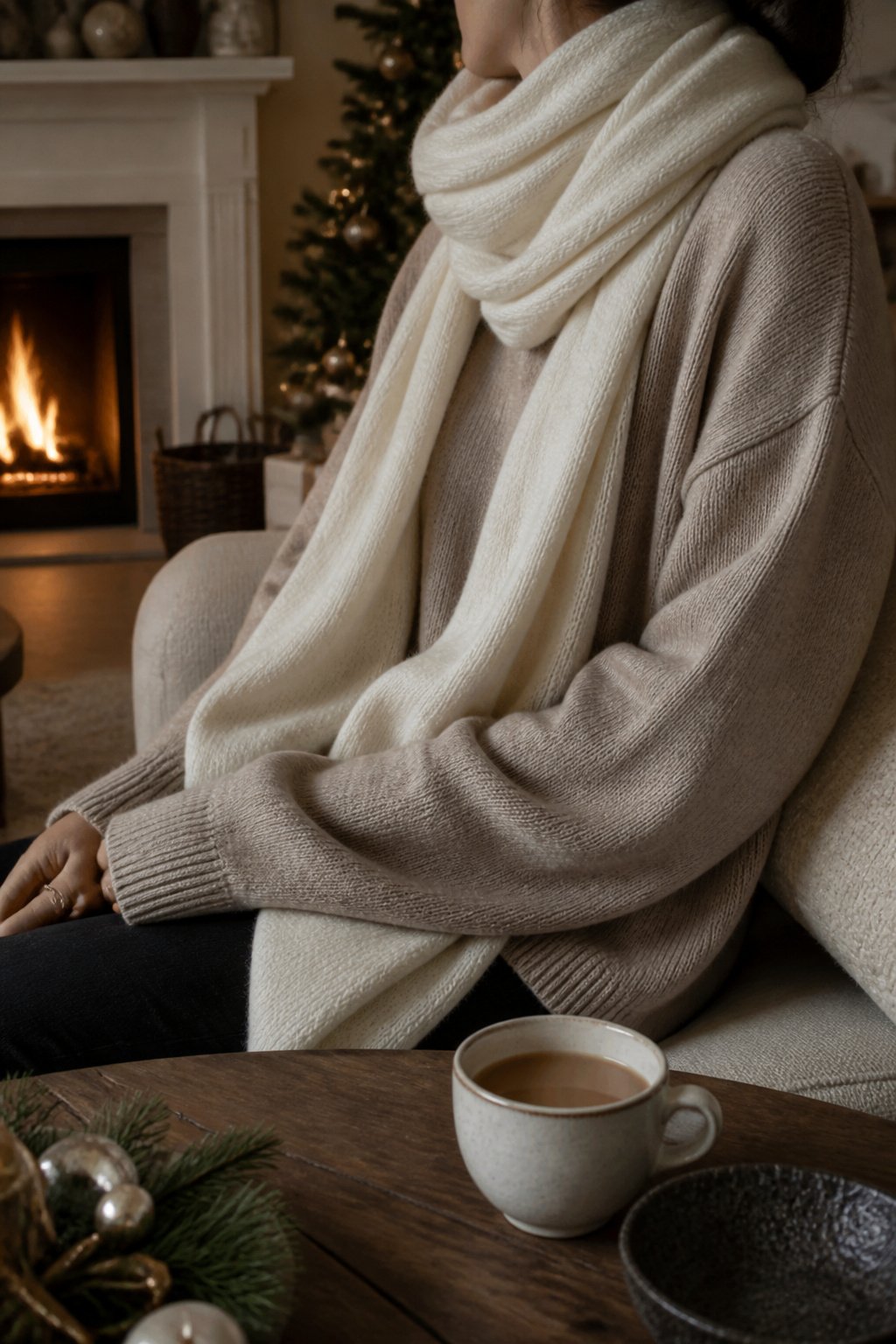
A soft cream knit scarf paired with a taupe sweater is where quiet luxury meets actual comfort. The palette does the work: cream catches winter light, taupe grounds it, and neither color competes for attention. You look pulled together without looking like you tried.
This is the outfit for the afternoon your family opens gifts in the living room, not the evening you stand for cocktails. The scarf should be long enough to loop twice but not so bulky it swallows your neck. A lightweight cashmere or fine merino wool works here; anything thicker and the shape collapses into lumpiness.
Taupe flatters most skin tones that wash out in harsh black or too-bright red. Keep the sweater fitted through the shoulder, relaxed through the body. Tuck the front lightly into trousers or leave it loose over slim silk pants. Either way, the scarf provides the single visible texture.
Skip jewelry. The knit is the detail. Add a watch with a thin leather strap if you want something that catches light when you reach for your coffee.
The risk is looking beige rather than intentional. Fix it with contrast in your lower half: charcoal trousers, chocolate loafers, or dark denim that reads polished, not casual. Without that anchor, the neutrals float away into invisibility.
4. Classic Brown Tweed Coat Dress
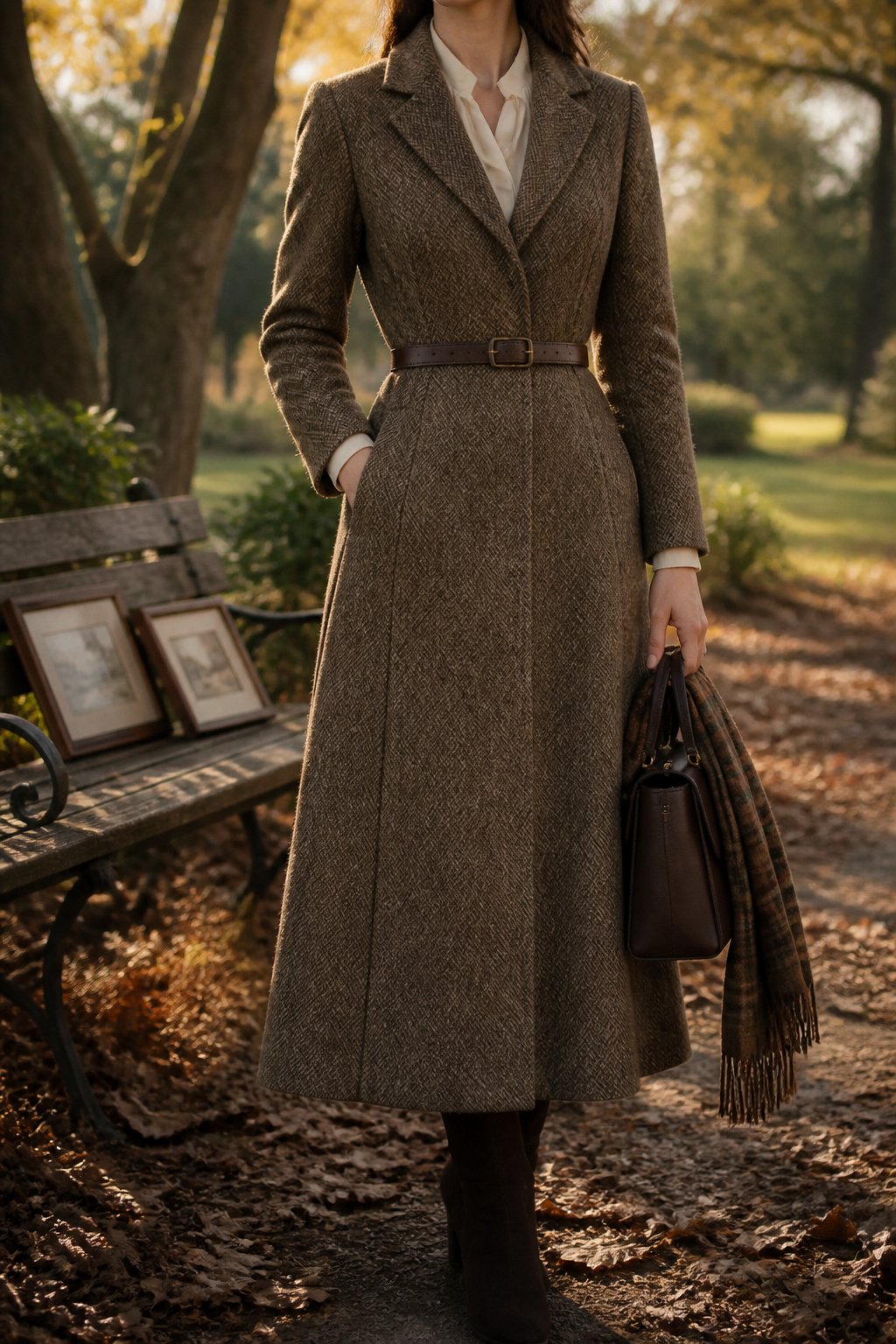
Tweed carries heritage texture like almost nothing else in an old money wardrobe. A brown tweed coat dress distills that history into a single piece you can wear to a morning church service, an afternoon gallery opening, or an evening dinner without looking either overdressed or underprepared.
The coat dress structure solves the problem tweed often presents: too heavy for indoor occasions, too rustic for formal ones. Worn closed with a thin leather belt, it reads as a tailored dress. Left open over a cream silk blouse and fitted trousers, it becomes a jacket that carries you through a full day of mixed events. The brown tones work doubly hard for Christmas, pairing cleanly with burgundy, forest green, or gold accessories without competing for attention.
You want a tweed with some visible weave, nothing too fine or pressed flat. The texture is the point. Skip anything with metallic thread or oversized buttons; those details push toward costume rather than refinement. Keep jewelry minimal, a single strand of pearls or a plain gold bangle, and let the fabric do the speaking.
5. Textured White Mini Dress with Black Tights
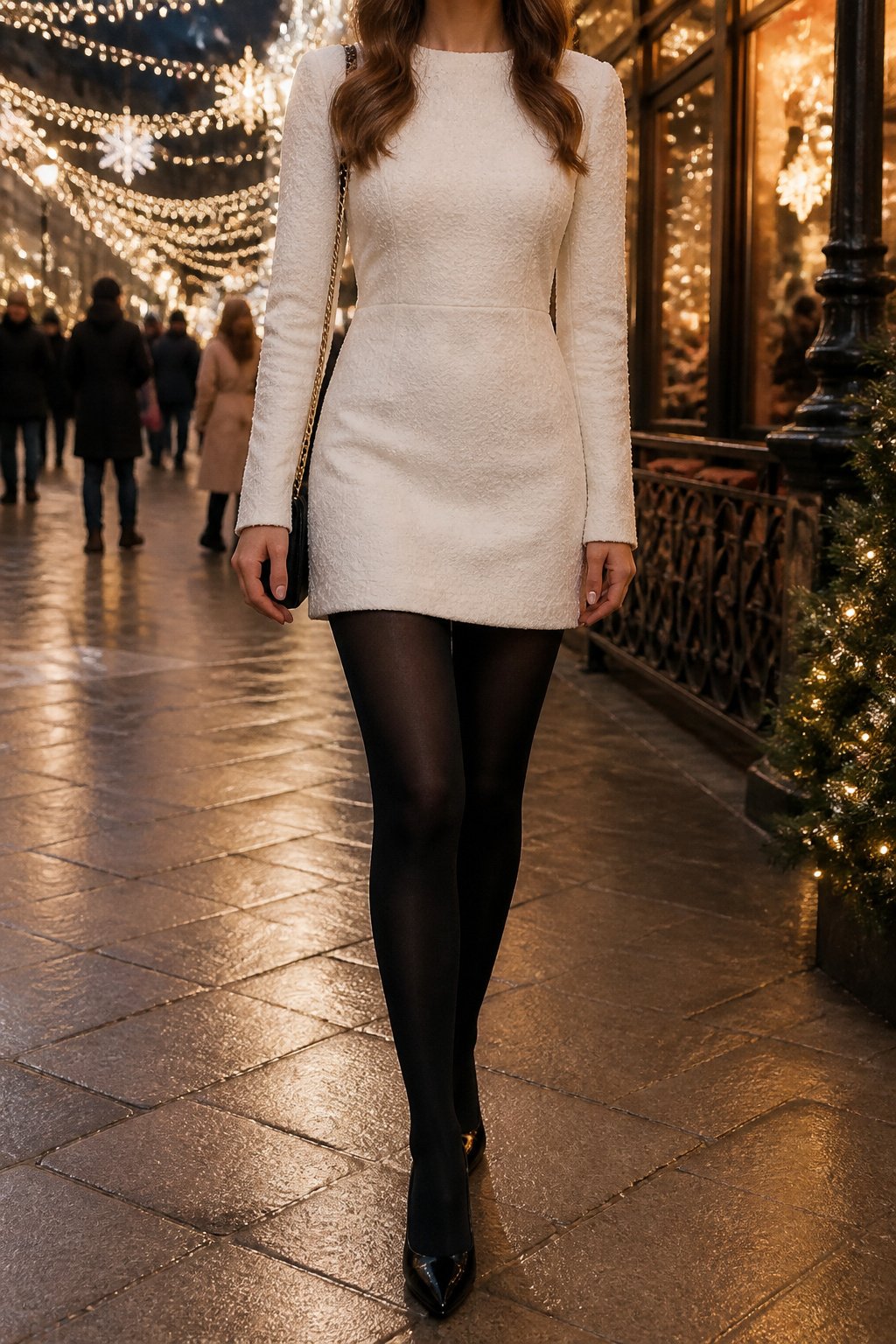
A textured white mini dress reads winter-white rather than summer party when you ground it with opaque black tights. The contrast works because the interest lives in the fabric itself: a bouclé, a heavy crepe, a matelassé that catches light without shouting for attention. That texture does the visual work so you do not need pattern, sparkle, or a competing color to make the outfit feel dressed.
Keep the tights fully opaque, 80 denier or heavier. Anything sheer shifts the mood toward evening flirtation, which is not the old money register for a Christmas gathering. The density of the black against the dimensional white creates a deliberate, almost architectural line at the hem.
For shoes, a black patent pump or a refined flat both work; the tights bridge the gap between leg and shoe so the eye reads one continuous dark column. Add a single piece of gold or pearl at the ear, and you have the coverage winter demands without abandoning the restraint this aesthetic requires. The mistake is choosing a white fabric too lightweight or too shiny, which cheapens against the weight of the black below.
6. Navy Wool Maxi Coat with Structured Shoulders
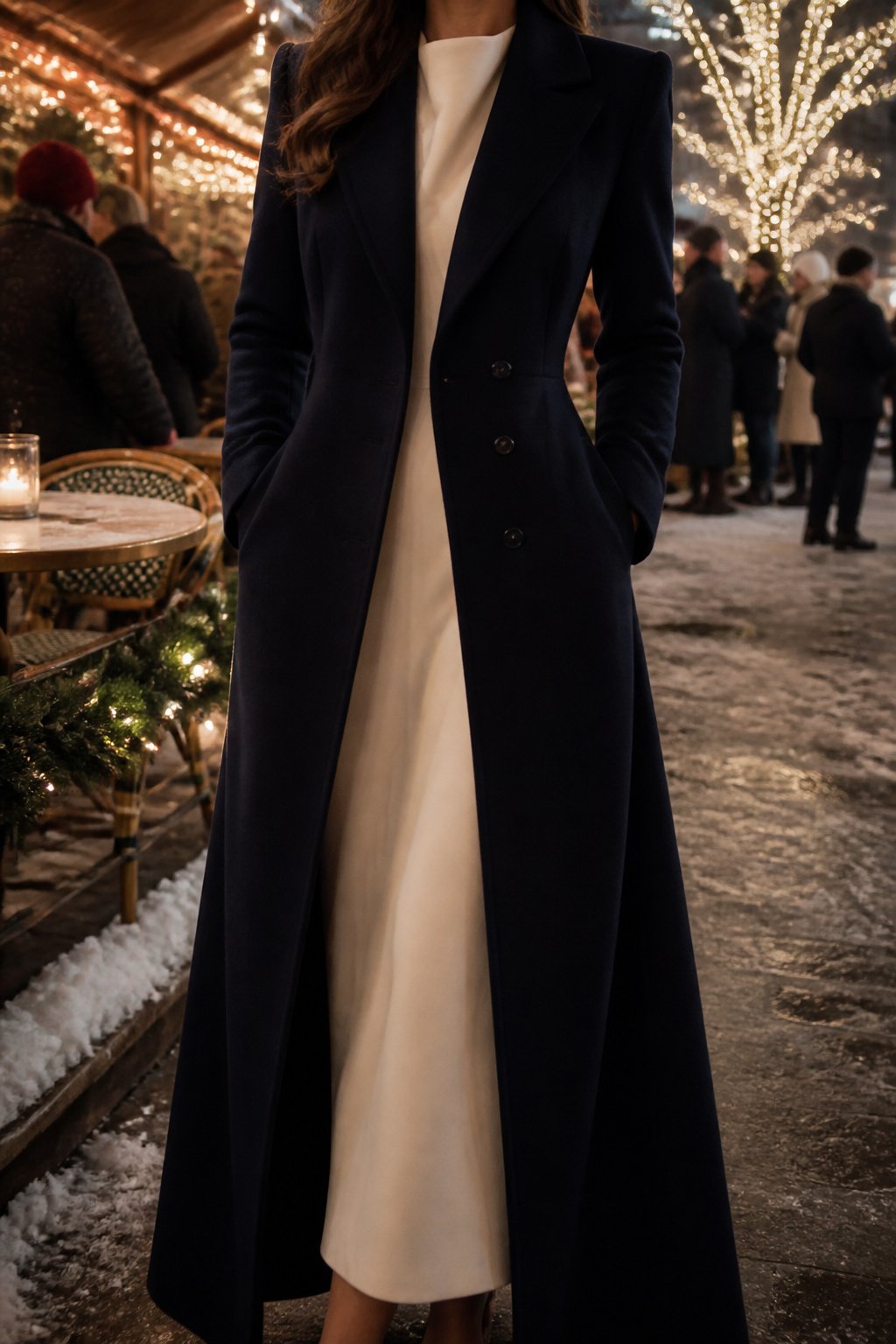
Navy wool earns its place in old money dressing because it carries color without announcing it. The structured shoulders on a maxi coat give you architecture that jewelry never could: a clean line from neck to hem that reads as intention, not effort. You notice the difference when you stand beside someone in a puffer coat at an outdoor carol service or a tree lighting. The maxi length does real work there. It keeps the cold from creeping at the hem and raises the formality enough that you do not look like you dressed for the commute and stayed for the party. A coat that hits mid-calf or lower lets you wear lighter pieces underneath without layering bulk at the waist, which is where most winter outfits fall apart. The shoulders need real construction to hold the weight of the wool. Soft shoulders in a maxi length sag and make you look borrowed from someone taller. Look for a sleeve head that sits flat and a seam that angles slightly upward toward the neck. That angle is what photographs well and what you see in the old press shots of women at Ascot in March. For holiday events, wear it over a simple dress or trousers in cream or soft grey. The coat is the outfit. Let it be.
7. Creamy Knit Sweater and Beige Pleated Skirt
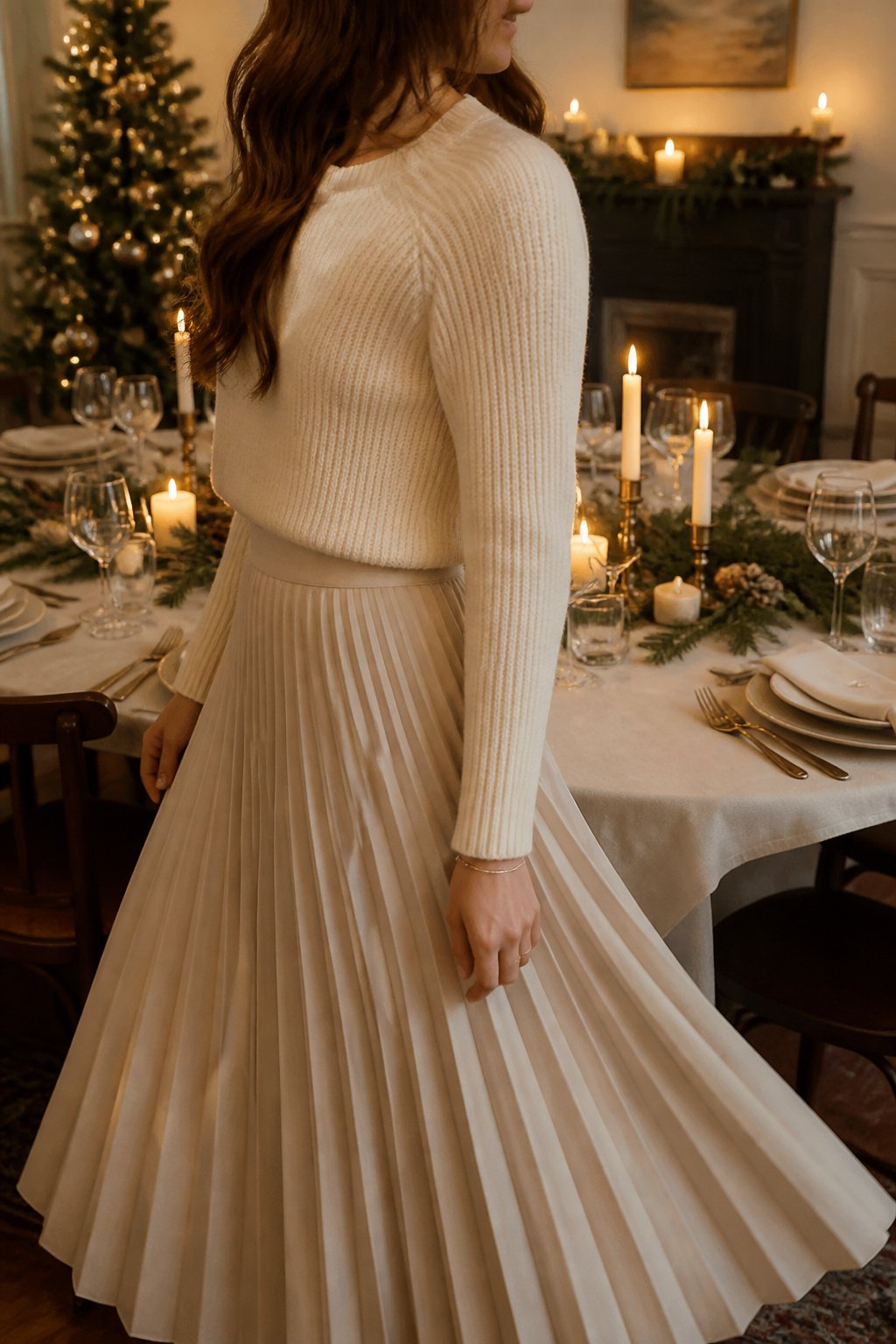
You want an outfit that reads old money without reading cold. The creamy knit sweater and beige pleated skirt pair gets there by staying in one neighborhood of tone, what you might call monochrome-adjacent: cream, beige, oat, all speaking the same quiet language without matching exactly. The pleated skirt does the formal work. Those pressed folds catch light differently as you move, so the fabric looks alive, and the silhouette nods to the kind of mid-century dressing that still codes as inherited taste rather than purchased trend. A knit on top keeps it from feeling like a uniform. The texture is soft, the fit forgiving, the overall effect approachable enough for a family lunch but polished enough if you end up at the club later. The risk is washing out entirely: you need some break between the two pieces, whether that is a shade step from warm cream to cooler beige, or a thin belt in caramel leather, or a strand of pearls that catches against the sweater’s weave. Without that anchor, the look goes bland rather than understated. A tucked front keeps the waist defined; untucked, you lose the shape that makes the skirt intentional.
8. Classic White Tweed Jacket Dress with Black Trim
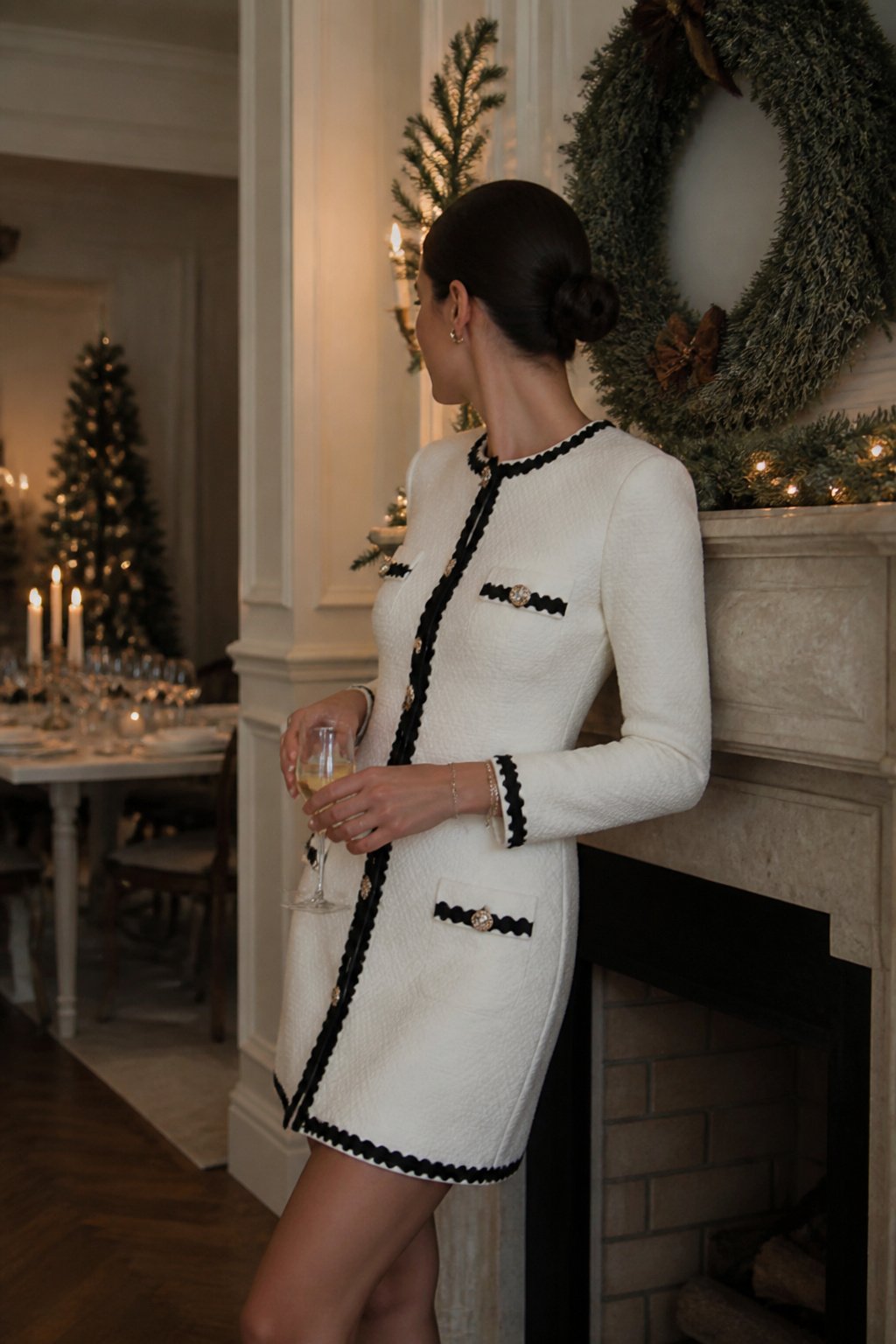
A white tweed jacket dress with black trim reads as tailoring rather than decoration because the contrast traces actual seams: the collar edge, the pocket welts, the center front where the jacket closes. The black line follows construction, not pattern, which is exactly what separates old money style from anything that looks dressed up for effect.
You see this in the way the trim stops at functional points rather than wandering as braid or piping might. It defines the shape of the garment the way a draftsman’s line defines a building. The eye registers structure, not embellishment.
Tweed itself helps here. Its texture gives the white body enough weight to carry the dark lines without looking like a costume or a uniform. A smoother fabric would make the same trim feel applied, maybe even naval. The slight irregularity of the weave keeps everything in the territory of clothes that were made, not bought for occasion.
For Christmas, this works at a daytime gathering or an early evening drinks party where you do not want to arrive looking like you dressed for a photograph. The palette is seasonal without being literal. Add pearl studs or a slim watch, nothing that competes with those clean edges. The trim already did the work.
9. Black Mini Dress with Red Sheer Tights
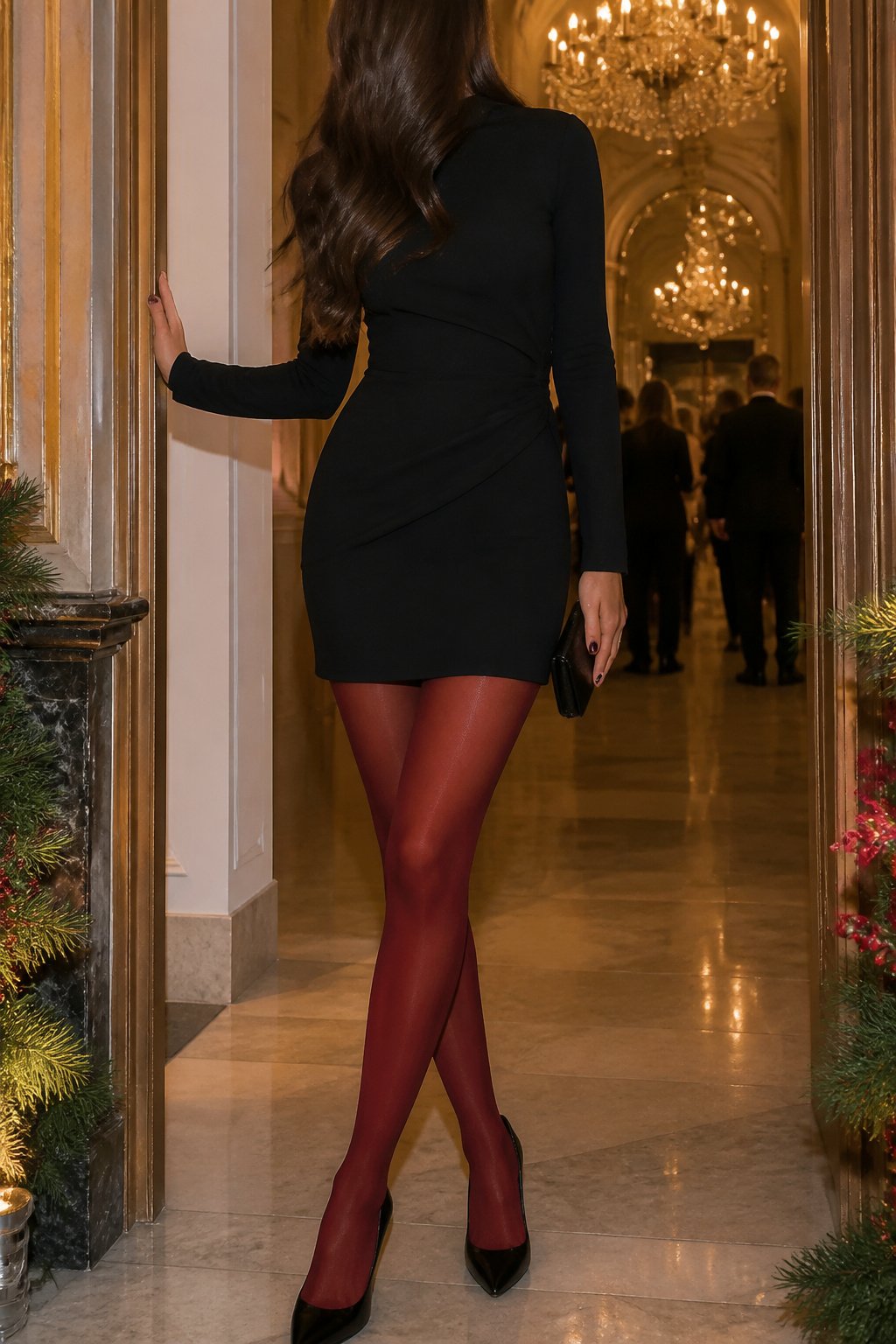
A black mini dress with long sleeves reads as quiet luxury on its own, but sheer red tights shift it into holiday territory without tipping into costume. The transparency is what saves it: light passes through, so the red registers as a wash of color rather than a solid block. You get the festive gesture, but the eye still travels to the cut of the dress and the line of the leg.
Pair this with black heels and keep jewelry minimal. A small earring or a slim watch is enough; the tights are already doing the work. The mistake is reaching for opaque red, which flattens everything into a single graphic shape and turns old money into department store Santa. Sheer fabric lets the black underneath show through, creating depth and keeping the whole look controlled.
This works best at an evening party where you want to acknowledge the season without announcing it. The silhouette stays sleek, the color stays conversational, and you never look like you tried too hard.
10. Ivory Satin Slip Dress with Sheer Robe
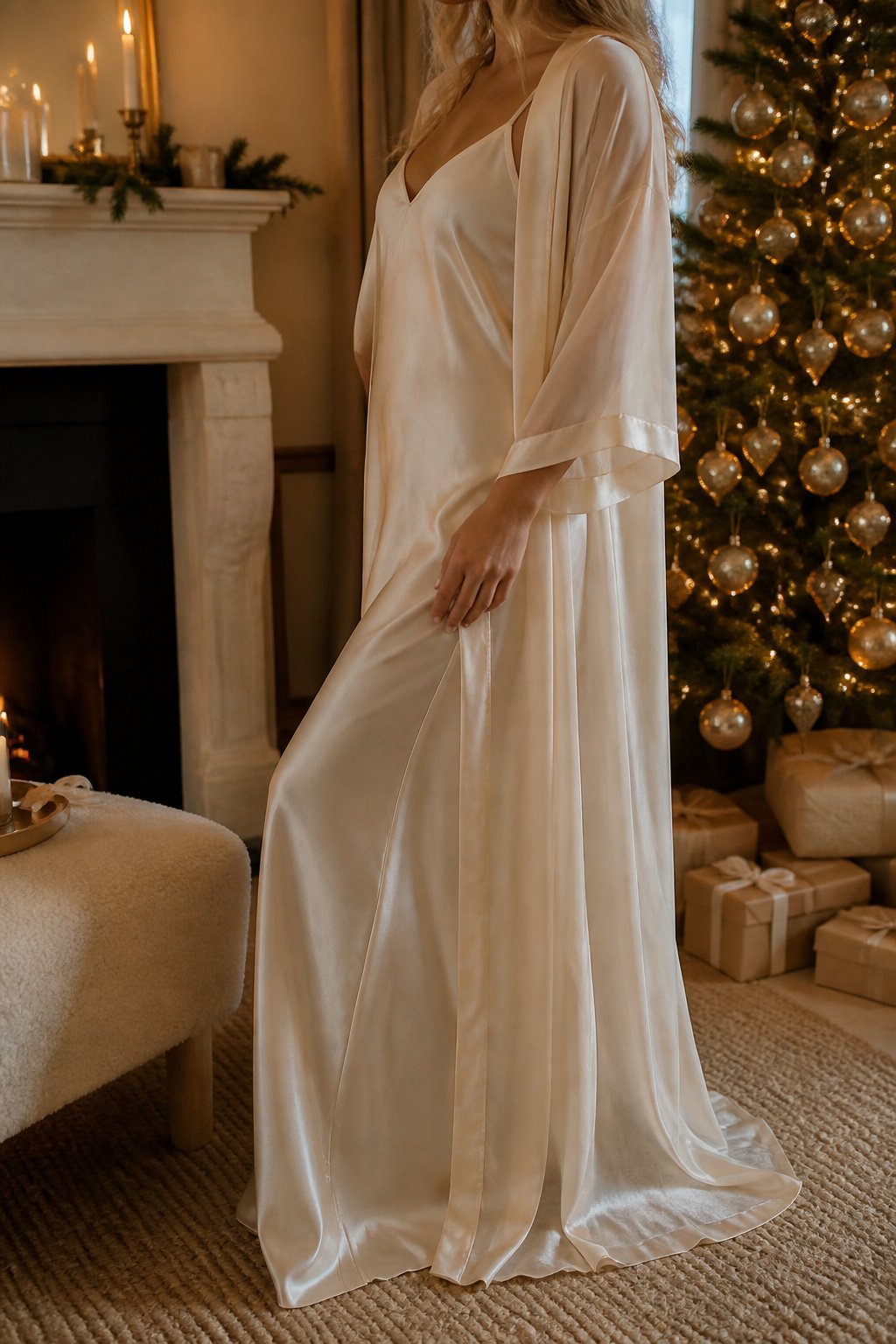
Satin and sheer together do something no single fabric can manage on its own. The ivory slip dress catches light with a soft shimmer, while the sheer robe over it breaks that glow into layers, so the whole look has depth without ever leaving the neutral palette. The robe should be fluid, not stiff; anything structured turns the pairing into costume.
This is where old money style leaves the party and comes home with you. The same combination works for a small Christmas dinner with the lights turned low, or for morning coffee on December 26th when the house is quiet and you are not ready for ordinary clothes yet. The sources call it "effortlessly luxe," but the real point is that it asks nothing of you. No jewelry required, no clutch to keep track of, no shoes that pinch by dessert.
Keep the tone monochromatic. A matching clutch and pointed pumps will extend it to a holiday soirée if you must leave the house, but the outfit earns its place in a Christmas wardrobe because it refuses to treat home as an afterthought. Old money dressing has always understood that the most expensive moments are the private ones.
11. Festive Red Knit Sweater with Silver Sequin Maxi Skirt
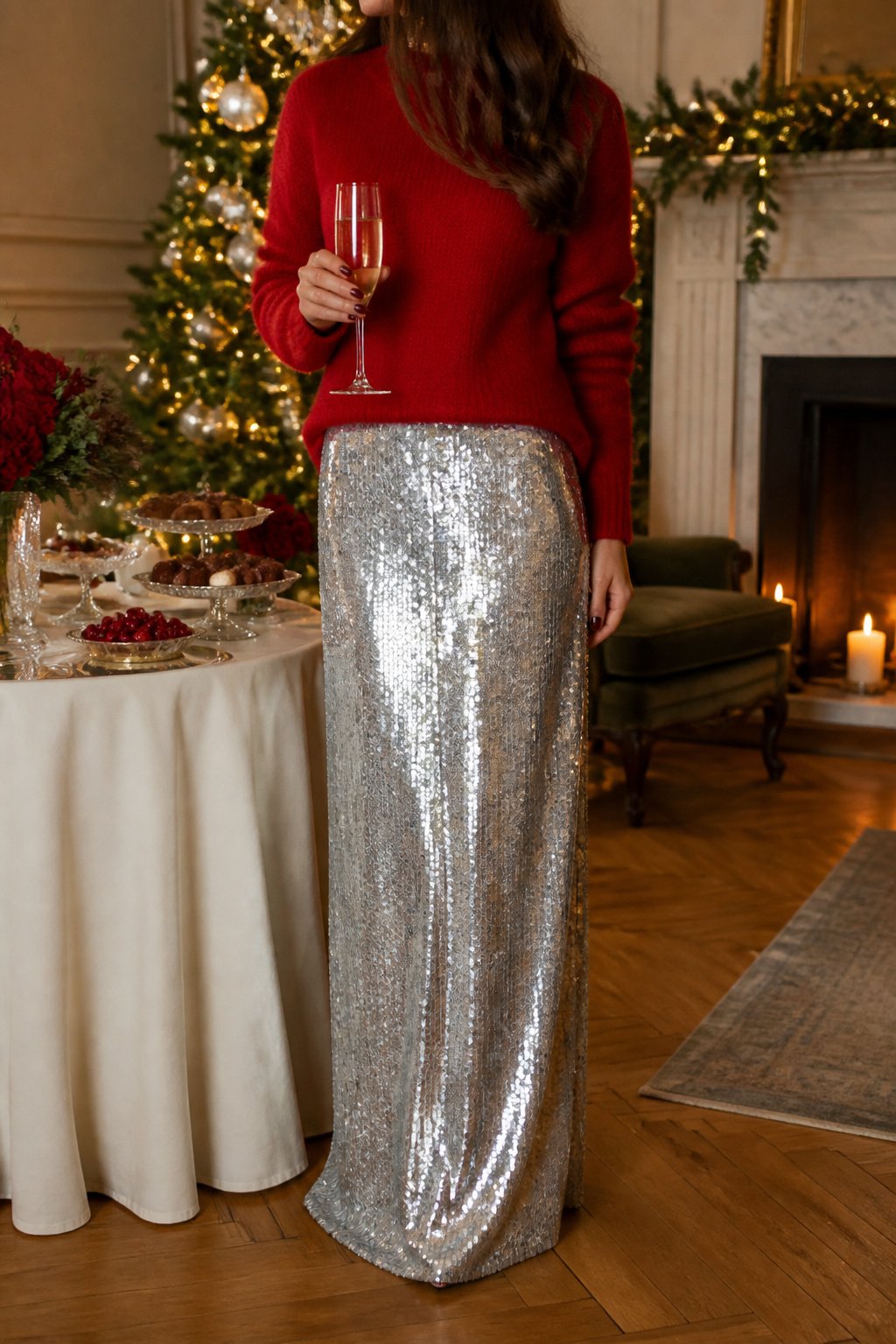
Sequins sit at the edge of what old money style allows, but this pairing keeps them in check. A silver tone rather than gold reads cooler and quieter, and the maxi length stretches that shimmer into a narrow column of light that moves when you move rather than broadcasting for attention. The knit sweater does the real work here. Its matte, fuzzy surface absorbs light the skirt throws off, so you register the whole shape before you notice anything flashy. Choose a sweater in a true festive red, something closer to cranberry than fire engine, with a relaxed crew or slight boat neck that shows a sliver of collarbone. Tuck it loosely so the waistline stays undefined and easy. The skirt should sit at the natural waist and fall straight, no flare, no slit climbing thigh-high. Silver sequins this long need to be fully lined or they itch and ride and cheapen the whole effect by the end of the night. Finish with sheer black tights and a simple black pump, nothing open-toed, nothing that competes. You are after the look of candlelight on snow, not a disco ball.
12. Double-Breasted Ivory Bouclé Jacket and Black Mini Skirt
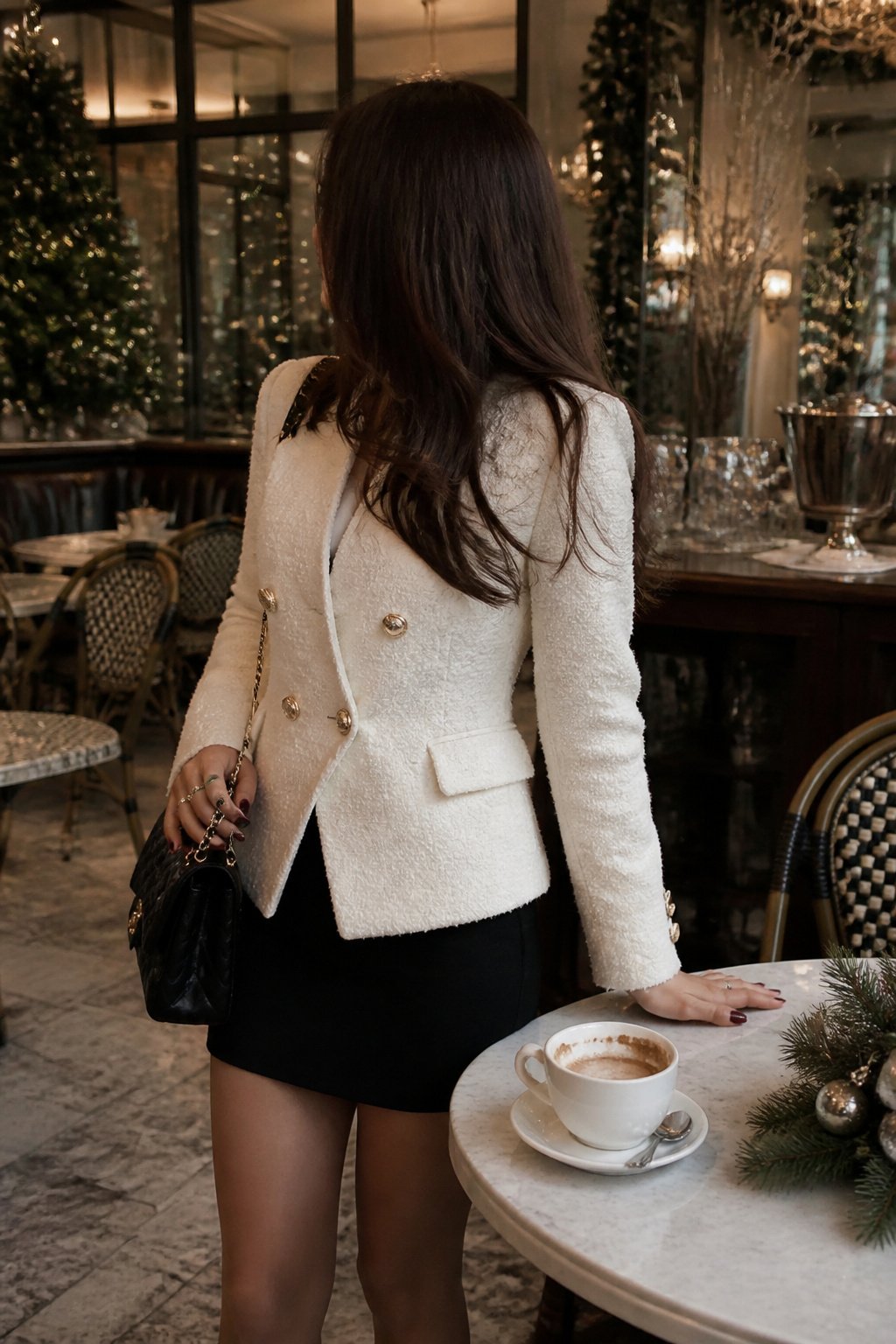
Bouclé carries immediate associations with the house of Chanel, and that heritage is precisely why it reads as old money rather than simply expensive. The double-breasted ivory jacket keeps the formality intact: the six-button front and squared shoulders give structure that a single-breasted cut would soften too far. Worn with a black mini skirt, the look balances that rigor against something younger and more mobile. A winter coffee date is where this pairing earns its place; the skirt keeps your legs free under the table while the jacket holds its shape through the afternoon. Gold buttons warm the ivory without drifting into flash. You want the bouclé tightly woven enough that it does not pill at the cuffs, and the skirt simple enough that it does not compete. The mistake is treating the jacket as armor and forgetting to move in it; the cut should follow you, not announce itself before you enter the room.
13. Cream Wool Maxi Coat with Matching Sweater
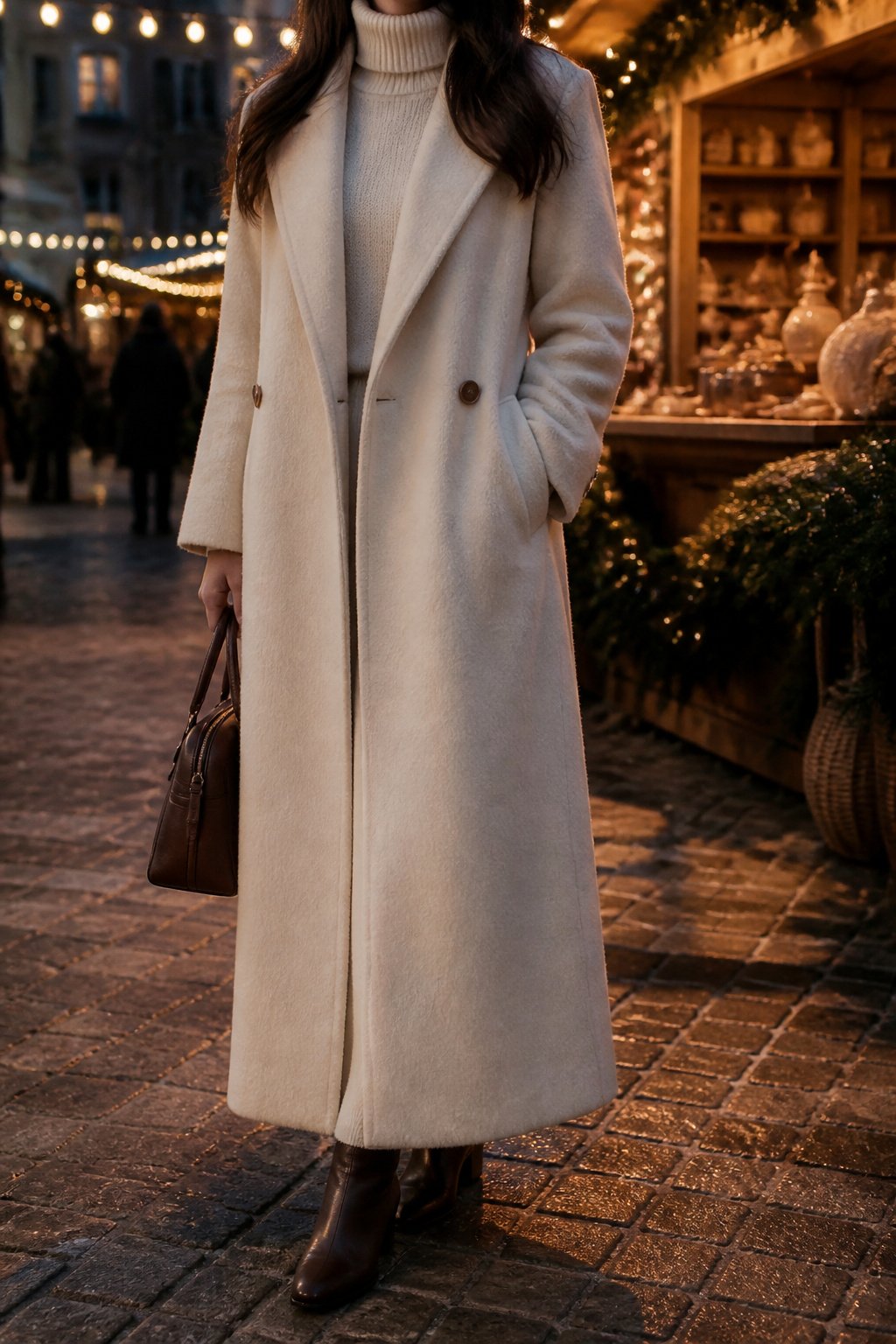
A full-length cream wool coat layered over a matching sweater reads as one continuous column rather than two separate pieces. The eye travels straight from shoulder to hem without stopping, which lengthens the silhouette in a way a contrasting underlayer never manages.
The tailoring matters here. Relaxed but structured keeps it from looking like you grabbed two similar items by accident. The monochrome palette works because the textures differ: the denser weave of the coat against the softer knit underneath creates depth without breaking the line.
This is where many get it wrong. A cream coat with a cream sweater can look repetitive if the shades clash even slightly, or if both pieces share the same surface finish. Check them in daylight before you commit. The coat should be the deeper, more saturated cream; the sweater a half-step lighter.
For Christmas shopping or city walks, the look carries warmth without the usual holiday noise. Add suede accessories in a tone that blends rather than pops. The overall effect is intentional, studied, and quietly expensive.
14. Black Mini Dress with Dramatic White Cuffs
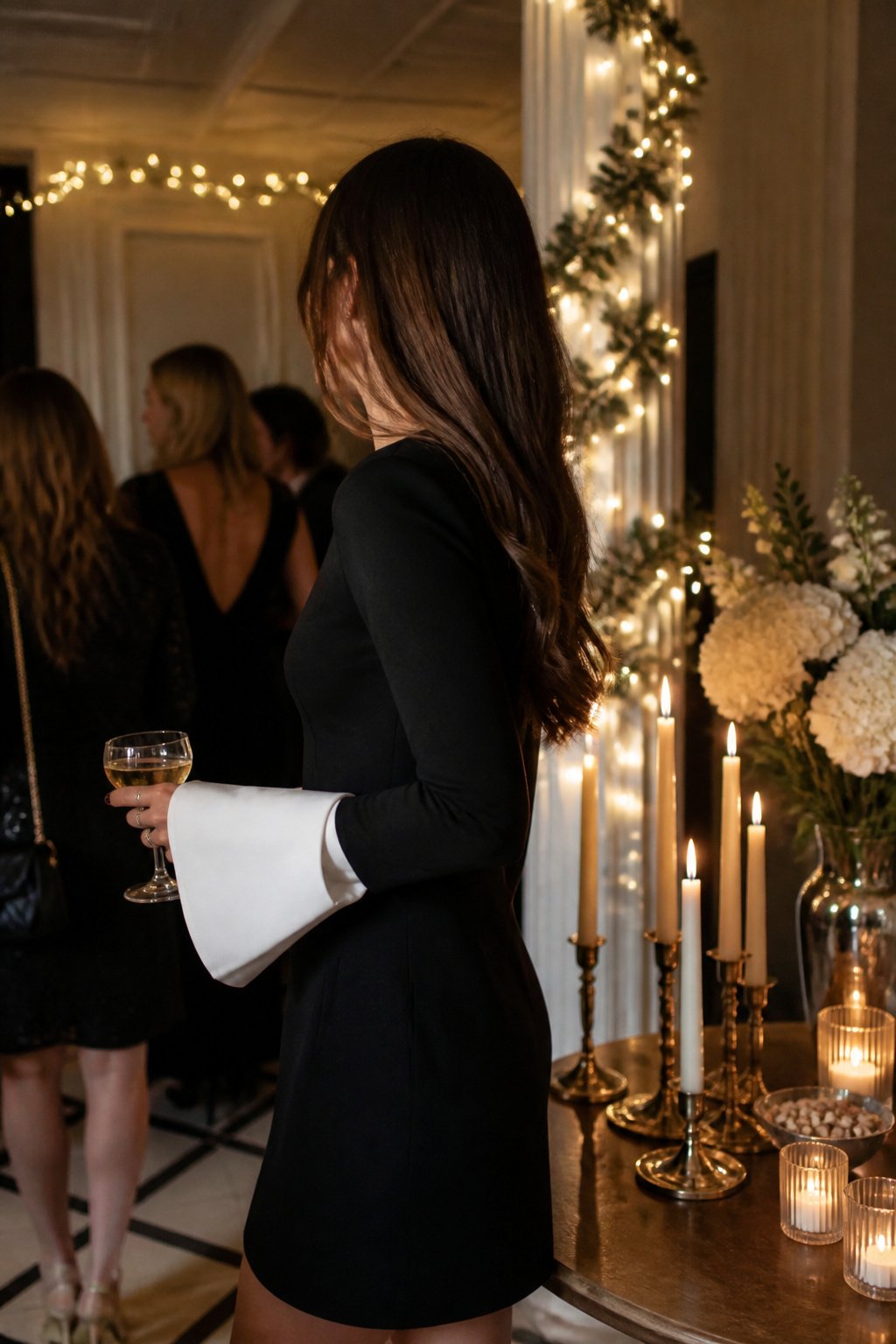
A black mini dress reads as safe until you notice the cuffs. Wide white bands at the wrist, crisp as a fresh tuxedo shirt, turn the whole piece into something that looks considered rather than convenient. That single contrast does the work of jewelry without any sparkle at all.
The detail borrows from historical menswear, from the detachable shirt cuffs of the early 1900s that signaled a man had a valet and a laundry schedule to match. On a woman, it carries the same note: someone who dresses with intention, not reaction. The intellectual weight lands because it references something functional that became purely decorative, the way old money style often does.
Keep the rest severe. Black tights, black pumps, maybe a pearl stud if you must. The cuffs need the silence around them to read as confidence rather than costume. Hair pulled back helps; the eye goes to the wrist, the gesture of the hand, the implied formality of someone who still writes letters or at least owns a pen that cost more than a dinner out.
The risk is overstatement. Skip a white collar to match, skip the belt, skip anything that turns this into a uniform. One gesture is enough. That restraint is what separates the look from something a stylist plotted for a photograph.
15. Cream Tweed Dress with Gold Buttons
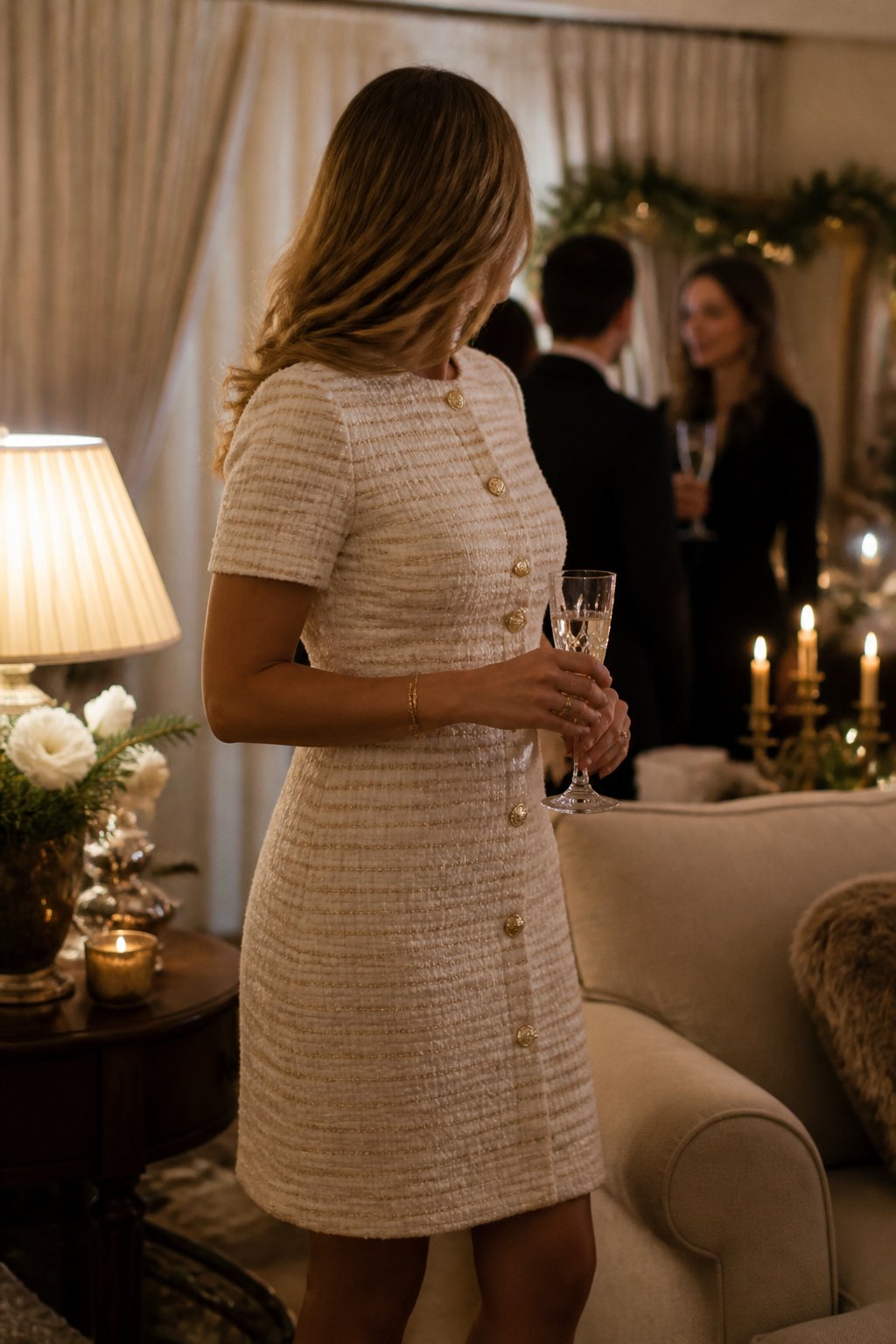
Gold buttons on cream tweed are one of the few embellishments that read as hardware rather than jewelry, which is why they pass in old money style where sequins or beading would not. The placement and scale are what keep you out of costume territory: three or four buttons marching down the front of a sheath or A-line dress, each no larger than a half-inch across, spaced evenly from bust to low hip. Any more than that and you start to look like marching-band trim; any larger and they swing toward pirate rather than Parisian.
The tweed itself should be a flat cream with a subtle weave, not the thick nubby stuff you see on country house sofas. You want the texture to suggest a well-kept inheritance, not a thrifted curiosity. Pair it with matte black tights and a simple pump in dark chocolate or burgundy. Skip the gold earrings or bracelet, since the buttons already carry that weight. A single strand of pearls, if you wear any jewelry at all, keeps the register quiet and the eye moving vertically rather than gathering at one shiny point.
16. Black Halter Neck Gown with Gray Fur Coat
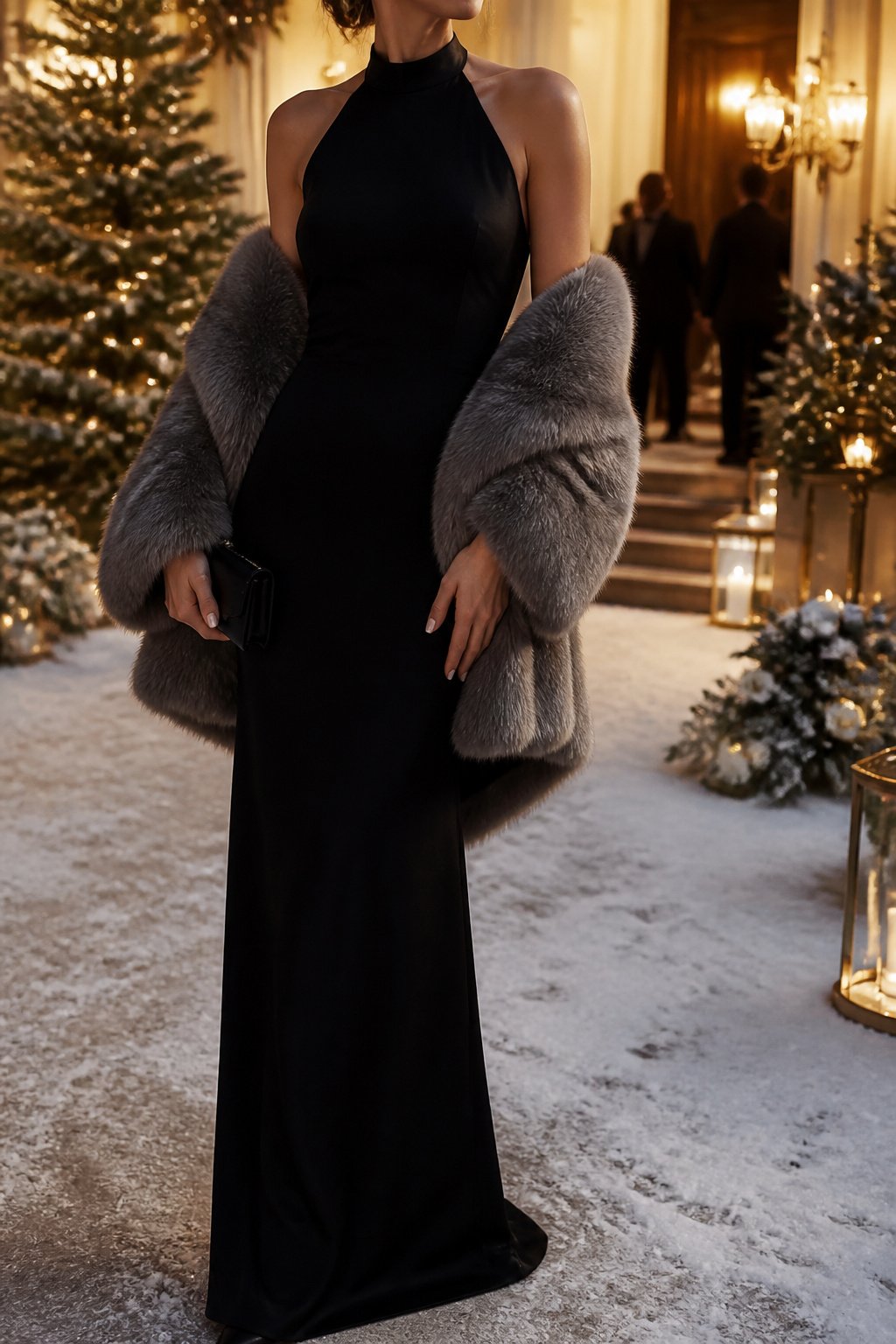
A black halter neck gown reads as standard evening wear until you drape a gray fur coat across the shoulders, and that shift in color is what keeps the pairing from feeling expected. Black or brown fur would land closer to Hollywood premiere territory; gray softens the contrast and nods at the restraint that older, established crowds tend to read as confidence rather than costume.
The halter leaves the neck and shoulders bare, which means the coat does the practical work of warmth and the social work of entrance-making. Let the fur sit open at the collar rather than closed; the gown’s line stays visible, and you avoid the bulk that can turn a sleek silhouette into something fought rather than worn.
For formal Christmas events, this combination works because it borrows from gala dressing without demanding it. The guest list has seen the predictable choices already. Gray against black offers them something to notice without asking them to decode it.
17. Deep Plum Satin Gown with Black Wool Coat
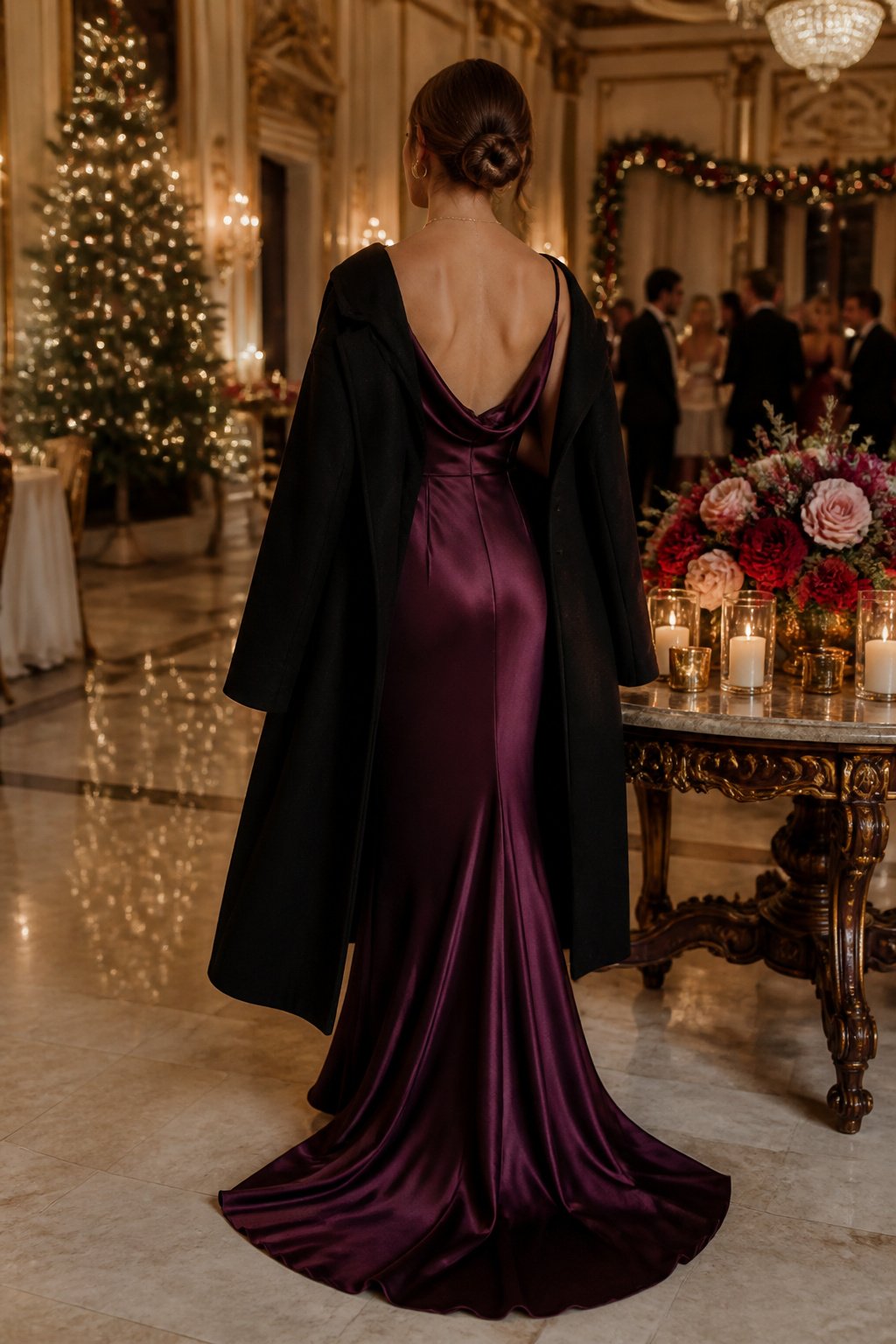
You have already seen a dozen red dresses by the time the seventeenth outfit rolls around, and that is exactly why plum works. Deep plum satin reads as formal without shouting holiday costume; the color carries the richness of wine or velvet curtains in a room where no one raises their voice. A halter neckline keeps the line clean, and satin catches light in low rooms, the kind with candles on mantels.
The black wool coat is not an afterthought. It gives you coverage from car to door without introducing a second statement, and the darkness against plum adds depth that a matching wrap would flatten. The coat also lets you move through a crowd without worrying about the gown, which is the practical half of old money dressing: looking like you never worried at all.
18. Ivory Satin Pajama Set with Knit Sweater
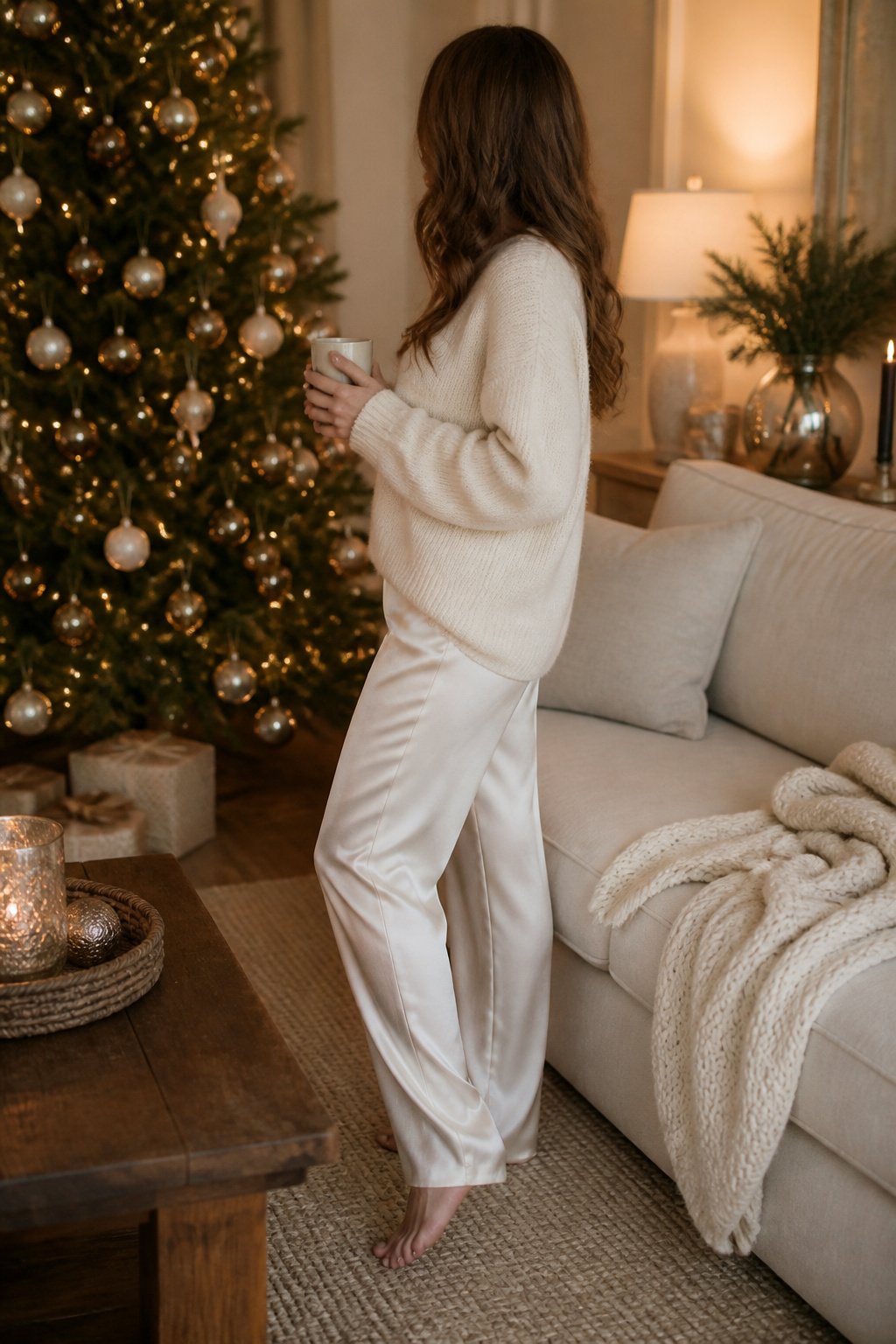
Satin pajamas read as costume if the cut is too costume-y. You want a tailored trouser with a proper waistband and a button-front top that sits flat across the chest, not a limp chemise that slides around. The sweater layered over it does the real work of pulling the look outside the bedroom. A fine-gauge cashmere or merino in cream or oatmeal, slightly cropped so the satin hem shows below, keeps the proportion deliberate. The sweater weight matters more than the pajama price: too heavy and it overwhelms the drape, too light and the whole thing collapses into actual loungewear.
This is where old money logic extends past where anyone sees you. The set you open presents in on Christmas morning, the one the dog climbs on and coffee spills near, still benefits from French seams and natural fiber. Silk satin at 19 momi or higher holds its shape through washing; polyester looks the same at first and pills or static-clings by February. You notice the difference in the second year, not the first.
Wear it with leather slippers that have a hard sole, not shearling mules. The boundary between private and public here is thin, and the shoe is usually what tips it.
19. Creamy Cable Knit Sweater with Burgundy Satin Trousers
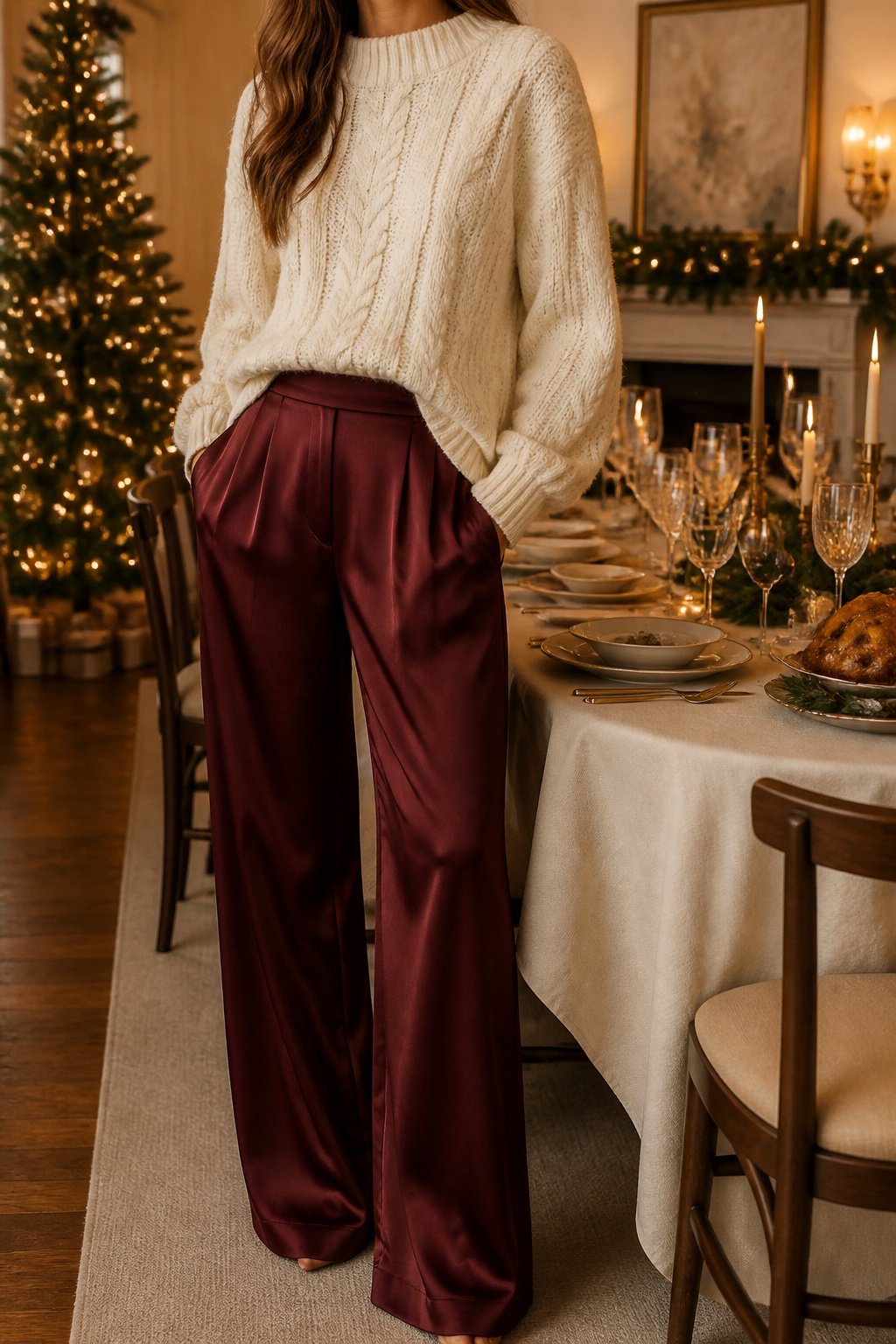
Cable knit carries the weight of heritage, and that is why it sits so naturally in an old money wardrobe. The creamy sweater here is worked in a traditional Aran or fisherman’s pattern, the kind of texture that reads as craft rather than trend.
Pair it with burgundy satin trousers and you have flipped the usual formula. Most holiday dressing puts the formality up top, the sparkle on the sweater, the silk on the blouse, while the bottom half retreats into wool or denim. Here the cable knit stays easy, almost rustic, and the satin below does the formal work. The contrast is deliberate: the eye expects one thing and gets another.
Tuck the sweater fully in to keep the line clean; a half-tuck reads as accident with this much volume on top. The waistband of the trousers should sit at the natural waist, not low, so the proportions feel pulled together rather than slouched. This is the move that takes the pairing from loungewear to a composed outfit you could wear to a daytime gathering or a quiet dinner where you still want to signal you dressed for it.
The color matters too. Cream against burgundy is warm without being festive in the obvious red-and-green sense. It whispers Christmas rather than announcing it.
20. Elegant White Ribbed Knit Midi Dress with Gold Accents
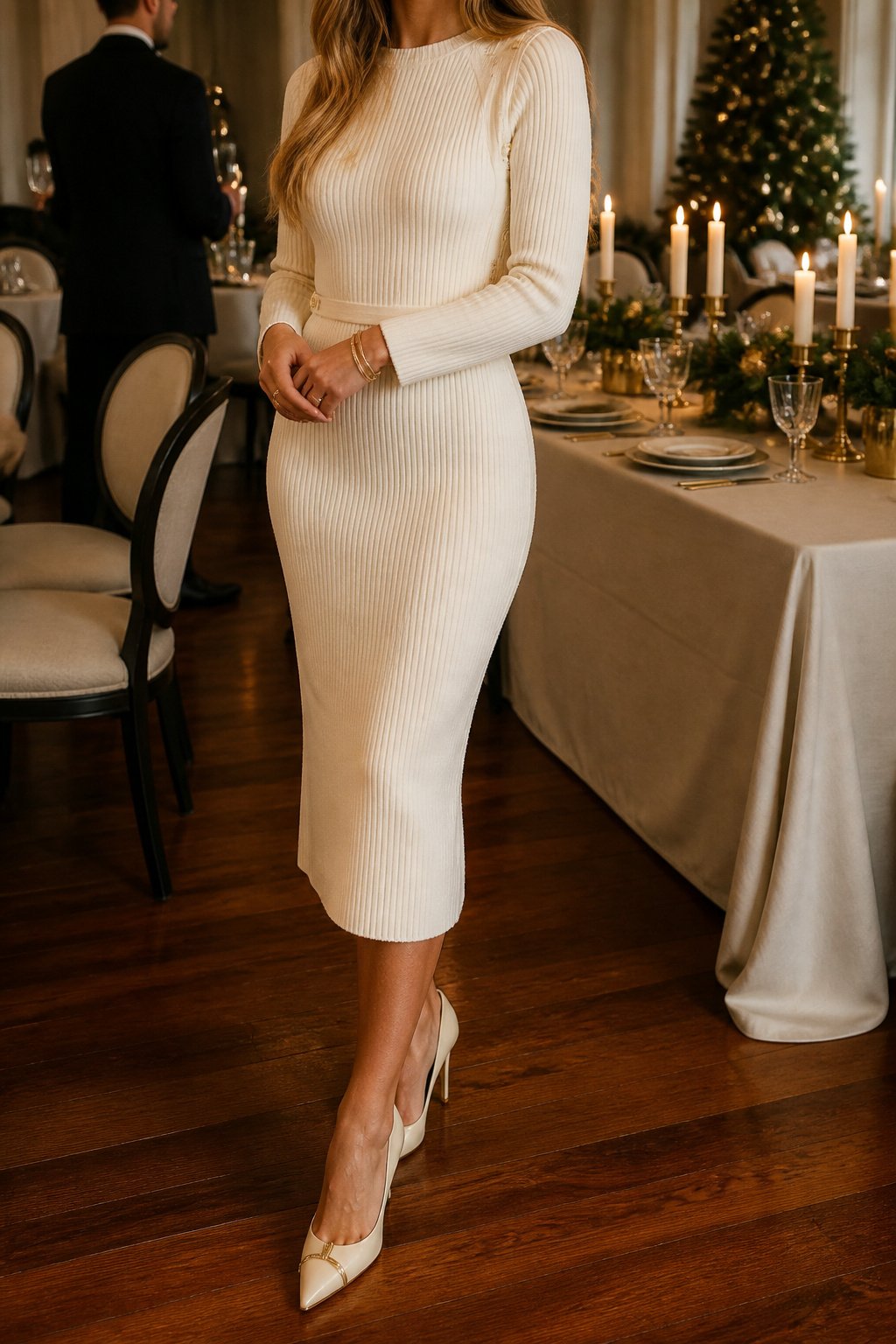
A ribbed knit midi dress lands at the same register as a cashmere sweater until you look at the cut. The weight of the fabric does the work here: double-kit construction, dense enough that light passes through only at the stretched rib, gives the silhouette structure without stiffness. That density is what lets you wear this to a Christmas dinner where jeans would fail.
The gold is where most get it wrong. You want it at points where the body already catches light: a thin chain belt riding the high waist, or a single bar closure at the left shoulder where cashmere would pill. Keep any metal within a quarter inch of skin, not floating on the fabric surface. A brooch on the chest reads as costume; the same weight of gold as a ring-pull zipper at the back neck reads as hardware you forgot to notice.
Earrings work only if they disappear behind hair when you turn your head. The effect you are after is someone catching the glint across the room, not following it to its source. If the dress has any metallic thread woven through the rib, skip jewelry entirely and let the weave do the catching.
21. Vanilla Ribbed Knit Wrap Dress with Cape-Style Coat
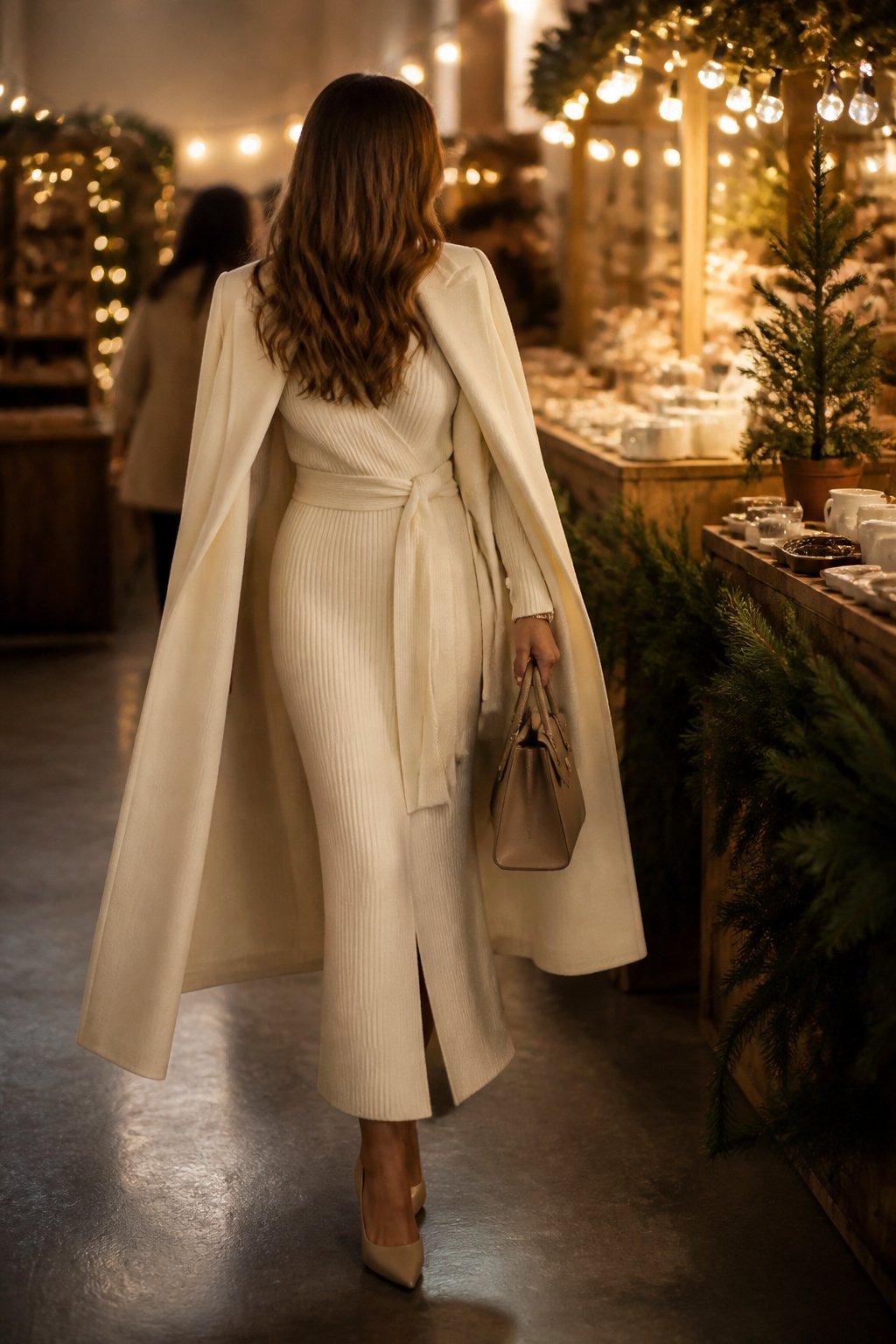
A wrap dress does the forgiving work here. The ribbed knit clings where you want definition and drapes where you do not, which matters after a long Christmas lunch. The cape-style coat over it is the move that saves the silhouette from going too soft. Without a sharp shoulder or nipped waist anywhere in the look, you risk reading as undone rather than relaxed. The cape fixes this with its structured hemline and the way it holds its shape in motion, giving you architecture without the padded structure of a traditional old money coat.
You wear this to a daytime church service or an early dinner where you will keep the coat on. The two pieces share a language, both fluid, but the cape’s outer volume keeps you from looking like you have given up on shape entirely. Choose the dress in a true vanilla, not cream, so it does not muddy against the coat. A darker coat, camel or soft charcoal, works better than matching white; the contrast gives the eye somewhere to rest.
The mistake is buying a cape that is too short. It should hit mid-thigh at least, or the proportions collapse into a costume. A longer line keeps the elegance intact.
22. Off-Shoulder Black Cardigan with Classic Belted Trousers
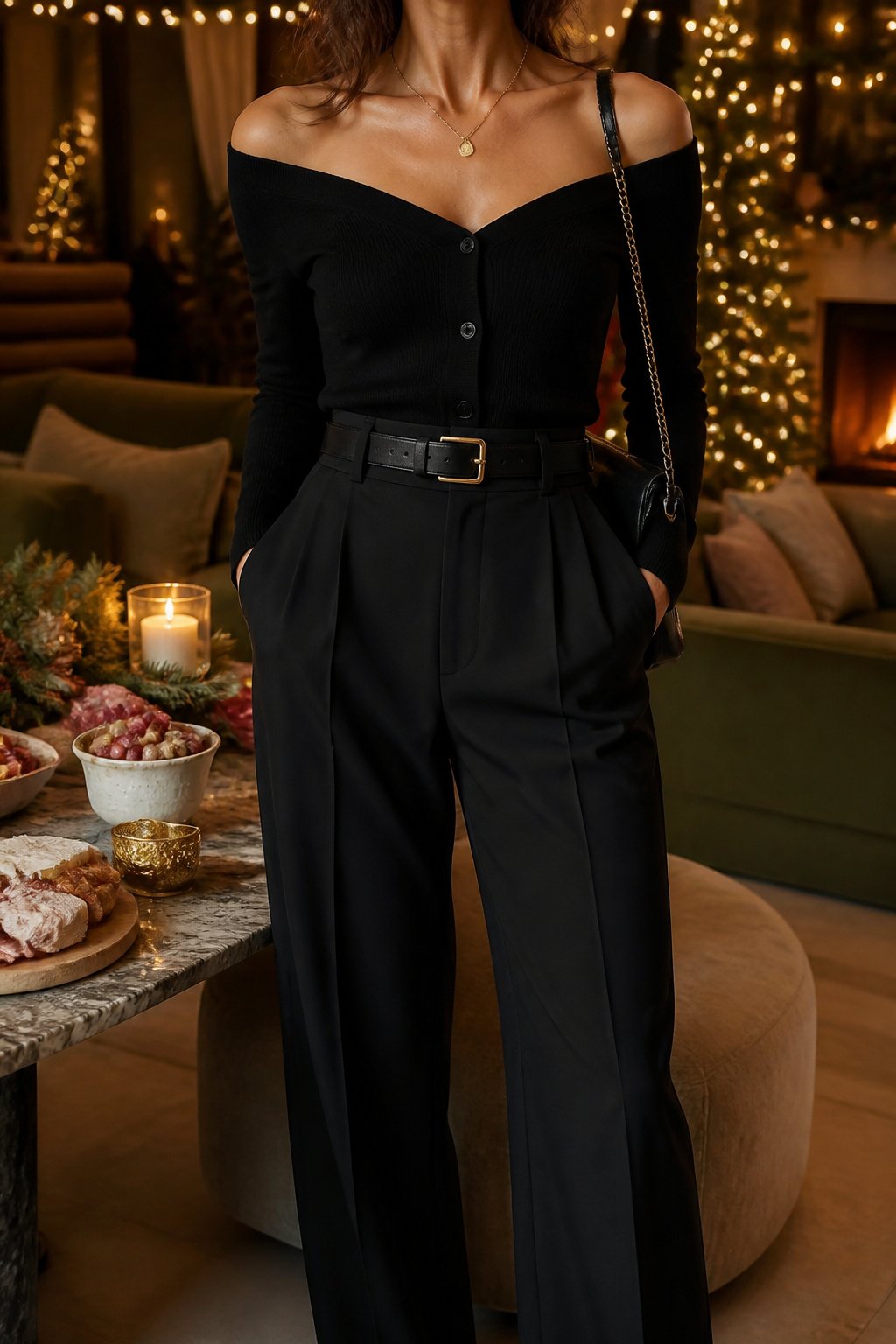
An off-shoulder cardigan is one of the few places old money style lets you show skin, and that restraint is exactly why it lands so well. The black keeps the gesture quiet, and a soft cashmere or fine wool knit keeps it from reading as evening wear. The risk is proportion: bare shoulders above can feel unmoored without something structured below.
That is where high-waisted belted trousers earn their place. The covered leg and defined waist restore the balance, and the belt itself, in leather or a matching fabric, adds the deliberate, finished note that separates this from something thrown on. Think of it as coverage as a choice, not a default.
This pairing works best at indoor holiday parties where you will not need a coat, because the silhouette depends on the shoulder line reading cleanly. A seated dinner, a drinks party in a warm room, a gallery opening on a December evening: these are the moments. Add pearl studs or a slim silk scarf if the room calls for it, but the outfit already carries enough structure to stand alone. The tailoring does the talking.
23. Luxe Brown Faux Fur Coat with Black Trousers
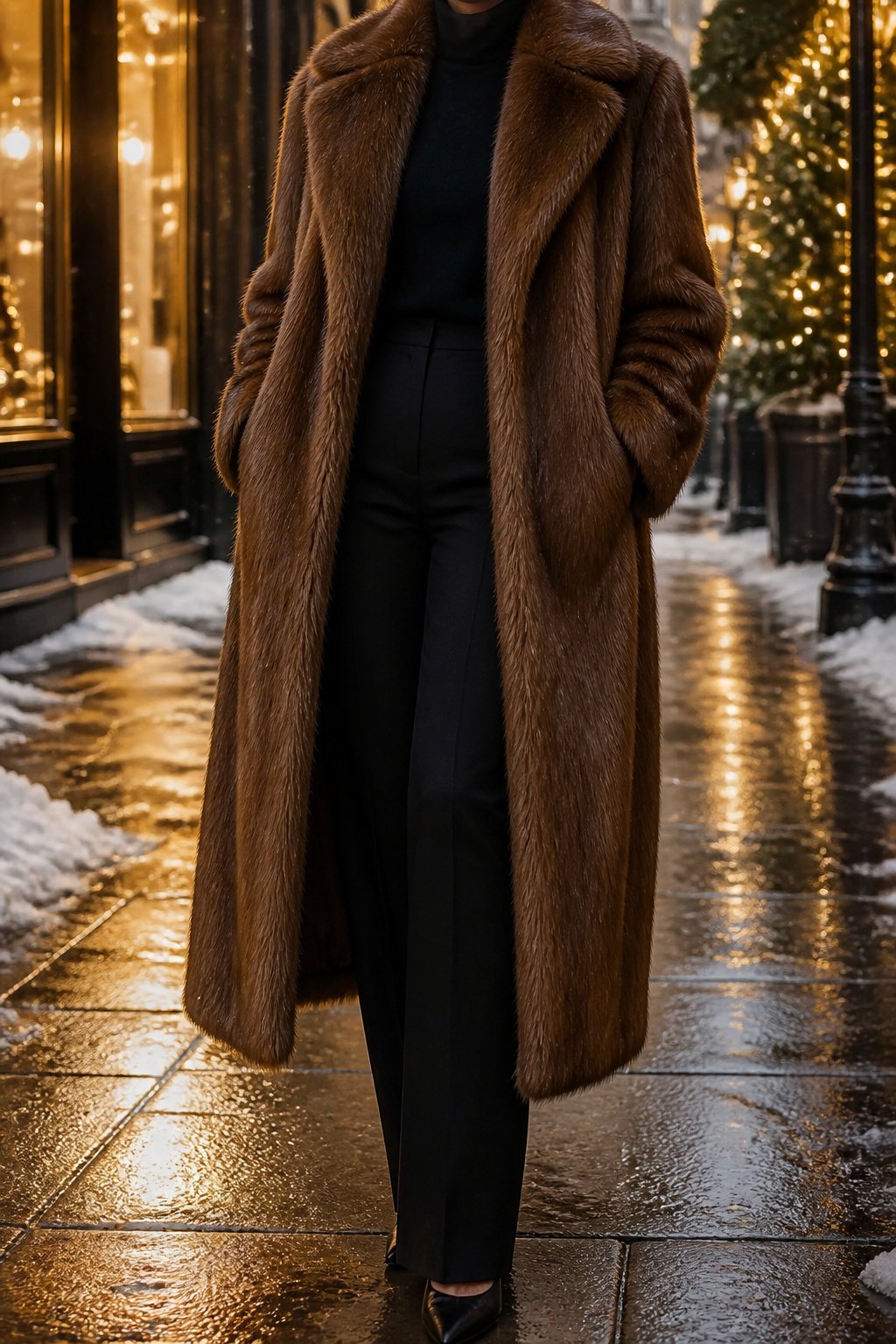
A brown faux fur coat carries the weight of something handed down rather than bought last week. The texture reads lived-in from the first wearing, and paired with simple black trousers, it does enough work that the rest of the outfit barely matters. You could wear a plain crewneck underneath and still look dressed.
The real advantage shows up at the door. You arrive in the coat, and it is the look. You leave in the same coat, and the departure feels as considered as the entrance. No need to plan a separate outer layer or worry about a host closet; this piece functions as both coat and statement. Black trousers keep the silhouette clean underneath, so you are not managing bulk through a long evening.
For an old money Christmas outfit, the restraint is the point. The coat supplies the luxury. Everything else stays quiet.
24. Plush White Fur Jacket with Ivory Satin Maxi Skirt
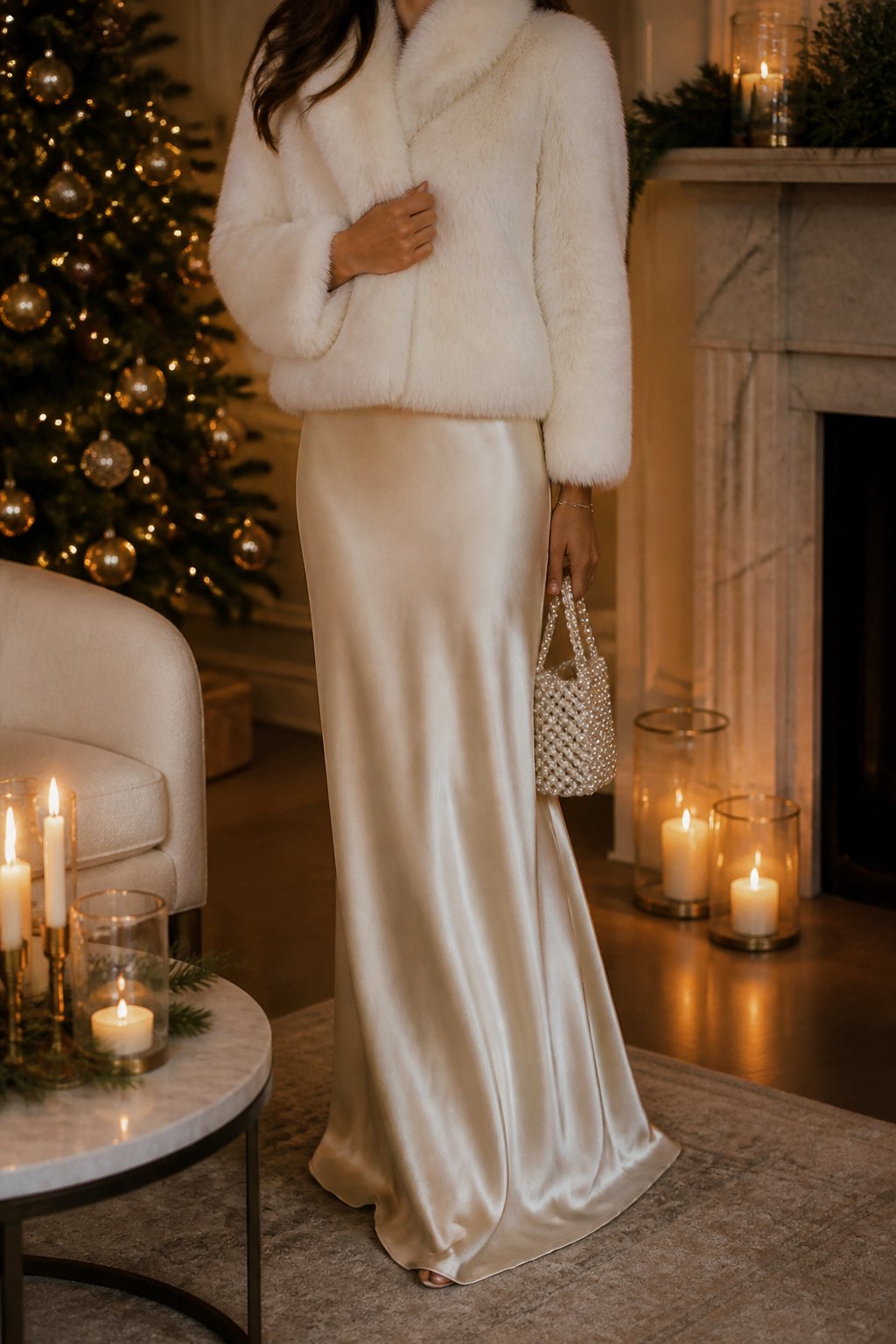
A plush white fur jacket over an ivory satin maxi skirt lives or dies by the gap between the two surfaces. Pair real or high-grade faux fur with liquid satin and the eye reads them as separate objects, not one overloaded piece. That contrast saves you from looking like you stepped out of a period film.
Keep the fur cropped or hip-length so the satin shows in panels, not glimpses. The skirt should sit at the natural waist and fall straight to the ankle; anything fuller fights the jacket’s volume. For color, match the ivory exactly or stay within a half-shade. Anything warmer than cream starts to read as mismatched rather than tonal.
This is an outfit for the seated events: a late Christmas Eve service, a private dinner where you will not be removing a coat in a crowded hallway. The satin marks and the fur sheds; you need space and stillness. Skip it for anything involving mulled wine passed on trays or coat checks with numbered tickets.
25. Asymmetric White Gown with Draped Sleeve Detail
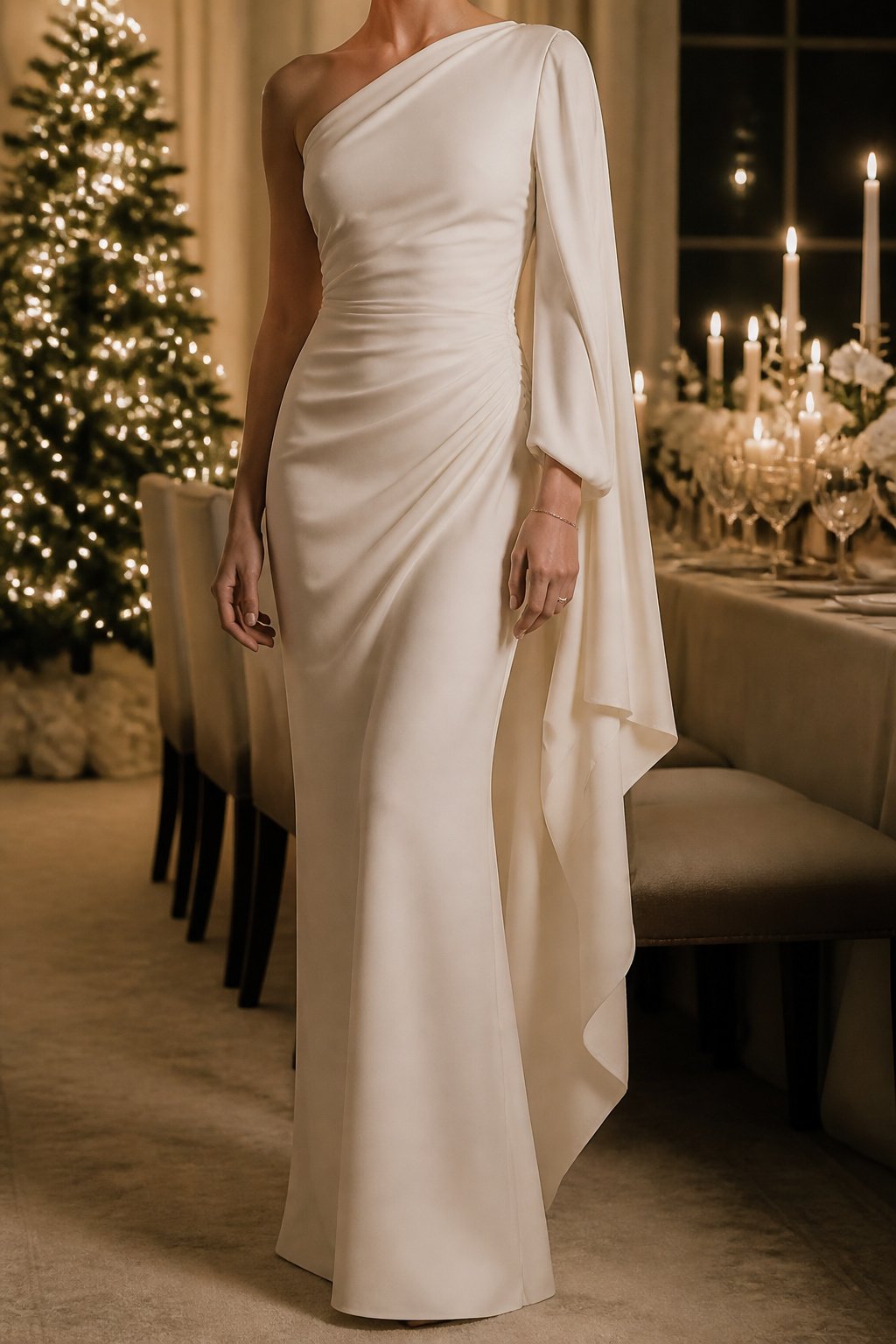
An asymmetric white gown with draped sleeve detail walks a narrow line you need to see before you wear it. The single sleeve and cascading fabric borrow from modern runway construction, but the fitted silhouette and white ground keep it anchored to formal tradition. That flower accent at the waist is the detail that tips either way: small and pinned, it reads as a studied, old-money nod to couture finishing. Oversized or trending toward costume, it becomes the thing that dates the photograph.
The draped sleeve itself works because it is silk or a silk-weight fabric that moves rather than holds its shape stiffly. You want the sleeve to fall and recover as you lift a glass or reach for a chair back, not to stay frozen in a pose that looks like architecture and feels like theater. The asymmetry should reveal itself in motion, not announce itself when you are standing still.
Where this fails into too-trendy territory is in the construction of the bodice. If the cut is loose or relies on the drape to do all the shaping, you lose the tailored fit that old money style demands. The gown must be fitted through the torso so the single sleeve and the empty opposite shoulder read as deliberate balance, not as a garment that needs the body underneath to give it structure. Pair it with simple heels, perhaps with a small bow, and keep jewelry at pearl stud or nothing. The dress is already doing the asymmetrical work; anything more competes with it.
What Old Money Christmas Style Means
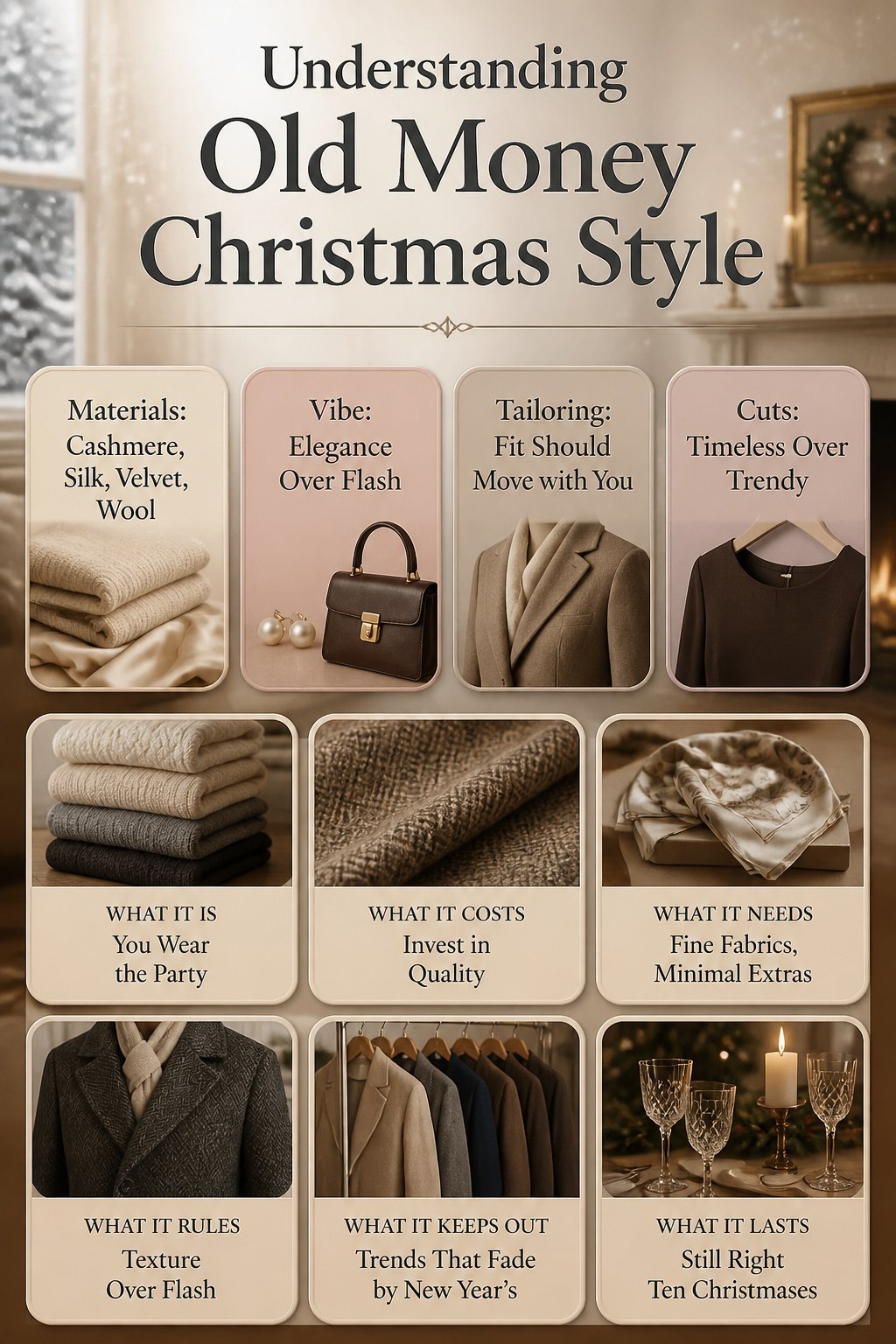
Old money Christmas style means you wear the party, not the costume. Cashmere, silk, velvet, and wool carry the look because they read as warmth and intention rather than decoration. A pearl earring or leather bag finishes the outfit; nothing needs to announce itself. The tailoring matters more than the label, whether the piece is a sleek dress or a well-cut coat, and the fit should sit close enough that the fabric moves with you, not against you.
The 25 outfits ahead keep to muted tones and classic cuts. They skip the seasonal sparkle and the trend piece that will date itself by New Year’s. The rule is texture over flash: a tweed that catches candlelight, a wool coat with shoulders that hold their line, a silk scarf tied simply at the throat. Winter gives you this naturally. You just have to choose the fabric that will still look right ten Christmases from now.
Fabrics That Carry the Look
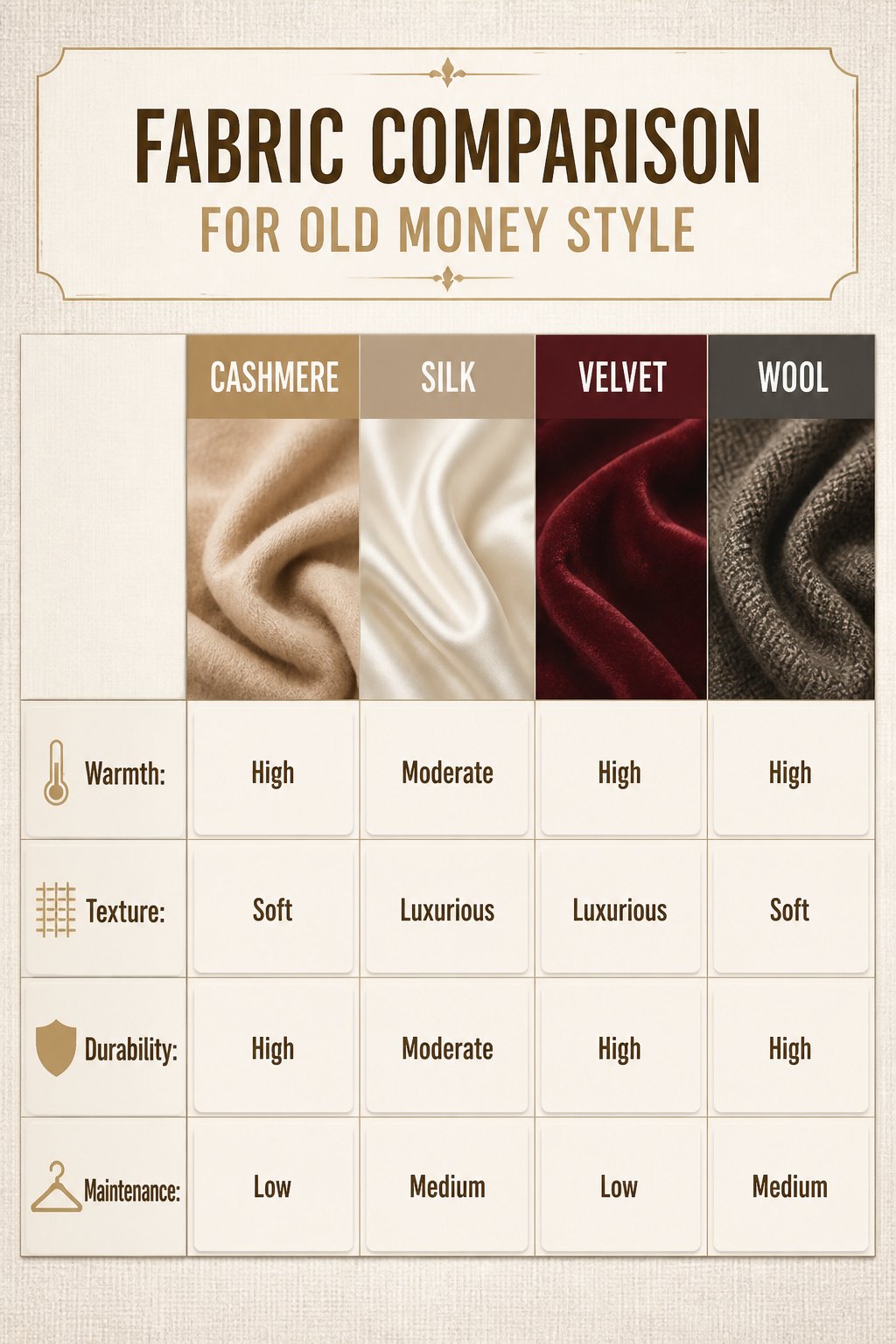
Cashmere, silk, velvet, and wool are the four fabrics that carry old money christmas outfits through winter with the weight and warmth the season demands. Cashmere lies closest to the skin and earns its price by holding heat without bulk; a single sweater worn weekly from November through March costs less per wear than three cheaper replacements that pill by February. Silk traps a surprising layer of warmth for its thinness and lets a blouse slide under wool without catching or riding up. Velvet carries light differently than flat weave, which means a dinner jacket in cotton velvet looks rented while silk velvet reads inherited; the pile also insulates better than you’d expect for fabric that drapes this softly. Wool is the workhorse, particularly in tweed or flannel weight, and the mistake is buying it too light: super 120s and above feel elegant in the hand but let wind through and wrinkle across the shoulders after an hour in a car. Heavier wool softens with brushing and keeps its structure for decades. Each of these four asks more at purchase and returns it in seasons of wear, which is the old money calculation in a single number.
Accessories Worth Adding
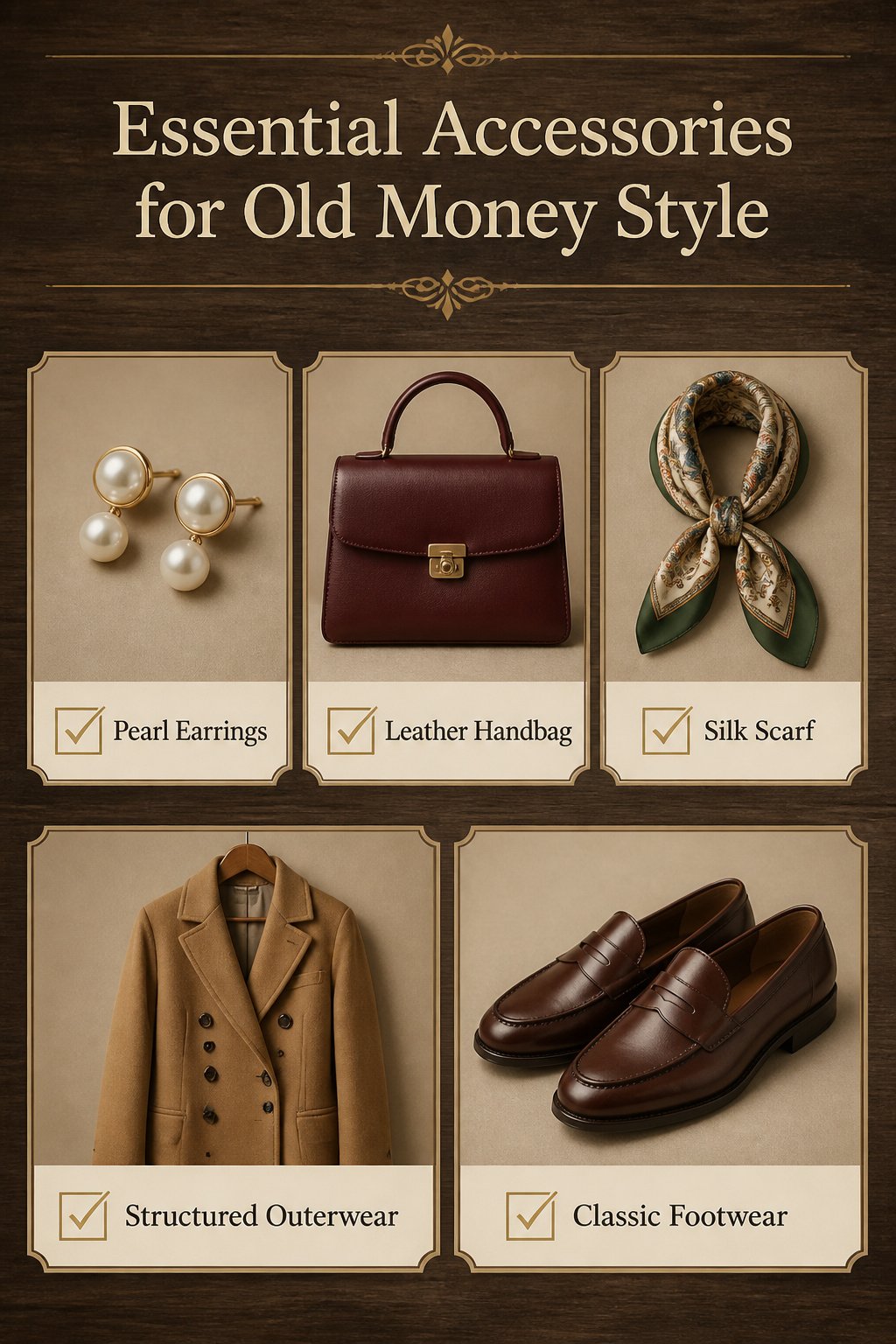
Pearl earrings set the tone without announcing themselves. Choose a stud or small drop that catches light when you turn your head, nothing that swings past the jawline. The mistake is treating them as the main event; they should read as a quiet habit, something you put on and forget.
A leather bag works best when it carries the weight of the outfit. Structured shapes in deep burgundy, forest green, or chestnut do more for old money christmas outfits than black ever will. Let the leather show age, and keep hardware small and matte. Oversized logos or heavy chains shift the look toward costume.
Silk scarves demand restraint in how you tie them. Folded narrow and knotted at the throat, they frame the face; draped loose, they read as an afterthought. The pattern should be small enough that someone has to step closer to see it. If the scarf competes with the collar or the neckline, remove it.
The rule across all three: one piece does the work, the others stay quiet. You are adding texture and history, not building a display.
Matching the Outfit to the Occasion
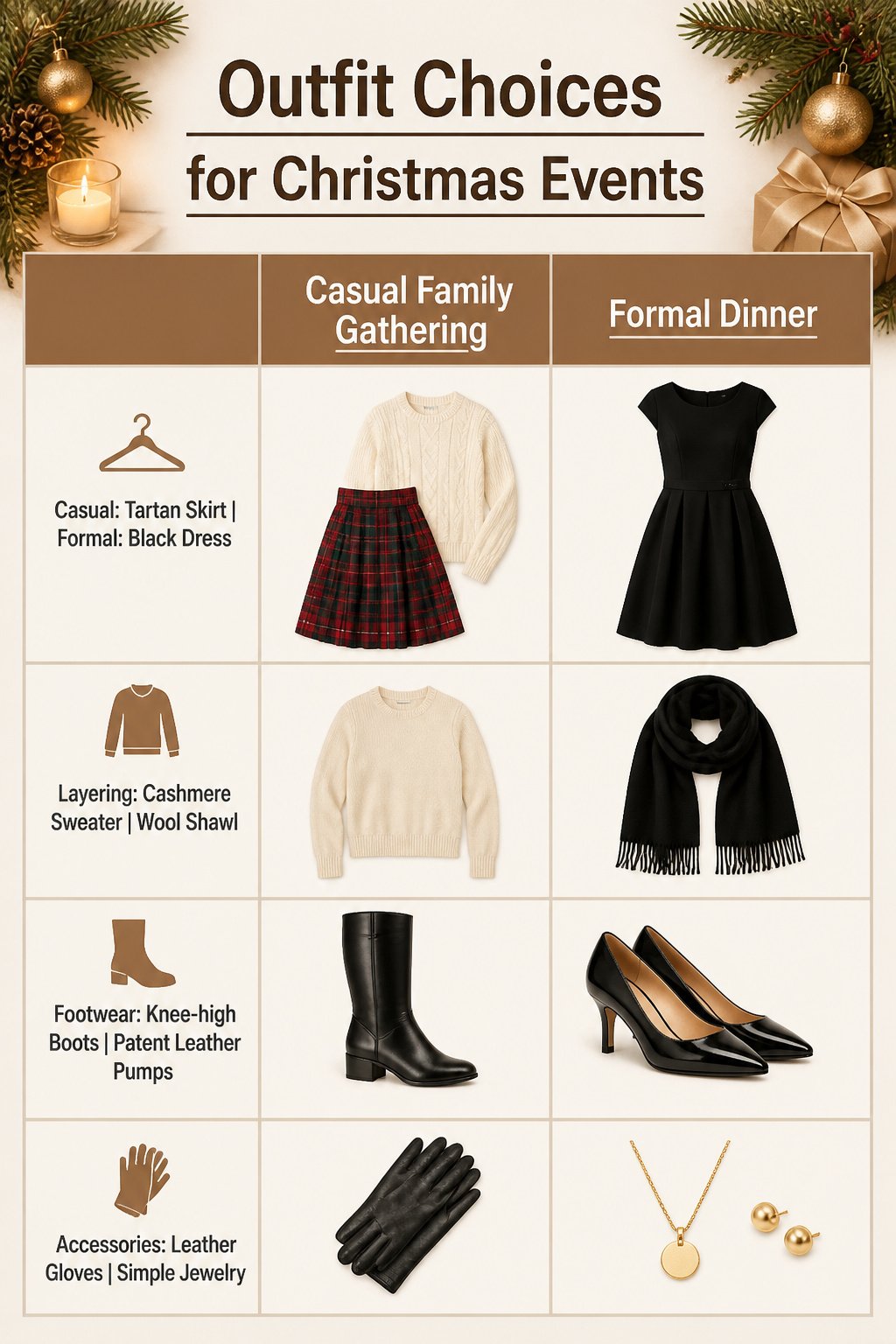
You need a different eye for each kind of Christmas gathering, and the outfits in this collection sort themselves cleanly once you know what to look for. For a casual family gathering, start with the tartan plaid skirt and cashmere sweater, or the black cashmere sweater with plaid skirt and knee-high boots. Both read festive without demanding attention, and the leather gloves or boots keep you practical for a morning that probably involves helping in the kitchen or sitting on the floor with nieces and nephews.
A holiday at a friend’s house calls for something slightly more composed. The white silk blouse with black wool trousers and leather loafers hits the mark, or the midi velvet skirt with silk top and block heels if the host tends to keep the heat low and the evening stretches long. The block heels matter here; you will be standing with a drink longer than you expect.
Formal Christmas dinner is where the restraint of old money pays off. The classic black dress with wool shawl and patent leather pumps, or the cashmere cardigan over black pencil skirt with leather pumps, both signal that you understood the invitation without trying to outdress it. The red silk dress with gold jewelry and nude heels works too, but only if the room is large enough to absorb that much color.
For Christmas morning at home, the leather midi skirt with fine-gauge turtleneck and riding boots is an unexpected choice that still feels right, or the camel coat layered over black dress with cashmere scarf if you are opening gifts with people you want to impress before noon. The mistake is dressing for the photograph instead of the room; the cashmere sweater and navy skirt with gold belt looks effortless in person but can flatten under phone flash.
Frequently Asked Questions
What are some Christmas outfits with an old money aesthetic?
The article features 25 specific looks, including a cream faux fur coat with red tights, a navy wool maxi coat with structured shoulders, a classic brown tweed coat dress, and an ivory satin slip dress with a sheer robe. Each pairing relies on texture and tailoring rather than sparkle or logos to signal luxury. The common thread is quiet pieces that do the work without announcing themselves.
How can I achieve an old money Christmas style?
Focus on classic silhouettes, high-quality fabrics, and understated accessories that read as deliberate rather than dressed up for effect. The article emphasizes tailoring that follows your body, monochrome or tone-adjacent palettes, and letting one element carry the outfit rather than competing details. Restraint is the governing principle: one gesture, like wide white cuffs on a black dress, is enough.
What fabrics are best for old money outfits?
Cashmere, silk, wool, and tweed are the foundations, with faux fur and satin appearing for specific occasions. The article notes that cashmere or fine merino works for scarves and sweaters, while heavier wool and bouclé carry coats and jackets. Texture matters more than sheen; a matte, dimensional fabric reads as more expensive than something glossy or thin.